Thanksgiving Dinner in Space Worksheet Download
Free reading comprehension worksheet about how astronauts celebrate Thanksgiving in space. Pick the reading level (3rd grade to 8th grade), print the passage with its questions, or assign it online.


Sheet Information >
Available at 3rd grade, 4th grade, 5th grade, 6th grade, 7th grade and 8th grade reading levels.
Read the passage
Imagine you are floating inside the International Space Station on Thanksgiving Day. Your dinner table has no chairs, because in space nobody needs to sit down. If you let go of your fork, it just drifts away! Astronauts really do celebrate this holiday up there, with food that was packed on Earth.
So where on Earth is a space dinner made? It starts at the Space Food Systems Laboratory, a NASA kitchen in Houston, Texas. Foods like turkey are thermostabilized, which means they are heated to kill germs and then sealed in a pouch. Mashed potatoes and stuffing are rehydratable, which means they are dried out and need water added before you eat them.
Once the water is added, the real challenge begins: eating without a floating mess. Astronauts hold their pouches and use spoons, and sticky foods like mashed potatoes cling to the spoon. Bread is a problem because crumbs float, and they could drift into equipment. So astronauts often use tortillas instead, which make far fewer crumbs.
After the last tortilla is eaten, the best part of the day may begin: a video call home. Astronauts see and talk with their families on Earth, even from about 250 miles up. Can you imagine sharing dinner with someone zooming along at about 17,500 miles an hour? The station circles Earth about every 90 minutes, so a dinner made in Houston is eaten beside a window where the sun rises about 16 times in one day.
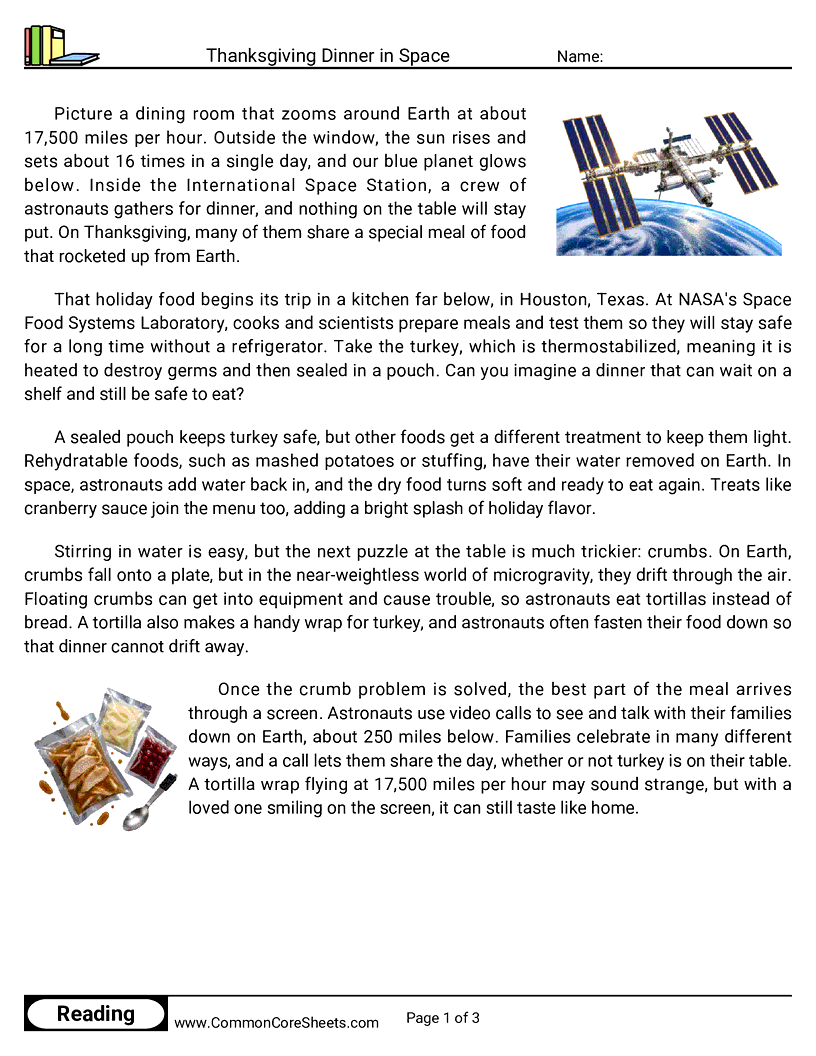
Picture a dining room that zooms around Earth at about 17,500 miles per hour. Outside the window, the sun rises and sets about 16 times in a single day, and our blue planet glows below. Inside the International Space Station, a crew of astronauts gathers for dinner, and nothing on the table will stay put. On Thanksgiving, many of them share a special meal of food that rocketed up from Earth.
That holiday food begins its trip in a kitchen far below, in Houston, Texas. At NASA's Space Food Systems Laboratory, cooks and scientists prepare meals and test them so they will stay safe for a long time without a refrigerator. Take the turkey, which is thermostabilized, meaning it is heated to destroy germs and then sealed in a pouch. Can you imagine a dinner that can wait on a shelf and still be safe to eat?
A sealed pouch keeps turkey safe, but other foods get a different treatment to keep them light. Rehydratable foods, such as mashed potatoes or stuffing, have their water removed on Earth. In space, astronauts add water back in, and the dry food turns soft and ready to eat again. Treats like cranberry sauce join the menu too, adding a bright splash of holiday flavor.
Stirring in water is easy, but the next puzzle at the table is much trickier: crumbs. On Earth, crumbs fall onto a plate, but in the near-weightless world of microgravity, they drift through the air. Floating crumbs can get into equipment and cause trouble, so astronauts eat tortillas instead of bread. A tortilla also makes a handy wrap for turkey, and astronauts often fasten their food down so that dinner cannot drift away.
Once the crumb problem is solved, the best part of the meal arrives through a screen. Astronauts use video calls to see and talk with their families down on Earth, about 250 miles below. Families celebrate in many different ways, and a call lets them share the day, whether or not turkey is on their table. A tortilla wrap flying at 17,500 miles per hour may sound strange, but with a loved one smiling on the screen, it can still taste like home.
Here is a puzzle: why would astronauts on the International Space Station leave the dinner rolls behind when they celebrate Thanksgiving? Picture a humming module where the crew gathers around a table covered with pouches and packets, and anything not held down drifts away. The station orbits about 250 miles above Earth, about as far as a long road trip, except this trip goes straight up! Solving the mystery of the missing bread takes us from a kitchen in Houston to the strange rules of floating.
That Houston kitchen is really NASA's Space Food Systems Laboratory, where food scientists prepare space meals long before launch. Foods such as turkey can be thermostabilized, which means they are heated to make them safe to store and then sealed in pouches. Mashed potatoes and stuffing are rehydratable, so the water is taken out on Earth and the astronauts add it back in space. Add a treat like cranberry sauce, and a holiday plate in orbit can look a lot like one at home.
Getting that plate ready is only half the job, because eating in microgravity comes with rules of its own. Astronauts float because the station and everyone inside it are constantly falling around Earth, so nothing feels heavy. Sticky foods such as mashed potatoes cling to a spoon, but anything loose, even a single speck of food, can drift away. Food packages are often held to trays and tables with Velcro or tape.
A wandering speck of food is exactly the trouble with bread, because crumbs float off in every direction. Those crumbs can clog air filters, get into equipment, or drift into an astronaut's eyes. Tortillas hardly crumble, so astronauts use them to wrap turkey and other fillings, the way you might use a sandwich roll. Salt and pepper follow the same rule, so they are used as liquids instead of grains that could scatter.
Keeping the table tidy matters, but the best part of any holiday is company. Astronauts can talk with their families by video call, seeing faces on a screen while Earth glides far below. The station circles Earth about every 90 minutes, so a long dinner can include several sunsets. Every part of a holiday meal up there, from sticky potatoes to a flat tortilla, is planned around one small fact: even a single crumb can float away.
You might picture astronauts celebrating holidays by squeezing brown paste out of a tube, but that picture is badly out of date! On the International Space Station, a Thanksgiving meal can include foods such as turkey, stuffing, mashed potatoes, and cranberry sauce. The station circles Earth about 250 miles up, finishing a lap about every 90 minutes. That means the crew sees about 16 sunrises and 16 sunsets every day, which makes for a very strange dinner clock. Even so, the heart of a space Thanksgiving feels familiar: good food, shared with people who matter.
That familiar food begins its journey far below the station, in NASA's Space Food Systems Laboratory in Houston. Food scientists there prepare dishes in several clever ways. Turkey, for example, can be thermostabilized, meaning it is heat-treated and then sealed in a pouch, so it stays safe to eat without a refrigerator. Treats such as cranberry sauce can ride along too. Foods such as mashed potatoes and stuffing are rehydratable, which means they are dried on Earth and then plumped up when astronauts add water, a bit like a sponge soaking up a bath.
Adding water is the easy part; keeping dinner from floating away is the real puzzle. In microgravity, nothing settles on a table, so food, forks, and even single crumbs drift wherever they please. That is why astronauts often reach for tortillas instead of bread, since crumbs float and can get into equipment. On Earth, a lost crumb is a snack for the dog, but on a spacecraft it is a tiny drifting problem. To keep meals under control, astronauts fasten food packages in place with hook-and-loop tape, snip them open with scissors, and eat with a spoon.
Even with every spoon and pouch under control, a table in orbit lacks the one thing no laboratory can pack: company. Fortunately, the station has video links to Earth, so crew members can call their families and see their faces on the holiday. Not every astronaut celebrates Thanksgiving, since crews come from several countries, and crewmates may share foods from their own homelands. That detail makes me smile, because it shows a table can be set for many traditions at once. I think a holiday is really about the people around it, whether they sit beside you or smile at you from a screen 250 miles away.
Being far from home will matter even more on the next big journeys. Space agencies hope to send astronauts back to the Moon and someday to Mars, a trip that would take many months and leave no chance of a quick grocery run. Food scientists are working on meals that stay safe, nourishing, and tasty for a very long time. Good food also lifts spirits, which matters when a whole crew lives in a small space far from family. So the next time you share a special meal, remember that a crew is circling Earth overhead every 90 minutes, proof that warm dinners and warm feelings can travel 250 miles straight up.
Picture a dinner table that zooms along at about 17,500 miles per hour, fast enough to circle the whole planet roughly every 90 minutes. That table is the International Space Station, which orbits about 250 miles above Earth, and for astronauts who celebrate Thanksgiving, it becomes the most unusual dining room around. Everything floats in orbit, so a spoonful of gravy could drift away like a tiny brown moon. Instead of plates, the crew uses pouches and packets, and trays are held down with Velcro or tape. So how do you serve a holiday meal where nothing stays put?
The answer begins on the ground, in Houston, Texas, where food scientists at NASA's Space Food Systems Laboratory prepare meals long before a rocket lifts off. Turkey, for example, is thermostabilized, meaning it is heated to destroy spoilage germs and sealed in a pouch, so it stays safe without a refrigerator. Mashed potatoes and stuffing are rehydratable: the water is removed on Earth, and astronauts add it back in orbit. Treats such as cranberry sauce travel in sealed packages too, ready to spoon out on the big day. Think of it as camping food designed by engineers: safe, lightweight, and tasty enough to earn a place on the rocket.
Packing dinner in a pouch is the easy part; eating it is where orbit gets tricky. To make stuffing, an astronaut pushes a needle from a water dispenser into the pouch, adds water, and mixes until the dry bits soften. Because liquids in orbit pull together into floating blobs instead of pouring, drinks come in pouches with straws. Even salt and pepper get a makeover: astronauts use liquid versions, since loose grains could drift into vents or eyes. Thick, sticky foods are easier to manage, because they cling to a spoon instead of floating off.
Those wandering grains of pepper hint at a bigger problem, crumbs, which is why the humble tortilla is a star of space dining. On Earth a crumb falls to the table, but in orbit it has nowhere to land, so it can drift into equipment or an astronaut's eyes. Tortillas are flat and hold together well, so they make few crumbs, and they can be wrapped around turkey or other fillings like a sandwich. Here, an engineering problem changed a tradition, and the dinner roll stepped aside for a flexible circle of flatbread. Notice the reasoning: it isn't about dislike of rolls, but about one floating crumb causing real trouble.
Fixing the crumb problem doesn't fix everything, because the next challenge comes from the astronauts' own bodies. In microgravity, body fluids shift toward the head, and many astronauts report a stuffy feeling that makes food taste blander. That is one reason many crew members say they enjoy strongly flavored foods, such as spicy sauces. Station crews also come from several countries, so not every crewmate grew up with this holiday, and a shared meal can become a chance to swap foods from different homes.
Swapping foods from different homes leads to the part of the day many astronauts treasure most: hearing from the people they left behind. Through video calls, crew members can see and talk with their families on Earth while the station sails overhead. Imagine a grandparent waving from a busy kitchen while the astronaut waves back from beside a window filled with Earth. After all, a table racing along at 17,500 miles per hour can still feel like a holiday table when someone you love says hello.
In March 1965, astronaut John Young reached into his pocket and pulled out something that was definitely not on the official menu: a corned beef sandwich. He had smuggled it aboard the Gemini 3 spacecraft, and his crewmate Gus Grissom took a bite before the sandwich started shedding crumbs that drifted through the cabin. Picture a blizzard of bread crumbs drifting toward the switches that keep two astronauts alive, and you can see why the sandwich was quickly tucked away. That silly moment points to a serious truth: in space, dinner is as much an engineering problem as a cooking one. Each November, crews on the International Space Station can mark Thanksgiving with a holiday meal that exists because designers learned from problems just like that one.
Those runaway crumbs explain why the station's holiday table often features tortillas where you might expect dinner rolls. On Earth, gravity pulls crumbs down onto a plate, but in microgravity they float until they settle in an air vent, a piece of equipment, or someone's eye. Instead of asking astronauts to be neater, engineers removed the hazard by changing the food itself. A tortilla holds together, keeps well in its package, and works as a flat wrapper for turkey or other fillings. Even salt and pepper got a redesign: they are served as liquids, with salt dissolved in water and ground pepper suspended in oil, so no loose grains can escape.
Keeping loose grains under control is only half the challenge, because a feast must also reach an orbit about 250 miles up and stay safe to eat until someone opens it. Much of that work happens at NASA's Space Food Systems Laboratory in Houston, where food scientists develop, prepare, and package meals for astronauts. Thermostabilized foods, such as turkey, are heat-treated to destroy the microbes that cause spoilage and then sealed in pouches, so they need no refrigerator. Rehydratable foods, such as mashed potatoes or stuffing, are dried first, which makes them light, and an astronaut adds water through a small port on the package. Each method is a trade-off: ready-to-eat pouches are heavier because the water stays in the food, while dried dishes launch lighter but need water later.
Once the pouches are open or the water is added, a new puzzle begins, because nothing stays where you put it. Astronauts fasten trays and packages to a table or their legs with Velcro so dinner does not drift off. Sticky foods, such as mashed potatoes or a spoonful of cranberry sauce, tend to cling to a spoon, which makes them easier to manage than runny ones. Many astronauts also report that food tastes blander in space, because body fluids shift toward the head and can leave a person feeling stuffed up, as if they had a cold. That may be one reason strongly flavored and spicy foods are so popular on the station.
If astronauts need extra flavor just to enjoy dinner, a bigger question appears: why bother with a holiday meal in orbit at all? Nutrition alone cannot be the reason, since everyday menus are already designed to meet astronauts' needs. A stronger argument is about morale: space agencies have long treated familiar food as a comfort for people who live far from home for months at a time. Supporting evidence comes from the way astronauts help choose some of their own foods before launch, which suggests that choice and comfort matter, not just calories. A holiday meal also pairs well with video calls, which let crew members see and talk with their families while they eat. Of course, the crew is international and not everyone aboard celebrates Thanksgiving, so the meal works best as an invitation to share a special moment, not a rule.
Sharing a moment is a bold goal on a station where even time behaves strangely. The station circles Earth about every 90 minutes, so its crew can see about 16 sunrises and sunsets in a single day. Their schedule follows Coordinated Universal Time, which means holiday dinner arrives by the clock, not by the sun outside the window. More than half a century after one sandwich sent crumbs drifting through a tiny capsule, the station's dinner has no crumbs at all, yet the old wish to share a good meal with people you care about made the trip anyway.
About this worksheet
Students read a nonfiction passage about how astronauts celebrate Thanksgiving in space, written at 6 reading levels (3rd grade to 8th grade), and answer multiple-choice questions about it.
A reading comprehension worksheet about how astronauts celebrate Thanksgiving in space with a different article for each reading level, 3rd grade to 8th grade, each with its own multiple-choice questions aligned to the Common Core Reading: Informational Text standards. Printable with an answer key, and available as an online assignment at any level.
Student objectives
- Read a nonfiction passage about how astronauts prepare and eat a holiday meal in space.
- Find details that explain how space food is made safe and kept light.
- Explain why astronauts eat tortillas instead of bread.
- Determine the meaning of science words such as thermostabilized and microgravity from context.
Everyday practice
- At your next meal, notice how gravity keeps your food on the plate and crumbs on the table, and imagine them floating instead.
- Look at a package of dried food, like instant mashed potatoes, and read how much water you need to add.
- Try a video call with a relative who lives far away and share something from your day.