Stone Flies Worksheet Download
Free reading worksheets on Stone Flies. Each worksheet has 20 problems with an answer key and are ideal for teachers and homeschooling. You can download the PDF, create a set of flash cards or set it up for online learning.


Sheet Information >
Available at 2nd grade, 3rd grade, 4th grade, 5th grade and 6th grade reading levels.
Read the passage
Hey there, have you ever heard of stoneflies? These fascinating insects can be found near water, like rivers and streams, and are pretty cool creatures. They come in different sizes and colors, and they have long antennae that help them sense their environment.
Stoneflies are part of an amazing life cycle, which starts as an egg. These eggs hatch into little water-dwelling nymphs, and after several molts, they become adult stoneflies. Adult stoneflies are not great fliers, but they sure are good at crawling around on rocks and plants.
Stoneflies have some interesting relationships with other creatures. For example, they are food for fish and other animals, and they also eat algae and small insects themselves. Although they may look a little scary, stoneflies are harmless to humans and are even helpful, as they are an indicator of clean water. So, next time you're near a river or stream, be on the lookout for these fantastic insects and remember how special they are in the world of bugs.
Hey kids, have you ever heard of stoneflies? They are fascinating insects that live near rivers and streams. These cool little creatures are super important for the environment because they help keep the water clean by eating dead leaves and other small insects. They are also an important part of the food chain, serving as a yummy snack for fish and other aquatic animals. Interesting fact: some people even use stonefly larvae as bait when they go fishing!
Now, let's talk about the life cycle of a stonefly. They start their lives as eggs, which are laid by the female in the water. After hatching, they grow and change through a process called incomplete metamorphosis, which means they don't have a pupa stage like butterflies or beetles. Instead, they go through several nymph stages before becoming adults, and this process can take anywhere from a few months to a few years!
Finally, let's learn about how stoneflies interact with humans and other insects. Unlike some insects that can be harmful to humans, stoneflies are totally harmless and don't bite or sting. In fact, they are considered beneficial insects because they help control the populations of other insects that might be pests. One cool thing about stoneflies is that they have a unique way of communicating with each other by tapping their abdomens on the ground, which creates a vibration that other stoneflies can sense. So that's the story of stoneflies, a super interesting and helpful insect that plays an important role in keeping our rivers and streams clean and healthy.
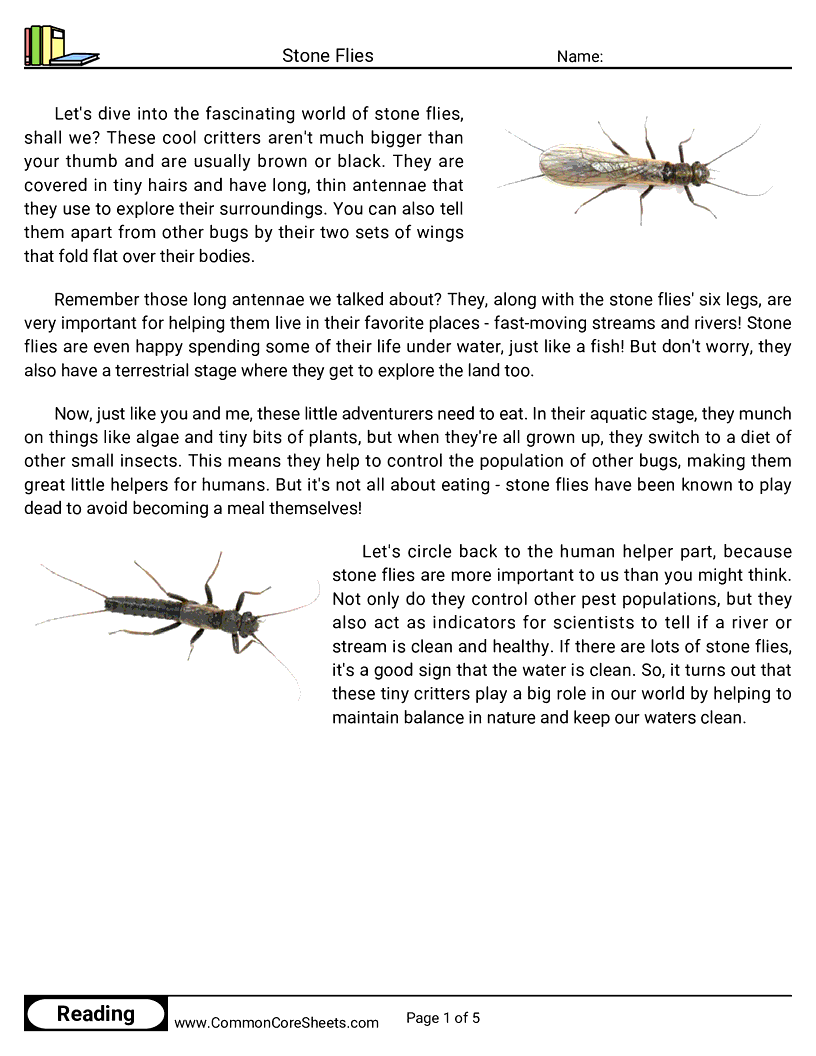
Let's dive into the fascinating world of stone flies, shall we? These cool critters aren't much bigger than your thumb and are usually brown or black. They are covered in tiny hairs and have long, thin antennae that they use to explore their surroundings. You can also tell them apart from other bugs by their two sets of wings that fold flat over their bodies.
Remember those long antennae we talked about? They, along with the stone flies' six legs, are very important for helping them live in their favorite places - fast-moving streams and rivers! Stone flies are even happy spending some of their life under water, just like a fish! But don't worry, they also have a terrestrial stage where they get to explore the land too.
Now, just like you and me, these little adventurers need to eat. In their aquatic stage, they munch on things like algae and tiny bits of plants, but when they're all grown up, they switch to a diet of other small insects. This means they help to control the population of other bugs, making them great little helpers for humans. But it's not all about eating - stone flies have been known to play dead to avoid becoming a meal themselves!
Let's circle back to the human helper part, because stone flies are more important to us than you might think. Not only do they control other pest populations, but they also act as indicators for scientists to tell if a river or stream is clean and healthy. If there are lots of stone flies, it's a good sign that the water is clean. So, it turns out that these tiny critters play a big role in our world by helping to maintain balance in nature and keep our waters clean.
Stoneflies are fascinating insects that you may not know much about, but they're pretty cool! These little creatures can be found near rivers and streams all around the world, particularly in North America, Europe, and Asia. They come in various sizes and colors, ranging from tiny ones that are only a few millimeters long to larger species that can be a couple of inches long. One fascinating thing about stoneflies is that some of them can live up to three years, which is quite a long time for an insect!
These amazing insects have a unique life cycle that starts when they're just eggs. Female stoneflies lay their eggs in water, and when the eggs hatch, the nymphs (or baby stoneflies) emerge. These nymphs live underwater and go through several stages of growth, shedding their exoskeletons as they get bigger. Finally, they leave the water, shed their exoskeleton one last time, and become adult stoneflies that can fly and mate.
Stoneflies have an interesting diet, as they're carnivorous insects. While living underwater, the nymphs feed on other small aquatic insects, plants, and even dead animals that they find. When they become adults, they don't eat much, as they're more focused on finding a mate and reproducing. Some adult stoneflies don't even have mouthparts to eat!
Humans and stoneflies have a unique relationship, especially when it comes to fishing. Fly fishers often use artificial lures that mimic the appearance of adult stoneflies to catch fish, as fish love to snack on these insects. Additionally, stoneflies are used as an indicator of water quality, since they can only survive in clean water. If there are a lot of stoneflies in a stream, it's a good sign that the water is healthy and clean!
Lastly, let's compare stoneflies with some other similar insects, such as mayflies and caddisflies. All three of these insects are aquatic and live near rivers and streams, but they have different life cycles and feeding habits. While stoneflies are carnivorous, mayflies are herbivores, and caddisflies can be either herbivores or omnivores. Also, stoneflies have a longer life span than both mayflies and caddisflies, which usually only live for a few weeks to a few months.
As you can see, stoneflies are truly remarkable insects with unique characteristics that set them apart from other aquatic insects. They play an important role in their ecosystems and even help humans by indicating the health of rivers and streams. So the next time you're near a river or stream, take a moment to appreciate these fascinating creatures!
Stoneflies are fascinating insects that can be found all around the world. These intriguing critters belong to the order Plecoptera and are named after their adult, winged stage. Stoneflies come in various shapes and sizes, with some species being as small as 6 millimeters, while others can grow up to 50 millimeters in length. They have two pairs of wings which are usually held flat over their bodies, and they have long, slender antennae on their heads. Next time you're near a stream or a river, keep an eye out for these fascinating creatures!
Stoneflies live near clean, freshwater habitats such as rivers, streams, and ponds. They prefer cool, well-oxygenated water, which makes them important indicators of water quality. In their juvenile stage, called nymphs, they live underwater and can be found clinging to rocks, leaves, and other submerged surfaces. Nymphs are well-adapted to life in the water, with flat bodies and strong legs for gripping onto surfaces against the current. Adult stoneflies, on the other hand, can be found on nearby vegetation or rocks close to the water.
The life cycle of stoneflies consists of four stages: egg, nymph, adult, and mating. After mating, female stoneflies lay their eggs in the water, where they eventually hatch into nymphs. These nymphs go through multiple stages of growth, shedding their exoskeleton as they get larger. When they are ready to transform into adults, they crawl out of the water and shed their skin one last time. Adult stoneflies live for a short period of time, usually just long enough to mate and lay eggs before they pass away.
Stoneflies have some interesting relationships with both humans and other insects. For humans, they serve as vital indicators of water quality, as they can only survive in clean, well-oxygenated waters. This makes them helpful for scientists who monitor the health of aquatic ecosystems. As for other insects, stoneflies are a food source for various predators such as birds, spiders, and fish. In turn, stonefly nymphs feed on algae, decaying plant matter, and even other smaller aquatic insects.
There are several defenses that stoneflies have to protect themselves from predators. One such defense is their excellent camouflage, which helps them blend in with their surroundings. Additionally, stoneflies are known to be quite swift, both in the water as nymphs and on land as adults. Some species of stoneflies even possess the ability to emit a foul-smelling substance when threatened, which deters potential predators. By learning about the unique characteristics and behaviors of stoneflies, we can develop a greater appreciation for these amazing insects.
About this worksheet
Students read an informational passage about stone flies and answer comprehension questions about the key details.
This worksheet is designed to boost children's reading comprehension while learning fascinating facts about stone flies. The content covers their behaviors, habitats, importance in nature, and relationship with humans, through 20 engaging multiple-choice problems. Perfect for distance learning, this teaching resource can easily be customized and converted into flash cards to enrich a child's learning experience.
Student objectives
- Read an informational passage about stone flies
- Find and understand key facts in what you read
- Answer questions using details from the text
- Learn new vocabulary about insects and their habitats
Everyday practice
- Read a nature guide or sign at a park and pull out the main facts
- Explain what you learned about an insect to a family member
- Look up details about a bug you found outside
- Answer questions about an article you read for a school report