Spotted Turtle Worksheet Download
Free reading worksheets on Spotted Turtle. Each worksheet has 20 problems with an answer key and are ideal for teachers and homeschooling. You can download the PDF, create a set of flash cards or set it up for online learning.


Sheet Information >
Available at 2nd grade, 3rd grade, 4th grade, 5th grade and 6th grade reading levels.
Read the passage
Hey there, kiddos! Let's talk about the adorable spotted turtle, a small and unique creature that loves to munch on lots of different things. These little turtles enjoy eating insects, worms, snails, and even small fish. They are not picky eaters and will eat almost anything they can find in their watery homes.
Now, let's learn about where spotted turtles live and how they grow up. Spotted turtles can be found in wetlands, marshes, and ponds in the eastern United States and Canada. These amazing creatures go through a life cycle that starts as tiny eggs, then hatches into cute baby turtles, and finally grows into the beautiful spotted adults we know and love.
Lastly, let's explore how spotted turtles interact with humans, other animals, and how they protect themselves. Spotted turtles are shy and try to avoid humans, but sometimes people keep them as pets or study them to learn more about their fascinating lives. When it comes to other animals, spotted turtles can hide using their unique shell patterns, making it difficult for predators like raccoons and birds to find them.
In conclusion, spotted turtles are fascinating creatures with interesting eating habits, beautiful habitats, and a strong sense of self-preservation. So next time you're exploring a wetland or pond, keep an eye out for these little wonders!
Spotted turtles are fascinating little creatures that you'll love learning about! These small turtles have a dark shell covered in bright yellow spots, making them easy to recognize. They live in wetlands, such as marshes and swamps, in the eastern part of North America. Their diet consists of a variety of foods, including insects, worms, plants, and even small fish.
The life cycle of a spotted turtle is an interesting journey that begins with eggs. Female spotted turtles lay their eggs in a nest dug in the ground during springtime. After about 10 weeks, the baby turtles hatch and start their life in the wild. These turtles can live up to 50 years, but they face many challenges from both humans and other animals.
Spotted turtles have some unique features and relationships with their environment. Their main defense is their tough shell, which helps protect them from predators like raccoons and herons. Compared to other turtle species, spotted turtles are smaller, with a shell length of only 4 to 5 inches. One fun fact is that the number of yellow spots on their shell can sometimes help indicate their age!
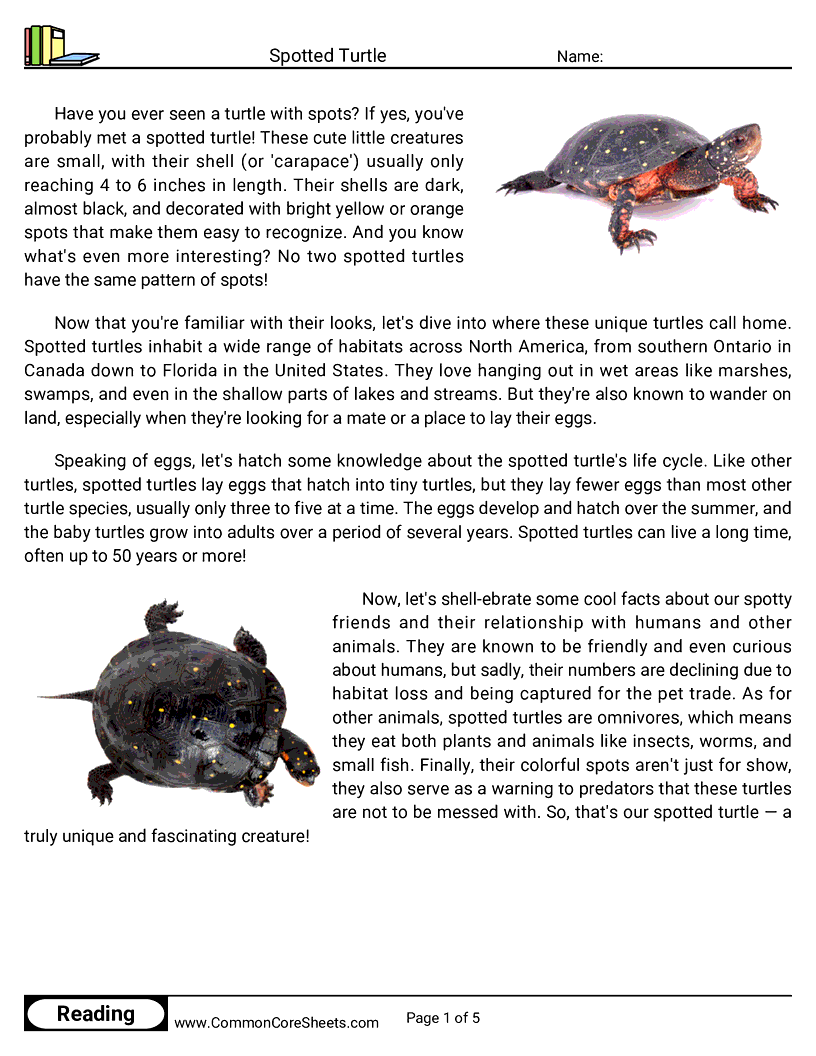
Have you ever seen a turtle with spots? If yes, you've probably met a spotted turtle! These cute little creatures are small, with their shell (or 'carapace') usually only reaching 4 to 6 inches in length. Their shells are dark, almost black, and decorated with bright yellow or orange spots that make them easy to recognize. And you know what's even more interesting? No two spotted turtles have the same pattern of spots!
Now that you're familiar with their looks, let's dive into where these unique turtles call home. Spotted turtles inhabit a wide range of habitats across North America, from southern Ontario in Canada down to Florida in the United States. They love hanging out in wet areas like marshes, swamps, and even in the shallow parts of lakes and streams. But they're also known to wander on land, especially when they're looking for a mate or a place to lay their eggs.
Speaking of eggs, let's hatch some knowledge about the spotted turtle's life cycle. Like other turtles, spotted turtles lay eggs that hatch into tiny turtles, but they lay fewer eggs than most other turtle species, usually only three to five at a time. The eggs develop and hatch over the summer, and the baby turtles grow into adults over a period of several years. Spotted turtles can live a long time, often up to 50 years or more!
Now, let's shell-ebrate some cool facts about our spotty friends and their relationship with humans and other animals. They are known to be friendly and even curious about humans, but sadly, their numbers are declining due to habitat loss and being captured for the pet trade. As for other animals, spotted turtles are omnivores, which means they eat both plants and animals like insects, worms, and small fish. Finally, their colorful spots aren't just for show, they also serve as a warning to predators that these turtles are not to be messed with. So, that's our spotted turtle — a truly unique and fascinating creature!
Spotted turtles are fascinating creatures that can be found in various parts of North America. These small turtles have dark shells with bright yellow spots, making them very recognizable. They usually grow to be about 4 to 5 inches long and are known for their friendly and curious nature. Let's dive into more details about these wonderful animals and learn all about their lives, habits, and unique features!
When it comes to their diet, spotted turtles are omnivores, meaning they eat both plants and animals. Their favorite foods include insects, worms, snails, and other small creatures, as well as different types of aquatic plants. Spotted turtles have strong jaws that help them catch and eat their prey with ease. As they grow older, they tend to eat more plants and less meat.
Spotted turtles can be found living in a variety of habitats such as marshes, swamps, and shallow ponds. They prefer areas with slow-moving or still water and plenty of vegetation, which provides them with food and hiding spots from predators. These turtles are cold-blooded, so they rely on the warmth of the sun to regulate their body temperature. During colder months, spotted turtles may hibernate in the mud at the bottom of their watery homes.
These turtles have a fascinating life cycle that begins when the female lays her eggs in a shallow nest on land. After about two months, the baby turtles, called hatchlings, emerge from the eggs and make their way to the water. Spotted turtles can live up to 25 years or more, and they reach maturity at around 7 to 10 years of age. Throughout their lives, they may face various threats such as habitat loss, predators, and pollution.
Spotted turtles have interesting relationships with both humans and other animals. They play an important role in their ecosystems by controlling insect populations and helping to keep the water clean. While they are generally not aggressive towards humans, it's essential to remember that they are wild animals and should be treated with respect. By learning more about these unique creatures, we can help protect them and appreciate their important role in nature.
Spotted turtles are fascinating creatures that live in wetlands and forests. These small turtles, usually no more than 5 inches long, have a dark shell covered in bright yellow spots. You can find them mostly in the eastern United States and southeastern Canada. They prefer environments with shallow water, such as marshes, swamps, and bogs. These unique turtles are known for their friendly and docile nature.
When it comes to their diet, spotted turtles are omnivores. This means they eat both plants and animals. Their favorite foods include insects, snails, worms, and small fish. For a balanced diet, they also munch on aquatic plants and algae. Spotted turtles have a sharp beak, which helps them catch and eat their prey.
The life cycle of spotted turtles is intriguing and complex. After mating in early spring, females lay their eggs in a shallow nest they dig in sandy or loamy soil. They usually lay 3 to 5 eggs, which hatch after about 11 weeks. Once hatched, the baby turtles, called hatchlings, make their way to the nearest water source to begin their life. Spotted turtles can live up to 50 years in the wild, making them an important part of their ecosystem.
Spotted turtles have a unique relationship with humans and other animals. Due to their small size and friendly nature, they are often collected as pets, which is detrimental to their wild populations. Some animals, like raccoons, skunks, and birds of prey, see spotted turtles as a tasty snack. However, they also play an important role in controlling insect populations by feeding on them. Conservation efforts are in place to protect this beautiful species from habitat loss and illegal collection.
There are some interesting differences between spotted turtles and other turtle species. Unlike most turtles, spotted turtles do not have a hinged plastron (the underside of the shell) to close and protect themselves. Instead, they rely on their dark coloration and bright spots as a form of camouflage to blend in with their environment. Additionally, spotted turtles are one of the few species that can tolerate cold temperatures, allowing them to live in areas with cooler climates. Spotted turtles are truly unique and beautiful creatures that deserve our admiration and protection.
About this worksheet
Students read a short informational passage about the spotted turtle and answer comprehension questions about its habitat, diet, and traits.
This worksheet is designed to enrich children's reading skills while educating them about the Spotted Turtle. Containing 20 questions, it covers relevant themes from their interaction with humans to habitat preferences and conservation issues. Suitable for distance learning, this adaptable resource can be customized and easily converted into flash cards for an interactive learning experience.
Student objectives
- Read a nonfiction passage about spotted turtles
- Find key facts about where spotted turtles live and what they eat
- Answer questions using details from the text
- Learn new vocabulary about turtles and their habitats
Everyday practice
- Read a sign about turtles at a zoo or nature center and explain what you learned
- Tell a friend facts about an animal you read about in a book
- Look up information about a pet turtle before caring for it
- Point out a spotted turtle you see near a pond and describe it