Kindergarten Math Sort By Grade Worksheets
Browse free printable Kindergarten math worksheets sorted by Common Core standard. Pick a standard below to see every matching worksheet, each available as a printable PDF with an answer key or as a digital assignment.
Counting & Cardinality
kcc1
Count to 100 by ones and by tens.
kcc2
Count forward beginning from a given number within the known sequence (instead of having to begin at 1).
kcc3
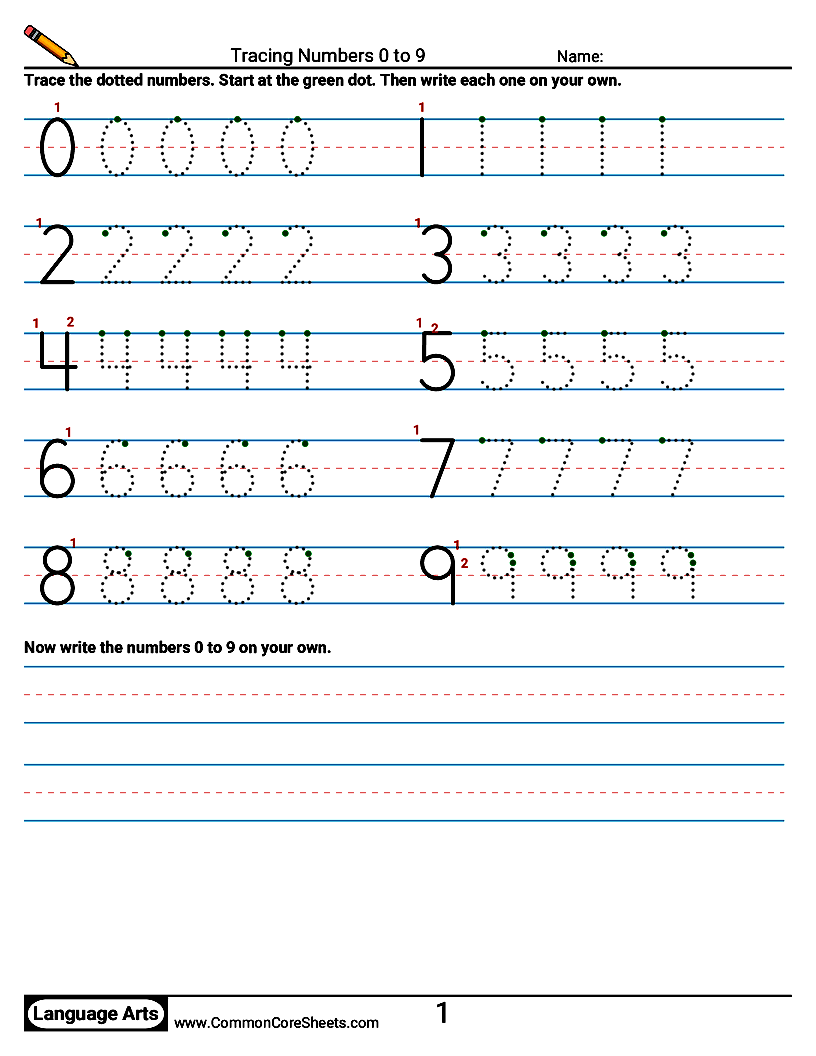
Write numbers from 0 to 20. Represent a number of objects with a written numeral 0-20 (with 0 representing a count of no objects).
kcc4a
When counting objects, say the number names in the standard order, pairing each object with one and only one number name and each number name with one and only one object.
kcc4b
Understand that the last number name said tells the number of objects counted. The number of objects is the same regardless of their arrangement or the order in which they were counted.
kcc4c
Understand that each successive number name refers to a quantity that is one larger.
kcc5
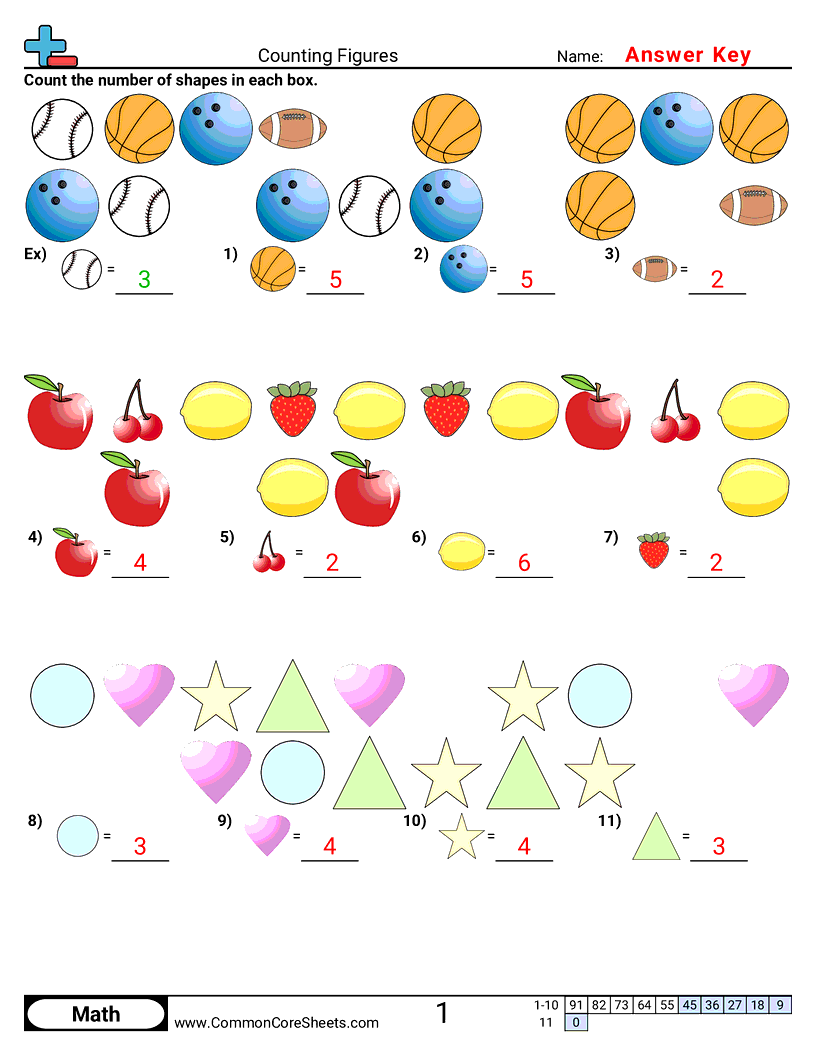
Count to answer "how many?" questions about as many as 20 things arranged in a line, a rectangular array, or a circle, or as many as 10 things in a scattered configuration; given a number from 1-20, count out that many objects.
kcc6
Identify whether the number of objects in one group is greater than, less than, or equal to the number of objects in another group, e.g., by using matching and counting strategies.
kcc7
Compare two numbers between 1 and 10 presented as written numerals.
Operations and Algebraic Thinking
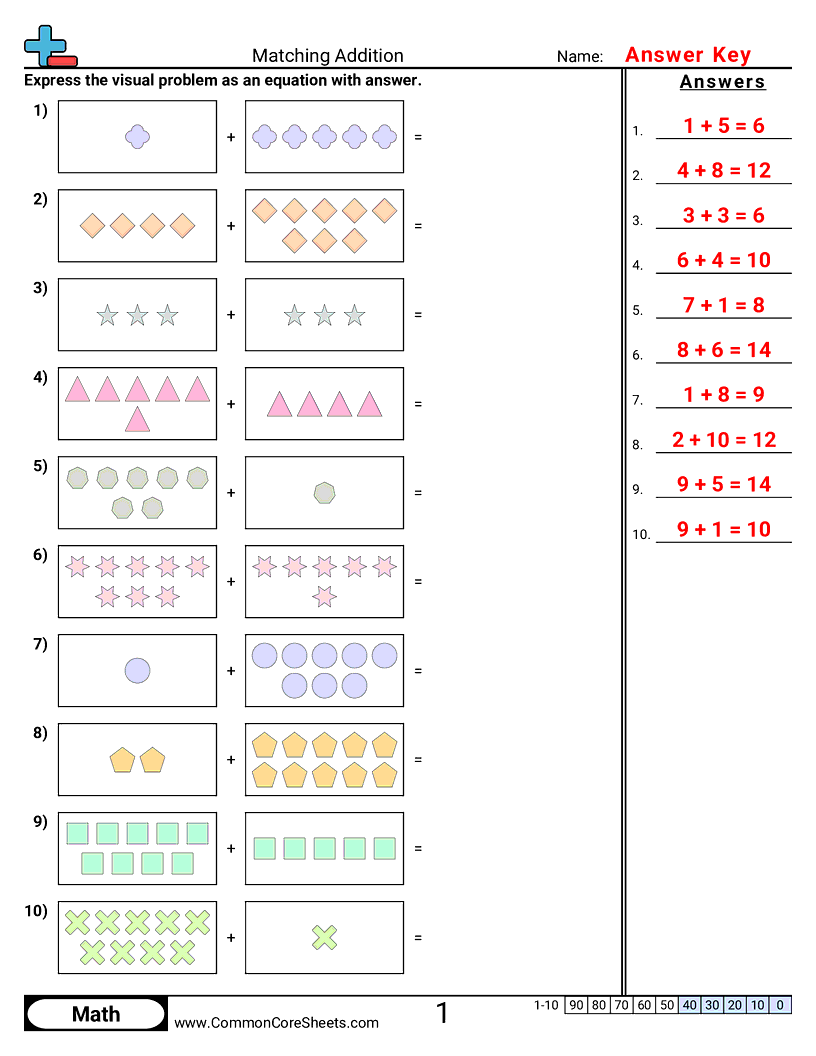
koa1
Represent addition and subtraction with objects, fingers, mental images, drawings, sounds (e.g., claps], acting out situations, verbal explanations, expressions, or equations.
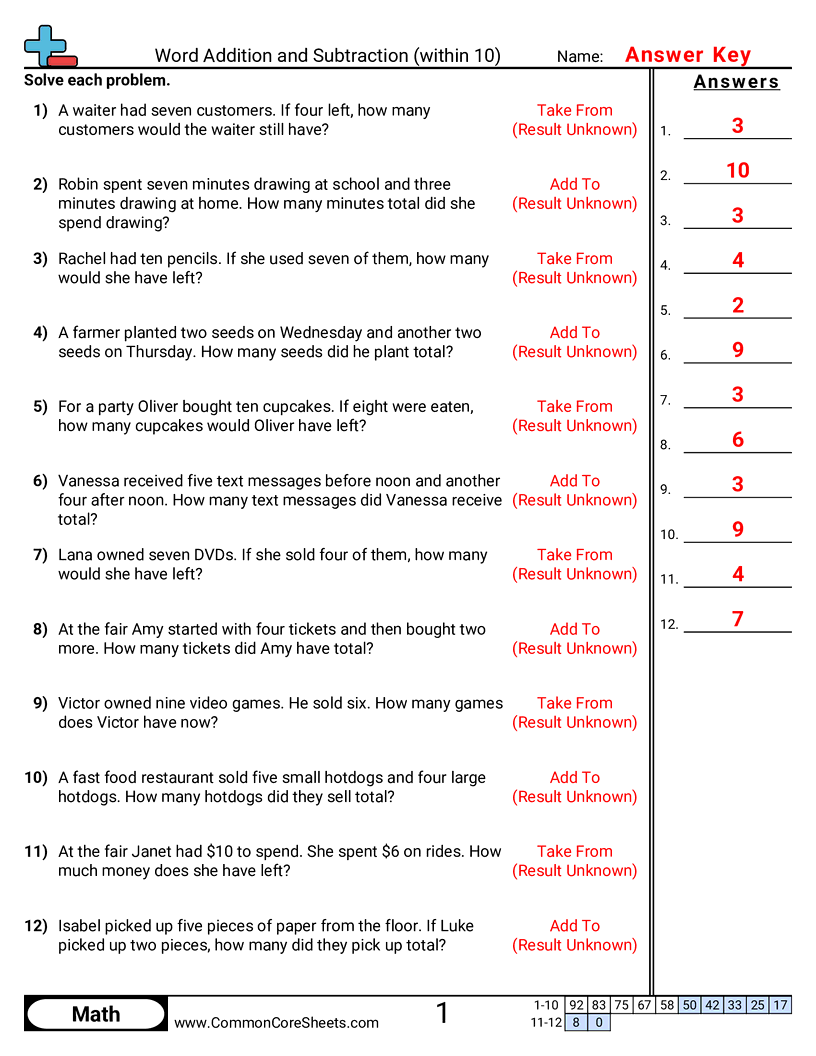
koa2
Solve addition and subtraction word problems, and add and subtract within 10, e.g., by using objects or drawings to represent the problem.
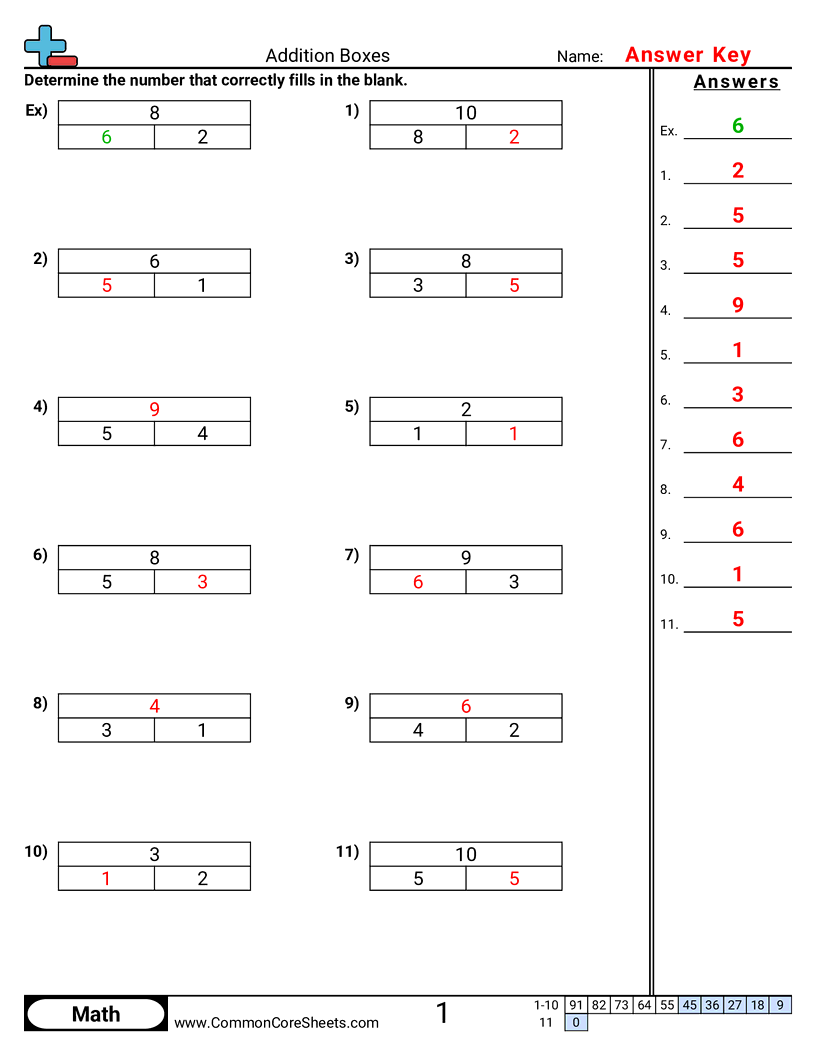
koa3
Decompose numbers less than or equal to 10 into pairs in more than one way, e.g., by using objects or drawings, and record each decomposition by a drawing or equation (e.g., 5 = 2 + 3 and 5 = 4 + 1).
koa4
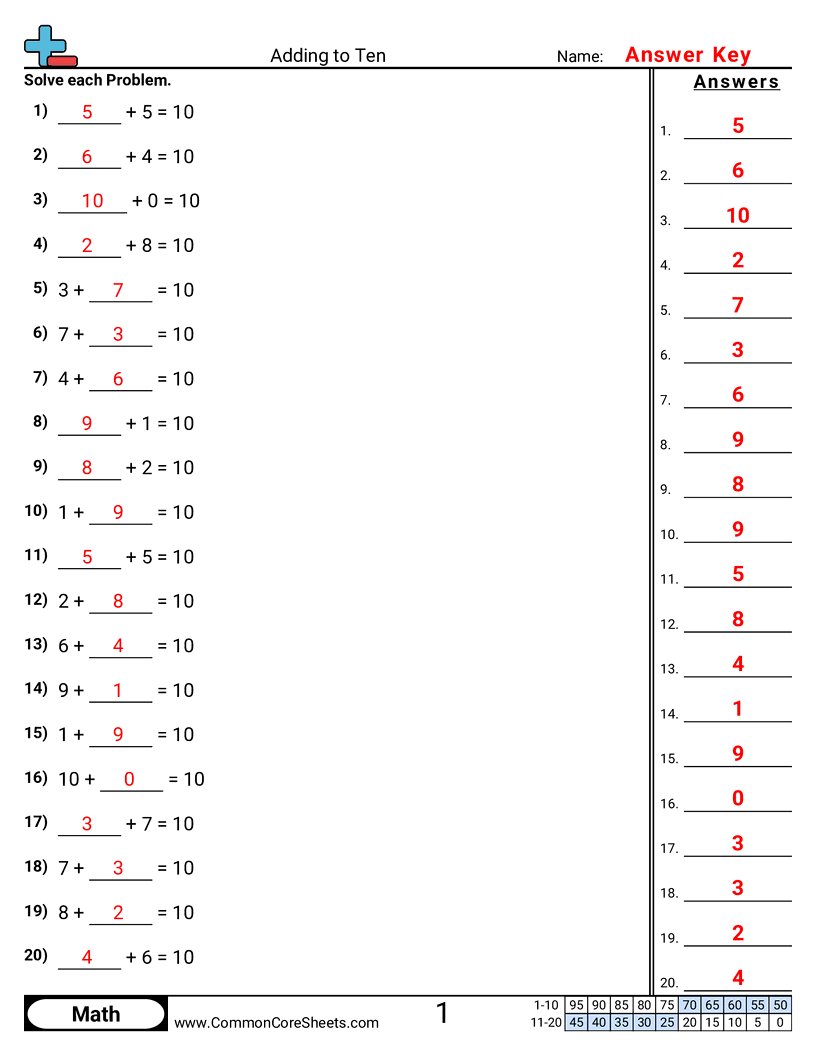
For any number from 1 to 9, find the number that makes 10 when added to the given number, e.g., by using objects or drawings, and record the answer with a drawing or equation.
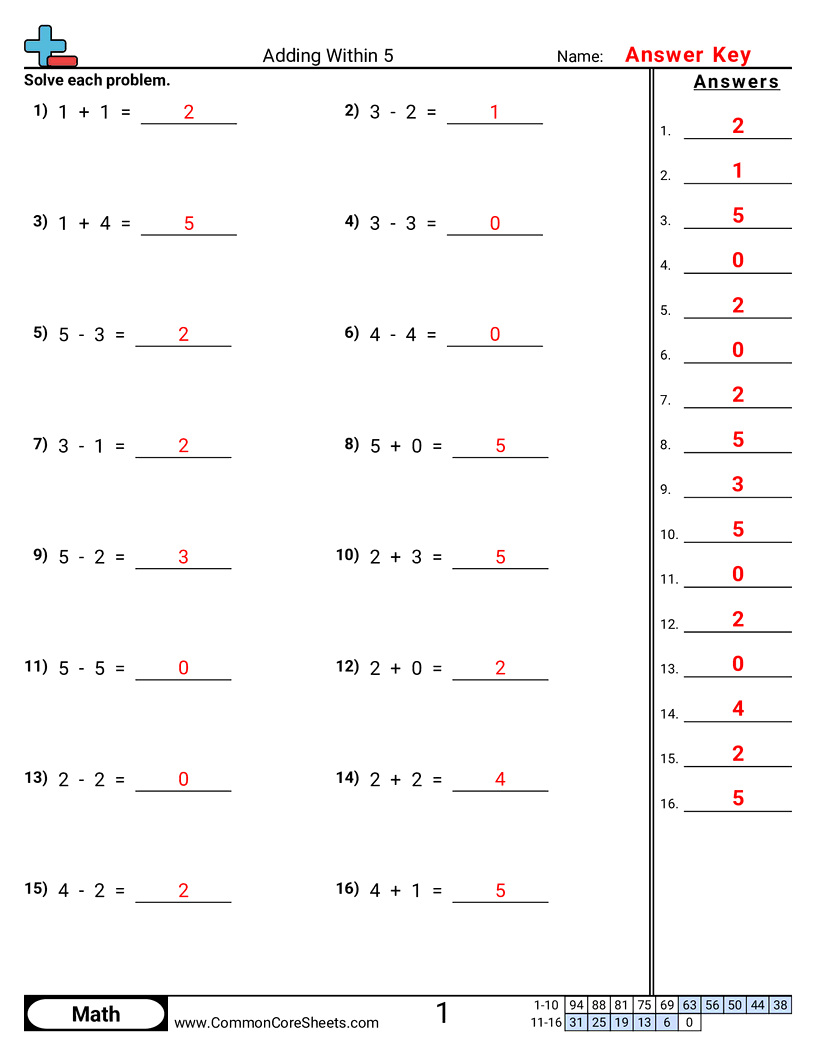
koa5
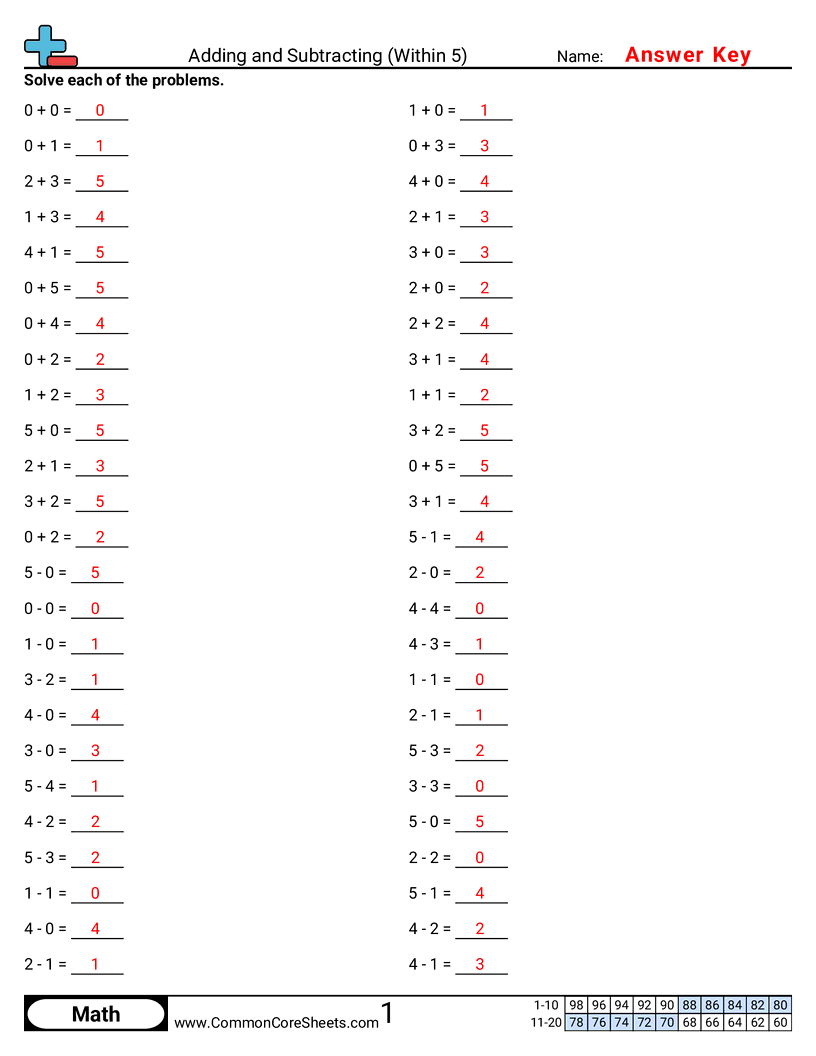
Fluently add and subtract within 5.
Number and Operations in Base Ten
knbt1
Compose and decompose numbers from 11 to 19 into ten ones and some further ones, e.g., by using objects or drawings, and record each composition or decomposition by a drawing or equation (e.g., 18 = 10 + 8]; understand that these numbers are composed of ten ones and one, two, three, four, five, six, seven, eight, or nine ones.
Geometry
kg1
Describe objects in the environment using names of shapes, and describe the relative positions of these objects using terms such as above, below, beside, in front of, behind, and next to.
kg2
Correctly name shapes regardless of their orientations or overall size.
kg3
Identify shapes as two-dimensional (lying in a plane, "flat") or three-dimensional ("solid").
kg4
Analyze and compare two- and three-dimensional shapes, in different sizes and orientations, using informal language to describe their similarities, differences, parts (e.g., number of sides and vertices/"corners") and other attributes (e.g., having sides of equal length).
kg5
Model shapes in the world by building shapes from components (e.g., sticks and clay balls) and drawing shapes.
kg6
Compose simple shapes to form larger shapes. For example, “Can you join these two triangles with full sides touching to make a rectangle?
Playwire Advertisement