Northern Leopard Frog Worksheet Download
Free reading worksheets on Northern Leopard Frog. Each worksheet has 20 problems with an answer key and are ideal for teachers and homeschooling. You can download the PDF, create a set of flash cards or set it up for online learning.
Select a Different Activity
>


Sheet Information >
Available at 2nd grade, 3rd grade, 4th grade, 5th grade and 6th grade reading levels.
Read the passage
Meet the Northern leopard frog, a fun and interesting creature that lives in North America. These frogs are green or brown with large, dark spots on their backs, making them look like they\'re wearing leopard print! You can find them near ponds, lakes, and marshes, where they like to hang out in the water or nearby plants.
Now let\'s learn about the Northern leopard frog\'s life cycle and what they eat. Their life starts as tiny eggs that hatch into tadpoles, and eventually grow into adult frogs. These hungry frogs love to snack on insects, spiders, and even small fish - they\'ll eat pretty much anything they can catch!
Lastly, we\'ll discover how Northern leopard frogs interact with humans and other animals. Humans sometimes catch these frogs for research, but they\'re also known to help us by eating pesky insects! Other animals, like snakes and birds, might see the Northern leopard frog as a tasty meal, but these clever frogs use their quick jumps and hiding skills to stay safe.
With their unique appearance and interesting habits, Northern leopard frogs are truly fascinating creatures to learn about.
Hey kids, let\'s learn about the amazing Northern leopard frog! These cool frogs have a green or brown body with dark spots, which look like a leopard\'s pattern, and that\'s how they got their name. They can be found living near ponds, marshes, and slow-moving streams in parts of Canada and the United States. Northern leopard frogs love to eat insects, spiders, and even small fish, using their long, sticky tongues to catch their prey.
Now let\'s explore the fascinating life cycle of the Northern leopard frog. Their journey begins as tiny eggs, laid in clusters in the water, which then hatch into tadpoles. As they grow, they develop legs, lose their tails, and become young frogs called froglets, before finally turning into adult frogs. These amazing frogs can live up to 2-4 years in the wild!
Northern leopard frogs have interesting relationships with humans and other animals. They are helpful to humans because they eat insects that can be harmful to plants and crops. In nature, they have many predators, like snakes, birds, and raccoons, but they can escape by jumping quickly and hiding in the water. Did you know that Northern leopard frogs are different from other frog species because of their unique leopard-like patterns and their ability to survive in colder climates?
So there you have it, kids - Northern leopard frogs are fascinating creatures with their interesting life cycle, their helpfulness to humans, and their unique appearance. It\'s always fun to learn about the wonderful world of animals!
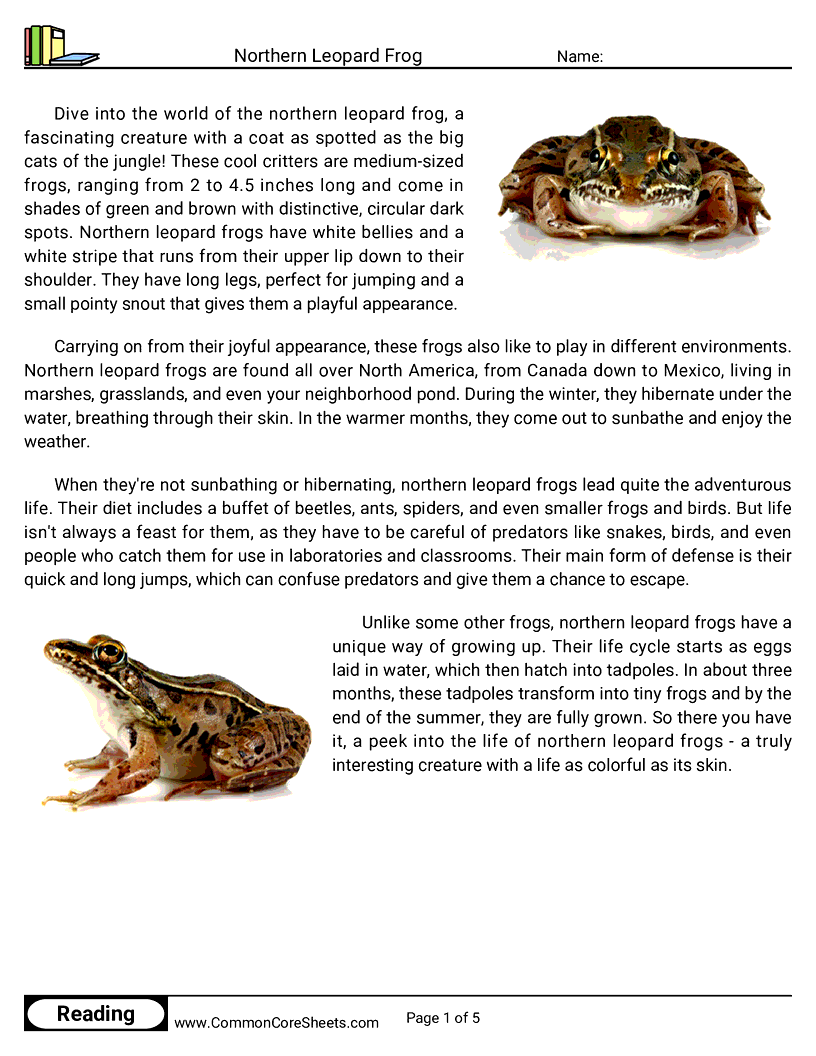
Dive into the world of the northern leopard frog, a fascinating creature with a coat as spotted as the big cats of the jungle! These cool critters are medium-sized frogs, ranging from 2 to 4.5 inches long and come in shades of green and brown with distinctive, circular dark spots. Northern leopard frogs have white bellies and a white stripe that runs from their upper lip down to their shoulder. They have long legs, perfect for jumping and a small pointy snout that gives them a playful appearance.
Carrying on from their joyful appearance, these frogs also like to play in different environments. Northern leopard frogs are found all over North America, from Canada down to Mexico, living in marshes, grasslands, and even your neighborhood pond. During the winter, they hibernate under the water, breathing through their skin. In the warmer months, they come out to sunbathe and enjoy the weather.
When they're not sunbathing or hibernating, northern leopard frogs lead quite the adventurous life. Their diet includes a buffet of beetles, ants, spiders, and even smaller frogs and birds. But life isn't always a feast for them, as they have to be careful of predators like snakes, birds, and even people who catch them for use in laboratories and classrooms. Their main form of defense is their quick and long jumps, which can confuse predators and give them a chance to escape.
Unlike some other frogs, northern leopard frogs have a unique way of growing up. Their life cycle starts as eggs laid in water, which then hatch into tadpoles. In about three months, these tadpoles transform into tiny frogs and by the end of the summer, they are fully grown. So there you have it, a peek into the life of northern leopard frogs - a truly interesting creature with a life as colorful as its skin.
Meet the Northern leopard frog, a fascinating amphibian that\'s full of surprises! These cool creatures are medium-sized frogs with a unique pattern of spots that resemble a leopard\'s. They can be found in a variety of colors, including green, brown, and even blueish-gray. Their distinctive appearance makes them easy to spot in the wild, so let\'s dive deeper into their world!
Northern leopard frogs have a diverse diet, which means they eat many different things. They are carnivorous, which means they love to eat insects, spiders, and even small fish. Sometimes, they will even eat smaller frogs! Their long, sticky tongues help them catch their prey with ease, making mealtime a breeze.
These amazing amphibians have a wide range of habitats, from grasslands to forests, and even marshes. They prefer to live near water sources, like ponds, lakes, or slow-moving streams. Northern leopard frogs are found throughout North America, from Canada all the way down to Mexico. Their adaptability to various environments makes them a thriving species.
The life cycle of the Northern leopard frog is truly fascinating. It all starts with the female laying her eggs in the water, which then hatch into tadpoles. Over time, the tadpoles grow legs, lose their tails, and turn into adult frogs. This incredible transformation is called metamorphosis, and it\'s a process many amphibians go through.
Lastly, let\'s explore the relationships these frogs have with humans and other animals. Northern leopard frogs are important to the ecosystem because they help control insect populations. They are also a food source for other animals, like birds and snakes. Humans appreciate them for their beauty and their role in the environment, making them a valuable part of our world.
Let\'s dive into the fascinating world of the Northern leopard frog! These cool creatures can be found in North America, specifically in the United States and Canada. Northern leopard frogs are usually green or brown with dark, circular spots on their backs, which is where they get their name from. They live in wetlands, ponds, and marshes, as well as grasslands and even urban areas. Their amazing adaptability allows them to thrive in various environments.
Now, let\'s take a look at these froggy friends' diet and how they eat. Northern leopard frogs are carnivorous, which means they eat other animals. Their menu consists mainly of insects like flies, beetles, and spiders, but they also snack on smaller amphibians and even small fish. These frogs have an interesting way of eating - they use their long, sticky tongues to catch their prey and swallow it whole! Talk about an exciting dinner time!
A Northern leopard frog\'s life cycle is quite interesting, too. Their life starts as eggs, which are laid in clusters on the surface of the water. After about two weeks, the eggs hatch into tadpoles and start to grow. Over time, the tadpoles transform into frogs through a process called metamorphosis. This incredible transformation takes about three months to complete.
Northern leopard frogs have a unique relationship with humans and other animals. These frogs are considered an important part of the ecosystem, as they help control insect populations. In turn, they are also a food source for larger animals like birds and snakes. Unfortunately, Northern leopard frogs are often affected by habitat loss and pollution, which puts them at risk. The good news is that many conservation efforts are in place to help protect these amazing amphibians.
Lastly, let\'s explore some interesting facts and differences between the Northern leopard frog and other species. One key difference is their unique call, which sounds like a series of low, guttural croaks and grunts. These frogs are also known for their impressive jumping abilities, as they can leap up to three feet in a single bound! Unlike some other frog species, Northern leopard frogs are mostly active during the day. It\'s safe to say that these fascinating frogs stand out among their amphibian friends!
About this worksheet
Students read an informational passage about the northern leopard frog and answer comprehension questions about its habitat, diet, and life cycle.
This worksheet is designed to advance children's reading comprehension through engaging content about the Northern Leopard Frog. Covering topics from its diet, defense mechanisms, predators, to its life cycle and habits, the worksheet provides 20 questions that stimulate inquiry and understanding about this unique species. It offers flexibility to be customized, converted into flash cards, or used for distance learning, adapting to various teaching methods.
Student objectives
- Read a nonfiction passage about an animal and understand the main ideas
- Find specific facts in a text to answer questions
- Learn details about where northern leopard frogs live and what they eat
- Understand how a frog grows and changes over its life
Everyday practice
- Read a sign at a zoo or nature center and explain what an animal eats
- Talk about frogs you spot near a pond or in your yard
- Pick out key facts when reading an animal book to a younger sibling
- Answer questions about a wildlife show you watched