Mountain Goat Worksheet Download
Free reading worksheets on Mountain Goat. Each worksheet has 20 problems with an answer key and are ideal for teachers and homeschooling. You can download the PDF, create a set of flash cards or set it up for online learning.


Sheet Information >
Available at 2nd grade, 3rd grade, 4th grade, 5th grade and 6th grade reading levels.
Read the passage
Hey kids, let's learn about mountain goats, nature's amazing climbers! These fascinating animals can climb steep slopes and live high up in the mountains, where they spend most of their time. Mountain goats have thick, warm coats that help them survive in cold weather and they can be found in the Rocky Mountains, Cascade Range, and other mountain ranges in North America.
What do mountain goats eat, you wonder? These furry friends love to munch on grass, herbs, moss, and even the bark of trees. Mountain goats also have a unique relationship with humans and other animals, as they are usually not afraid of people and can live peacefully alongside other creatures like deer and bighorn sheep.
Let's talk about some interesting facts about mountain goats! Did you know that a baby mountain goat is called a 'kid'? And unlike other species, both male and female mountain goats have horns! Their horns and powerful legs are their main defenses, helping them to escape from predators like bears and wolves. Isn't that cool?
I hope you enjoyed learning about mountain goats, and remember, there's always more to discover about the amazing creatures that share our world!
Hey kids, let's talk about the amazing mountain goat! These amazing creatures have thick white fur to keep them warm in their high-altitude homes. Mountain goats can be found living in the Rocky Mountains of North America and are known for their incredible climbing abilities. They have strong legs and hooves that allow them to climb steep, rocky cliffs with ease.
Now, let's learn about the life of a mountain goat and what they like to eat. These goats are herbivores, which means they eat plants like grasses, flowers, and even small trees. Mountain goats usually live for about 12-15 years, and their life cycle includes being a baby (kid), a teenager (juvenile), and an adult. Adult males, called billies, have longer, curved horns, while the females, called nannies, have shorter, straighter horns.
Lastly, let's explore the mountain goats' relationships with humans and other animals. Mountain goats generally avoid humans, but sometimes they do come into contact with hikers and other outdoor enthusiasts. They have few natural predators, but they need to watch out for eagles, bears, and cougars. To protect themselves, mountain goats use their horns and their agility to escape from dangerous situations.
So, there you have it, kids - mountain goats are fascinating animals that live in the high mountains, eat plants, and have interesting relationships with humans and other animals. Keep exploring the wonders of nature!
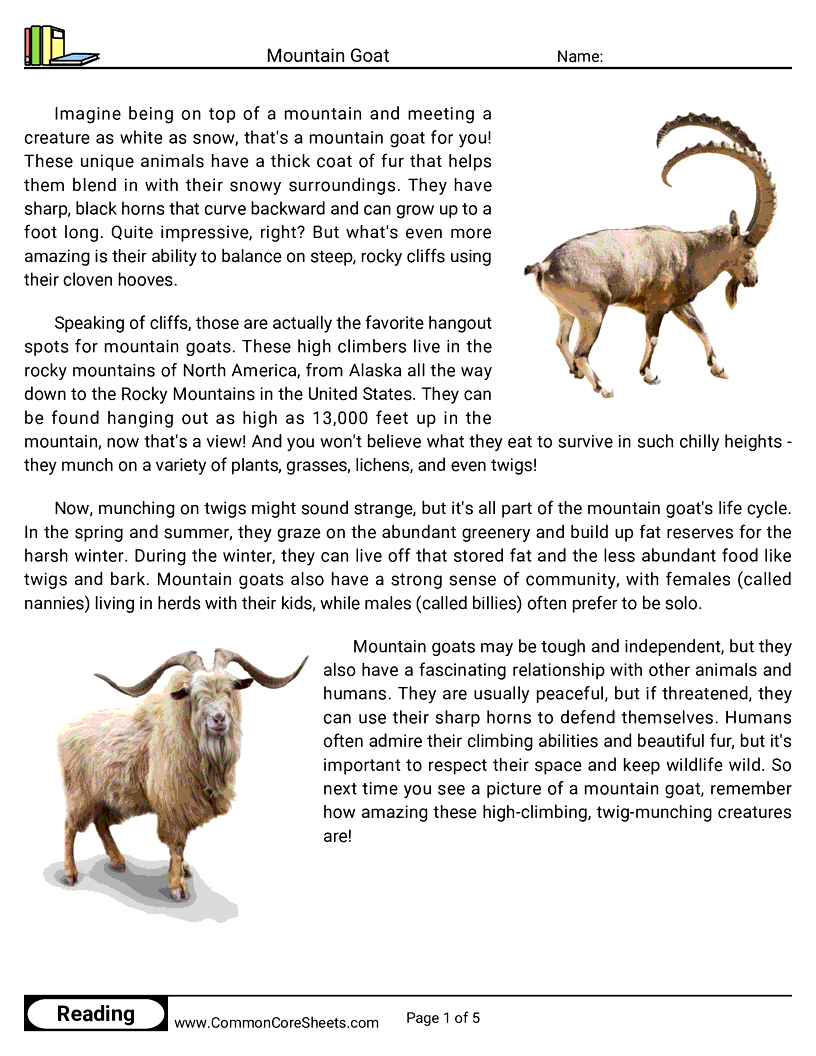
Imagine being on top of a mountain and meeting a creature as white as snow, that's a mountain goat for you! These unique animals have a thick coat of fur that helps them blend in with their snowy surroundings. They have sharp, black horns that curve backward and can grow up to a foot long. Quite impressive, right? But what's even more amazing is their ability to balance on steep, rocky cliffs using their cloven hooves.
Speaking of cliffs, those are actually the favorite hangout spots for mountain goats. These high climbers live in the rocky mountains of North America, from Alaska all the way down to the Rocky Mountains in the United States. They can be found hanging out as high as 13,000 feet up in the mountain, now that's a view! And you won't believe what they eat to survive in such chilly heights - they munch on a variety of plants, grasses, lichens, and even twigs!
Now, munching on twigs might sound strange, but it's all part of the mountain goat's life cycle. In the spring and summer, they graze on the abundant greenery and build up fat reserves for the harsh winter. During the winter, they can live off that stored fat and the less abundant food like twigs and bark. Mountain goats also have a strong sense of community, with females (called nannies) living in herds with their kids, while males (called billies) often prefer to be solo.
Mountain goats may be tough and independent, but they also have a fascinating relationship with other animals and humans. They are usually peaceful, but if threatened, they can use their sharp horns to defend themselves. Humans often admire their climbing abilities and beautiful fur, but it's important to respect their space and keep wildlife wild. So next time you see a picture of a mountain goat, remember how amazing these high-climbing, twig-munching creatures are!
Let's explore the amazing world of mountain goats, unique animals that live in high altitudes. These fascinating creatures are known for their incredible climbing skills and their ability to survive in harsh environments. Often found in North America, mountain goats prefer rocky terrains and steep cliffs, making them well suited for life in the mountains. Their white fur and unique features help them blend in with their surroundings, making them difficult to spot.
When it comes to their diet, mountain goats are herbivores, which means they eat plants. During the warmer months, they enjoy munching on grasses, flowers, and moss, while in winter, they switch to eating lichens, ferns, and even twigs from trees. Their agile bodies and strong legs allow them to climb to great heights in search of food, and their specialized hooves help them grip onto slippery rocks. In fact, some mountain goats have been known to climb as high as 13,000 feet just to find a tasty meal.
The life cycle of a mountain goat is quite interesting to learn about. They usually live for around 12-15 years, and during that time, they experience several important stages. Female mountain goats, called nannies, give birth to one or two babies, known as kids, after a 6-month pregnancy. The kids grow up quickly, learning to climb and become independent within just a few months.
Mountain goats have unique relationships with both humans and other animals. While they are naturally curious creatures, they tend to keep their distance from humans and are not considered a threat. In the wild, mountain goats share their habitat with other animals such as bears, wolves, and eagles, which are their main predators. To protect themselves, mountain goats rely on their agility and climbing skills to escape danger.
There are some interesting differences between mountain goats and other species. While they may look like true goats, mountain goats are actually more closely related to the antelope family. One unique feature is their beards, which both male and female mountain goats have, unlike other species. Additionally, their hooves are designed with special pads that allow them to grip onto rocks and maintain their balance, an adaptation not found in other goats. In conclusion, mountain goats are fascinating animals that have adapted perfectly to their challenging mountain environments.
Have you ever wondered about the incredible mountain goats and their fascinating lives? These amazing animals are known for their impressive climbing skills and ability to navigate steep, rocky mountain terrain. Mountain goats are covered in thick white fur, which keeps them warm in their cold habitats. Both males and females have curved black horns that continue to grow throughout their lives. These creatures are not actually goats, but belong to a family called Rupicaprids, which includes chamois and goral as well.
Mountain goats can be found in the western parts of North America, from Alaska to the Rocky Mountains. They prefer high alpine environments, where they can easily escape predators and find food. During the summer, mountain goats climb to the highest peaks, while in winter, they descend to lower elevations to avoid harsh weather conditions. Their specialized hooves have a rubbery pad for grip and sharp edges for digging into rocky surfaces. This adaptation allows them to move with ease on the steepest slopes.
An important part of a mountain goat's diet is the variety of plants that grow in their high-altitude habitats. These herbivores mainly eat grasses, herbs, mosses, and lichens. They will also consume twigs, leaves, and even the bark of trees if other food sources are scarce. Mountain goats have been known to travel long distances to find mineral licks, where they can get essential nutrients. These nutrients help them stay healthy and maintain their growth.
Mountain goats have a fascinating life cycle, starting from their birth in late spring or early summer. Baby mountain goats, called kids, are born after a six-month gestation period and can stand and walk within hours of being born. By three months old, the kids are already skilled climbers and can keep up with their mothers. At around two years old, young mountain goats will leave their mothers and join a group of other young goats. Mountain goats have a life expectancy of around 12 to 15 years in the wild.
When it comes to their relationship with humans and other animals, mountain goats are known to be quite shy and elusive. They are generally not aggressive toward humans unless they feel threatened or cornered. Mountain goats face threats from predators such as mountain lions, wolves, and bears. However, their amazing climbing abilities usually help them escape dangerous situations. In conclusion, mountain goats are truly fascinating animals, with their unique adaptations, incredible agility, and intriguing life cycle.
About this worksheet
Students read a passage about mountain goats and answer comprehension questions about the animal's habitat, behavior, and features.
This worksheet is designed to educate children on Mountain Goats. It includes 20 engaging reading problems that cover variety of details including their physical features, habitat, diet, and adaptive behaviors. Customizable for unique learning requirements, these worksheets can be converted into flash cards for individual study or used for distance learning to enhance remote education experiences. Suitable for young, curious minds eager to learn about wildlife.
Student objectives
- Read a nonfiction passage carefully to understand the main ideas
- Find and recall specific facts about mountain goats from the text
- Answer questions using details from what you read
- Learn new vocabulary about animals and their mountain environment
Everyday practice
- Read facts about an animal at the zoo and remember details to tell someone later
- Look up information about a wild animal for a school project
- Read a sign at a park or nature center about local wildlife
- Understand a nature magazine or website article about animals