Mistletoe and Holly Worksheet Download
Free reading comprehension worksheet about mistletoe, holly and other Christmas greenery. Pick the reading level (2nd grade to 8th grade), print the passage with its questions, or assign it online.


Sheet Information >
Available at 2nd grade, 3rd grade, 4th grade, 5th grade, 6th grade, 7th grade and 8th grade reading levels.
Read the passage
Wow, some plants stay green even when snow covers the ground! Holly, ivy, and mistletoe are evergreens, which means they keep their leaves all year long. Holly is easy to spot with its shiny, prickly leaves and bright red berries.
Birds love berries, and they help mistletoe reach the treetops. A bird eats a sticky white berry, then wipes a seed onto a branch, where it sticks like glue. The seed grows into a plant that sips water from the tree.
In bare winter treetops, green mistletoe stood out like a surprise. Long ago, people hung holly, ivy, and mistletoe indoors to enjoy something green in the dark winter. Some families still hang mistletoe in a doorway, and a kiss under it is part of the fun.
Green branches indoors are still a favorite, and families twist them into garlands and wreaths. A wreath is a ring of leaves that people hang on a door. Next time you see one, remember that mistletoe may have been planted by a hungry bird!
Imagine you are walking through a snowy forest on a gray winter day. High in a bare tree, you spot a round green clump that looks like a giant bird's nest. That is mistletoe, and it stays leafy while everything around it looks asleep. Nearby, a holly bush glitters with prickly leaves and red berries.
Bright colors like these cheered people up long ago, so they carried green branches indoors in the coldest months. Holly, ivy, and mistletoe are evergreens, plants that keep their leaves all year. Families hung them up as a reminder that spring would return. In England, people also began hanging mistletoe in doorways and sharing a kiss beneath it.
But how does mistletoe climb so high in a tree? Birds do the job! They eat its sticky white berries, and the gooey seeds stick to branches when the birds wipe their beaks. Each seed then sends tiny roots into the branch and borrows water from the tree.
Mistletoe is not the only plant with a secret, because holly has one too. Only female holly plants grow red berries, which birds enjoy but people should not eat. People twist holly and ivy into garlands, which are long ropes of leaves, and wreaths, which are rings of branches for doors. So when you see a green wreath, remember that it carries a very old promise: even in the coldest weather, green things keep growing.
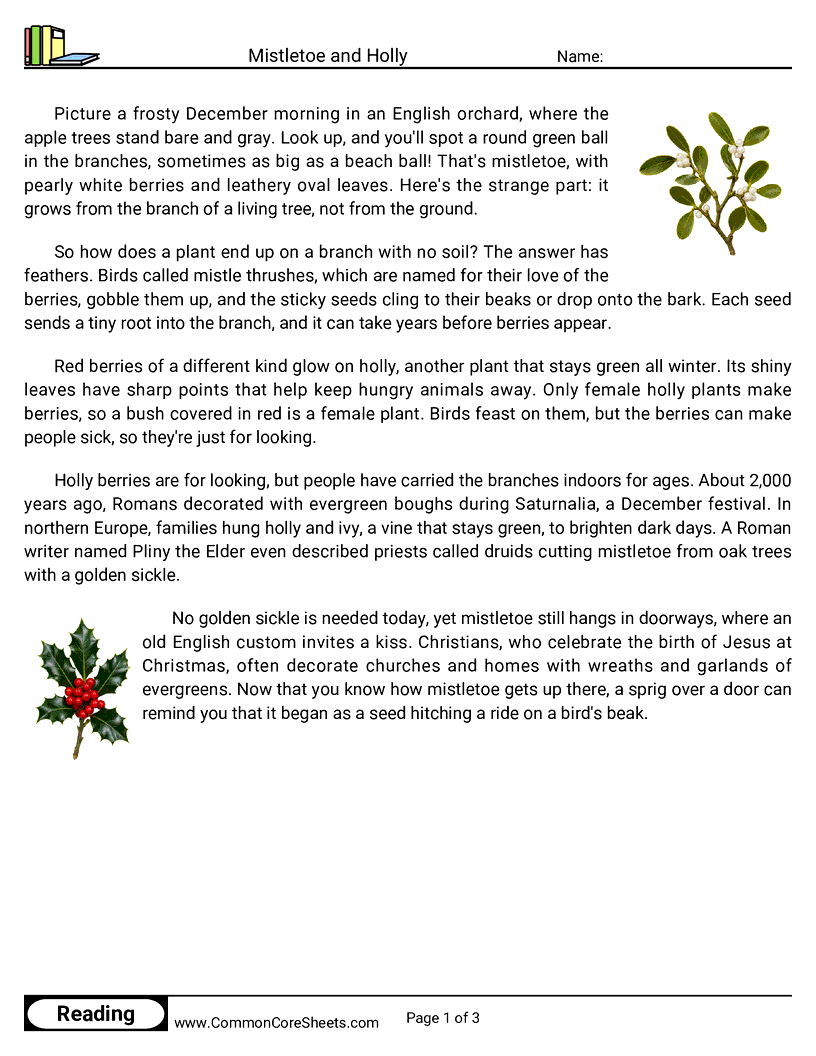
Picture a frosty December morning in an English orchard, where the apple trees stand bare and gray. Look up, and you'll spot a round green ball in the branches, sometimes as big as a beach ball! That's mistletoe, with pearly white berries and leathery oval leaves. Here's the strange part: it grows from the branch of a living tree, not from the ground.
So how does a plant end up on a branch with no soil? The answer has feathers. Birds called mistle thrushes, which are named for their love of the berries, gobble them up, and the sticky seeds cling to their beaks or drop onto the bark. Each seed sends a tiny root into the branch, and it can take years before berries appear.
Red berries of a different kind glow on holly, another plant that stays green all winter. Its shiny leaves have sharp points that help keep hungry animals away. Only female holly plants make berries, so a bush covered in red is a female plant. Birds feast on them, but the berries can make people sick, so they're just for looking.
Holly berries are for looking, but people have carried the branches indoors for ages. About 2,000 years ago, Romans decorated with evergreen boughs during Saturnalia, a December festival. In northern Europe, families hung holly and ivy, a vine that stays green, to brighten dark days. A Roman writer named Pliny the Elder even described priests called druids cutting mistletoe from oak trees with a golden sickle.
No golden sickle is needed today, yet mistletoe still hangs in doorways, where an old English custom invites a kiss. Christians, who celebrate the birth of Jesus at Christmas, often decorate churches and homes with wreaths and garlands of evergreens. Now that you know how mistletoe gets up there, a sprig over a door can remind you that it began as a seed hitching a ride on a bird's beak.
Look high into a bare winter oak, and you might spot a puzzle: a round green bush perched right on a branch! That's mistletoe, and it has no roots in the ground, so how did it get up there? Down below, holly shines with glossy, prickly leaves and red berries, while ivy climbs walls in ropes of green. All three stay leafy when other plants turn brown and bare, so people have carried them indoors for centuries.
The answer has wings, because birds are mistletoe's delivery service! Birds eat the sticky white berries, and the gluey seeds get wiped onto a branch when a bird cleans its beak. A stuck seed sprouts and pushes a special root into the branch to sip water and minerals, though the plant's green leaves still make some of its own food. Some word experts think its name comes from Old English words for "dung" and "twig," a not-so-fancy hint about where seeds often land.
Whatever its name means, a plant floating in a treetop looked magical to people long ago. Nearly 2,000 years ago, the Roman writer Pliny the Elder described Celtic priests called druids cutting mistletoe from oaks with a golden sickle, a curved blade. In snowy northern lands, evergreen boughs stood out against bare trees and short winter days. Greenery that never died seemed like a promise that spring would return.
Spring's promise was easy to see in holly, whose berries glow red when the world looks gray. Here's a surprise: only female holly plants grow berries, and they need a male holly plant nearby. Some Christians, who celebrate the birth of Jesus at Christmas, see the prickly leaves and red berries as reminders of the crown of thorns in his story. An old English carol, "The Holly and the Ivy," even pairs holly with its climbing partner.
Speaking of climbing partners, ivy's twining stems are perfect for winding into garlands, and a ring of greenery makes a wreath, a shape with no beginning or end. In the 1800s, Christians in Germany began making Advent wreaths, adding candles to count the weeks before Christmas. Later, people in England added a playful custom of kissing under a hanging sprig of mistletoe. So when you see mistletoe over a doorway, remember that it may have started as a sticky seed wiped from a bird's beak high in a tree.
Think mistletoe is just a sweet little sprig that hangs in a doorway? Look closer, because that green puffball is a plant with a sneaky secret. High on the branch of a host tree, it taps into the wood and sips water and minerals, which makes it a partial parasite. Its Christmas-greenery cousins are just as bold: holly bristles with glossy, spiny leaves and red berries, while ivy climbs walls in ropes of green. All three stay leafy while the world around them turns gray and bare.
That sneaky lifestyle raises a puzzle: how does a seed end up on a branch high in the treetops? Birds are the delivery service. Each mistletoe seed wears a coat of sticky goo called viscin, so when a hungry bird wipes its beak on a limb, the seed stays stuck like a tiny glued-down button. Other seeds pass right through the bird and land on branches in its droppings, and that explains the plant's odd name, which many word experts trace to Old English words meaning "dung" and "twig." Not exactly a fancy name for a holiday favorite!
A plant with such a strange life was bound to inspire strange stories. Almost 2,000 years ago, the Roman writer Pliny the Elder described how druids, priests of ancient Gaul, cut mistletoe from an oak with a golden sickle. To them, it was sacred, a living green treasure on a tree that looked dead in winter. Across Europe, people in the darkest months began carrying evergreens indoors, perhaps hoping to brighten gloomy days and keep a bit of summer near the fire. The habit is so old that no one knows who hung the first sprig.
Once the greenery was indoors, each plant gathered its own meaning. Holly, with its prickly leaves and red berries, became a favorite for doorways and mantels, and many Christians saw in it a reminder of Jesus's crown of thorns, an image found in the old carol "The Holly and the Ivy." Here's a surprise: only female holly bushes grow berries, and a male plant must live nearby for them to appear. Twisted into garlands and bent into wreaths, greenery could dress an entire hall, and a circle with no end seems right for plants that never seem to quit. In England, a playful custom of kissing beneath a hanging sprig of mistletoe joined the fun.
Those wreaths on your neighbors' doors may look like simple decoration, but evergreens matter far beyond December. Mistletoe deserves better than its villain reputation, in my opinion, because scientists who study forests have found that its clumps can give birds and other animals food and shelter. Holly berries also feed winter birds, although the berries of both plants are poisonous to people and should stay out of reach of small children and pets. So when you spot a sprig over a door this December, remember that it began as a sticky seed wiped onto a branch by a hungry bird.
What do a pincushion and a pickpocket have in common? In the plant world, they are holly and mistletoe, two Christmas favorites with very different personalities! Holly is the pincushion, a shrub with glossy, spiny leaves and berries as red as candy. Mistletoe is the pickpocket, a round tuft of pale green leaves that grows on other trees and quietly borrows from them. Add curly ivy, and you have a trio that stays green while most plants turn brown, which is why people have hauled them indoors for centuries.
Bringing holly indoors means handling a plant built to keep grazing animals away. Sharp spines make a mouthful painful for deer, and on many holly trees the highest leaves, far out of reach, are smoother. The berries come with a surprising rule: only female plants produce them, and they usually need a male holly nearby. Birds feast on the red berries in winter, though the berries can make people and pets sick. Birds, it turns out, are secret helpers for another winter plant, too.
For mistletoe, those bird helpers work as a delivery service. Its berries hold seeds coated in sticky goo, so when a bird wipes its beak on a branch or leaves droppings there, a seed can glue itself in place. Once the seed sprouts, it taps the branch for water and minerals, though its green leaves still make some food of their own. Scientists call plants like this hemiparasites, or "half parasites," a fitting name for something that both earns and borrows its living. Some word experts think even the name mistletoe comes from Old English words for "dung" and "twig," a nod to the droppings that help it spread.
A plant with such an odd life story was bound to inspire odd stories. Nearly 2,000 years ago, the Roman writer Pliny the Elder described Druids, priests of the ancient Celts, who considered oak mistletoe sacred and cut it with a golden sickle. Pliny added that mistletoe was rare on oaks, so finding it felt like discovering treasure. Across Europe, people also hung evergreen branches indoors in the darkest weeks of winter, and many historians think the green promised that spring would return. Christians, who celebrate the birth of Jesus at Christmas, later gave evergreens meanings of their own, such as everlasting life, and linked holly's red berries and spines to the crown of thorns.
Symbols like these were easy to pass along, but in the 1800s a cheap postage stamp made them travel faster than ever. Britain launched its Penny Post in 1840, and within a few years printed Christmas cards were on sale, many decorated with holly and ivy. Meanwhile in Germany, the Advent wreath, a ring of evergreens holding candles that many Christian families light as Christmas approaches, took shape in the 1800s. Because a circle has no beginning or end, many people find it a fitting shape for plants that stay green all winter. Even the custom of kissing under mistletoe, which had appeared in England by the 1700s, traveled along with the cards and carols.
Cards and carols are still part of the season, but today they share the spotlight with shelves full of plastic and fabric wreaths and garlands. Fresh greenery still has fans, because a real wreath brings the smell of a forest to your front door. Even the plastic versions copy nature closely, from holly's spiky leaves to mistletoe's pale berries. So the next time you spot a sprig of mistletoe, remember that it hitchhikes on birds, borrows from trees, and, according to a Roman writer, was once cut with a golden sickle.
Around the year 77 CE, a Roman admiral named Pliny the Elder finished a 37-volume encyclopedia, and tucked inside was a scene people still argue about. He described priests called druids, robed in white, climbing an oak to cut mistletoe with a golden sickle while a helper caught it in a cloak so it never touched the ground. That scene is one thread in the story of Christmas greenery: glossy, prickly holly with red berries, trailing ivy, and pale green clumps of mistletoe that look like bird nests in bare winter trees. Historians keep asking how much of our decorating truly comes from ancient rituals.
Those clumps are not nests, so what are they? Mistletoe is a hemiparasite: its green leaves make some of its own food, but rootlike structures called haustoria tap into the host tree to steal water and minerals. Its sticky white berries feed birds, and a bird that wipes its beak on a branch, or drops seeds after a meal, may plant the next mistletoe in just the right spot. The mistle thrush, a European songbird, is widely thought to be named for its fondness for the berries. People and pets should avoid them, though, because the berries are poisonous.
Poisonous or not, a plant that stayed green in the middle of a bare tree must have seemed almost magical, and Pliny says the druids thought so too. He reports that their word for it meant 'all-healing,' and that mistletoe growing on oak was rare, which made it precious. Here is the catch, and it is a big one: the druids left no writings of their own, so much of what we know comes from Romans, who were outsiders and often rivals. Can you imagine trusting one outside reporter for everything you know about a group of people? Many historians treat his account as a valuable clue, not a complete record.
Even if Pliny got every detail right, a clue about druids is not proof about Christmas. Romans had their own winter customs, including Saturnalia in December and the Kalends of January, when homes were decorated with greenery. Around the year 200, the Christian writer Tertullian complained that some fellow Christians hung laurel on their doors during Roman festivals, which suggests greenery was already an everyday habit. A vivid picture of Christmas decorating in London comes from John Stow, who wrote in 1598 that houses and churches were decked with holly, ivy, and bay. The simplest explanation may be the strongest: in a season of bare branches, evergreens were the obvious plants to bring inside, so different peoples could have reached the idea on their own.
Churches in Stow's London were decorated too, and over time Christians, who celebrate the birth of Jesus at Christmas, gave the greens meanings of their own. Some linked holly's sharp leaves and red berries to the crown of thorns, and the English carol 'The Holly and the Ivy,' published in the early 1900s, sings of holly's berry, prickle, and bark. Notice the difference from the druid debate: here no one has to guess at the meaning, because the carol spells it out. Nature added its own twist, since only female holly plants make berries, so a tree loaded with red fruit must have a male plant growing nearby.
Holly may need a partner to make berries, but in the 1800s it was mistletoe that gained a reputation for bringing people together. Charles Dickens helped by staging a lively party scene with kissing under the mistletoe in The Pickwick Papers, published in 1836 and 1837, although the custom was already known in England. Kissing, however, is a small chapter in a much bigger story of greenery moving indoors. In Germany in the 1800s, Advent wreaths of evergreens and candles helped Christians count down the weeks to Christmas, and today wreaths hang on doors and garlands drape stair rails around the world. Nearly 2,000 years after Pliny wrote his few lines about a golden sickle, historians still debate what they prove, while the plant itself keeps growing quietly in the treetops, waiting for a bird to plant its seeds.
About this worksheet
Students read a nonfiction passage about mistletoe, holly and other Christmas greenery, written at 7 reading levels (2nd grade to 8th grade), and answer multiple-choice questions about it.
A reading comprehension worksheet about mistletoe, holly and other Christmas greenery with a different article for each reading level, 2nd grade to 8th grade, each with its own multiple-choice questions aligned to the Common Core Reading: Informational Text standards. Printable with an answer key, and available as an online assignment at any level.
Student objectives
- Read a nonfiction passage about mistletoe, holly and ivy and explain how birds spread mistletoe seeds.
- Find details that show why holly leaves are prickly and which holly plants make berries.
- Explain the meaning of a word such as ivy from the way it is used in the text.
- Identify the main idea and use evidence to show how people have used greenery for a very long time.
Everyday practice
- Look at wreaths, garlands or trees around your neighborhood and spot which plants stay green in winter.
- Watch birds on a bare winter tree or bush and notice which ones are eating berries.
- Ask a family member what greenery they decorate with and whether it comes from a tradition.