Jaguar Worksheet Download
Free reading worksheets on Jaguar. Each worksheet has 20 problems with an answer key and are ideal for teachers and homeschooling. You can download the PDF, create a set of flash cards or set it up for online learning.


Sheet Information >
Available at 2nd grade, 3rd grade, 4th grade, 5th grade and 6th grade reading levels.
Read the passage
Jaguars are fascinating big cats that live in the wild. They are the third largest cats in the world and can be found in Central and South America, mainly in the Amazon rainforest. These beautiful creatures have golden-yellow fur with black spots, which makes them great at camouflage in their natural habitat.
Now let's talk about what jaguars eat and their life cycle. Jaguars are carnivorous animals, which means they love eating meat, especially deer, capybara, and even caimans. Jaguars are solitary creatures and their life cycle involves being born, growing up, finding a mate, having babies called cubs, and then eventually passing away after living for about 12 to 15 years.
Lastly, let's learn about jaguars' relationships with humans and other animals, as well as their defenses. Jaguars have been admired and sometimes feared by humans for centuries, but unfortunately, their habitats are being destroyed and they are hunted for their beautiful fur. Jaguars have powerful jaws and sharp teeth, which help them defend themselves and catch their prey, making them different from other big cats like lions and tigers.
In this fun article, we learned about where jaguars live, what they eat, and their life cycle. We also discovered their relationships with humans and other animals, as well as their unique defenses. Jaguars are truly amazing creatures!
Let's learn about jaguars, fascinating creatures that are known for their incredible hunting skills and beautiful coats. Jaguars live in the rainforests, swamps, and grasslands of Central and South America. These large cats have a yellowish-brown coat with black spots, called rosettes, that help them blend into their surroundings. Jaguars are great swimmers and climbers, which allows them to catch a variety of prey like fish, turtles, and monkeys.
Now, let's explore the life cycle of a jaguar and their relationship with other animals. Jaguars are solitary animals, which means they usually live and hunt alone, only coming together during mating season. After about 100 days, the female jaguar will give birth to one to four cubs, who will stay with their mother for up to two years before venturing out on their own. These powerful predators are at the top of the food chain, which means they help keep the ecosystem balanced by controlling the population of other animals.
Lastly, let's discuss how jaguars interact with humans and what makes them unique among big cats. Jaguars have been admired and respected by humans for centuries and are often featured in the art and mythology of indigenous cultures. One interesting fact is that jaguars have the strongest bite force of any cat, which allows them to easily crush the bones of their prey. Unlike other big cats, like lions and tigers, jaguars are not known for their roaring abilities, but they do make a variety of other sounds to communicate.
In this article, we learned about the amazing jaguar, their habitat, life cycle, and unique characteristics. We also discovered how they interact with humans and their role in the ecosystem. These beautiful and powerful creatures continue to captivate our imaginations and remind us of the importance of preserving their natural habitats.
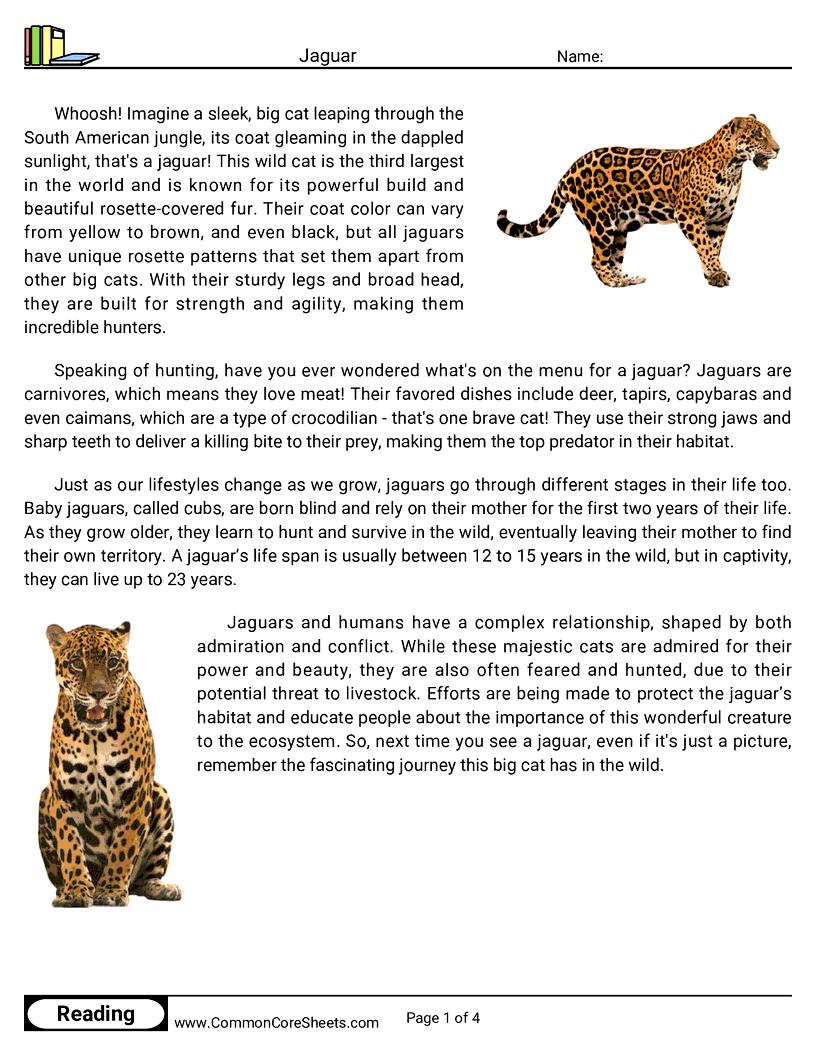
Whoosh! Imagine a sleek, big cat leaping through the South American jungle, its coat gleaming in the dappled sunlight, that's a jaguar! This wild cat is the third largest in the world and is known for its powerful build and beautiful rosette-covered fur. Their coat color can vary from yellow to brown, and even black, but all jaguars have unique rosette patterns that set them apart from other big cats. With their sturdy legs and broad head, they are built for strength and agility, making them incredible hunters.
Speaking of hunting, have you ever wondered what's on the menu for a jaguar? Jaguars are carnivores, which means they love meat! Their favored dishes include deer, tapirs, capybaras and even caimans, which are a type of crocodilian - that's one brave cat! They use their strong jaws and sharp teeth to deliver a killing bite to their prey, making them the top predator in their habitat.
Just as our lifestyles change as we grow, jaguars go through different stages in their life too. Baby jaguars, called cubs, are born blind and rely on their mother for the first two years of their life. As they grow older, they learn to hunt and survive in the wild, eventually leaving their mother to find their own territory. A jaguar’s life span is usually between 12 to 15 years in the wild, but in captivity, they can live up to 23 years.
Jaguars and humans have a complex relationship, shaped by both admiration and conflict. While these majestic cats are admired for their power and beauty, they are also often feared and hunted, due to their potential threat to livestock. Efforts are being made to protect the jaguar’s habitat and educate people about the importance of this wonderful creature to the ecosystem. So, next time you see a jaguar, even if it's just a picture, remember the fascinating journey this big cat has in the wild.
Jaguars are fascinating animals that have captured the imagination of people all over the world. These big cats are known for their impressive size, powerful build, and beautiful spotted fur. Jaguars are native to the Americas, and they live in a variety of habitats, including rainforests, grasslands, and even mountainous regions. Let's take a closer look at these amazing creatures and learn more about their lives.
When it comes to their diet, jaguars are true carnivores, which means they eat other animals to survive. Their favorite prey includes deer, tapirs, and capybaras, but they are also known to eat smaller animals like birds and reptiles. Jaguars have incredibly powerful jaws, which allow them to crush the skulls of their prey with just one bite. These big cats are also excellent hunters, using their stealth and agility to sneak up on their prey before pouncing.
The life cycle of a jaguar begins when they are born as cubs, usually in a litter of two to four siblings. For the first couple of years of their lives, jaguar cubs rely on their mother for protection and food while they learn to hunt on their own. Jaguars become fully independent around the age of two and will typically live for about 12 to 15 years in the wild. During their lifetime, they will establish their own territory and find a mate to reproduce and continue the cycle.
Jaguars have a unique relationship with both humans and other animals. In some indigenous cultures, the jaguar is considered a sacred animal and a symbol of power and strength. However, in some areas, jaguars are also considered a threat to livestock and can come into conflict with humans as a result. Jaguars are also considered apex predators, meaning they play a crucial role in maintaining the balance of their ecosystem by keeping the populations of other animals in check.
There are some interesting differences between jaguars and other big cat species. For example, jaguars are the only big cats native to the Americas, while lions, tigers, and leopards are found in other parts of the world. Jaguars also have a stockier build and shorter legs compared to other big cats, making them excellent swimmers and climbers. Finally, jaguars are known for their distinctive coat pattern, featuring spots that form a unique pattern called rosettes, which helps them blend into their surroundings. As we've discovered, jaguars are truly remarkable animals that play a crucial role in their environment and hold a special place in the hearts and minds of people all over the world.
Jaguars are amazing creatures that can be found in the wild. These large cats are known for their beautiful golden-yellow fur and unique black spots. Jaguars are the third-largest cats in the world, after lions and tigers. They are native to South and Central America and can be found in countries like Brazil, Argentina, and Mexico. Jaguars prefer to live in dense forests, swamps, and grasslands where they can hide and hunt for food.
Now let's talk about what these fantastic felines eat. Jaguars are carnivores, which means they eat meat. Their diet consists mainly of large mammals like deer, pigs, and tapirs, but they are also known to eat smaller animals like birds and fish. Jaguars are skilled hunters and use their powerful jaws and sharp teeth to catch their prey. They usually hunt at night and can jump up to 20 feet in the air to catch their dinner!
The life cycle of a jaguar is really interesting. Female jaguars give birth to one to four cubs after a pregnancy of about 100 days. The cubs are born blind and rely on their mother to protect them and teach them how to hunt. After two years, young jaguars become independent and start searching for their own territory. Jaguars can live up to 12 years in the wild, but they usually live longer in captivity.
Humans have had a complex relationship with jaguars throughout history. In many indigenous cultures, jaguars are seen as sacred animals and symbols of power and strength. Sadly, jaguars are also hunted for their fur and sometimes killed by farmers to protect their livestock. Conservation efforts are now being made to protect these incredible animals and their habitats. By learning more about jaguars and educating others, we can help ensure their survival for future generations.
Finally, let's explore some fascinating facts about jaguars and how they differ from other big cats. Unlike most big cats, jaguars are excellent swimmers and like spending time in the water. Jaguars are also unique because they have a special type of spots called rosettes, which are different from the spots on leopards and cheetahs. Their powerful jaws and strong bite allow them to pierce the skulls of their prey, something that other big cats cannot do. These incredible creatures have many adaptations that make them stand out in the animal kingdom, and they continue to captivate our imaginations.
About this worksheet
Students read an informational passage about jaguars and answer comprehension questions about the animal's habitat, diet, and characteristics.
This worksheet is designed to enhance children's reading comprehension around the subject of jaguars. It includes 20 questions ranging from the jaguar's appearance, diet, lifespan, to its role in the ecosystem. With its easily customizable format, this worksheet can be adapted into flashcards or utilized in a distance learning setup, making learning about this majestic creature flexible and engaging.
Student objectives
- Read a nonfiction passage about jaguars and understand the main ideas
- Find specific facts and details in the text to answer questions
- Learn new vocabulary related to animals and their habitats
- Practice summarizing what an animal passage is about
Everyday practice
- Understand facts about animals seen at the zoo
- Read a nature magazine or book about big cats and follow along
- Answer questions about a wildlife show after watching it
- Share interesting facts about jaguars with family or friends