How Santa Claus Got His Look Worksheet Download
Free reading comprehension worksheet about how the picture of Santa Claus came to be. Pick the reading level (1st grade to 8th grade), print the passage with its questions, or assign it online.


Sheet Information >
Available at 1st grade, 2nd grade, 3rd grade, 4th grade, 5th grade, 6th grade, 7th grade and 8th grade reading levels.
Read the passage
Can you picture Santa Claus with your eyes closed? He wears a red suit and a fluffy white beard. It all began with kind Saint Nicholas, who gave gifts to people.
To carry all those gifts, Santa needed a ride! In 1823, a famous poem gave him a sleigh. It also named his eight reindeer, all ready to fly!
Those reindeer needed a place to start their trip! In the 1860s, artist Thomas Nast drew his workshop, a room for making toys. Then, ads in the 1930s made his red suit famous, finishing the picture!
Wow, Santa Claus took about one hundred years of stories and pictures to get his look! You know the red suit, the white beard, and the sleigh full of gifts. The stories began with Saint Nicholas, a kind man who gave gifts long ago.
People kept telling those stories, and in 1823 a poem gave Santa a sleigh. The poem, "A Visit from St. Nicholas," named eight reindeer to pull it. Readers could picture all eight reindeer landing on a snowy roof.
Readers kept picturing him, and soon cartoonist Thomas Nast, who draws story pictures, began drawing Santa in the 1860s. Nast drew a toy workshop at the North Pole and a list of children's names. His pictures ran in a magazine called Harper's Weekly.
Magazines were not the only place to see Santa, since 1930s ads, pictures that help sell things, showed him too. Artist Haddon Sundblom painted a jolly Santa in a red suit for Coca-Cola ads. Next time you see that red suit, remember a poem, a cartoonist, and a painter each added a piece.
Imagine you are curled up by a crackling fire on a snowy night, hearing a poem about a jolly man with a sleigh and eight reindeer! That poem, "A Visit from St. Nicholas," was printed in 1823 and gave readers a brand-new picture of Santa Claus. Long before, people told stories of Saint Nicholas, a kind church leader who gave gifts, and of Father Christmas in England. Those old tales were puzzle pieces waiting to be fitted together.
Some of the biggest pieces came from Thomas Nast, a cartoonist, which is an artist who draws pictures for newspapers and magazines. From the 1860s into the 1880s, he drew Santa for a magazine called Harper's Weekly. What did his drawings show? A workshop at the North Pole where toys were made, plus a list of children's names.
After peeking into the workshop, readers wanted a closer look at Santa himself. In the 1930s, artist Haddon Sundblom painted him for Coca-Cola ads, with rosy cheeks, twinkling eyes, and a red suit trimmed in white fur. Santa had worn red in some earlier pictures, but these ads filled magazines across the country, so the red suit became famous.
Thanks to all those pictures, families everywhere began imagining Santa in much the same way. You can spot that look on cards and in parades. From that poem in 1823 to the ads of the 1930s, Santa's look took more than 100 years to come together!
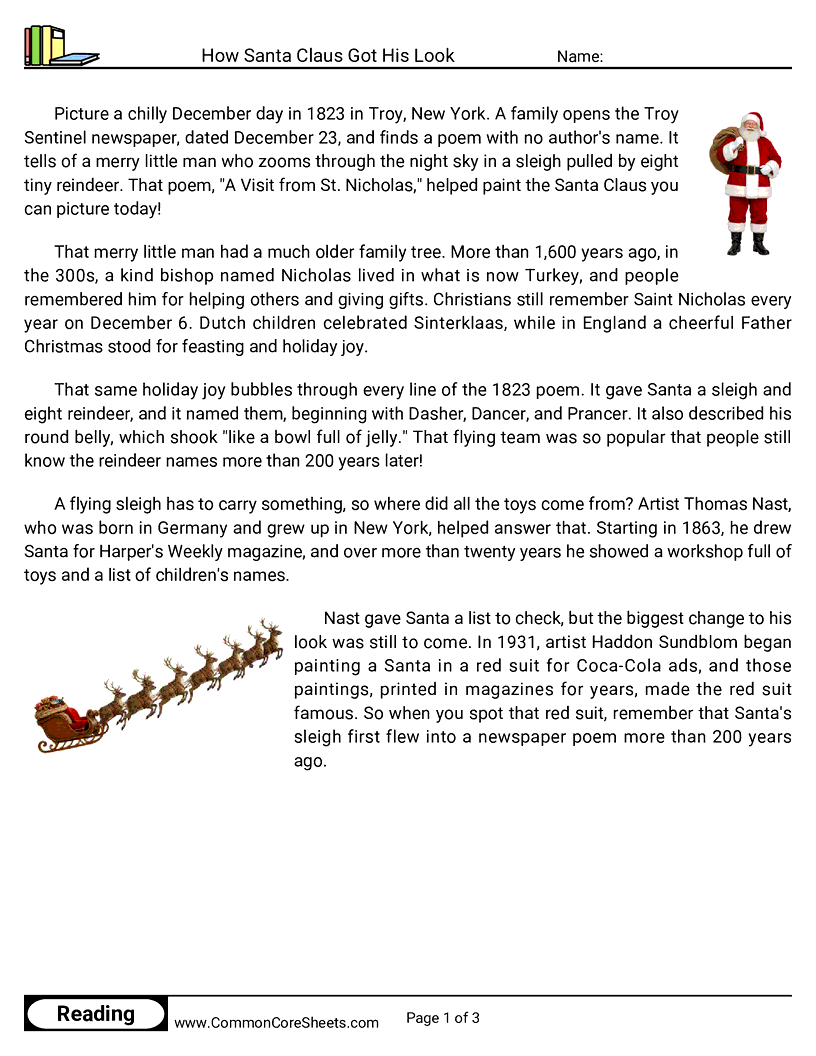
Picture a chilly December day in 1823 in Troy, New York. A family opens the Troy Sentinel newspaper, dated December 23, and finds a poem with no author's name. It tells of a merry little man who zooms through the night sky in a sleigh pulled by eight tiny reindeer. That poem, "A Visit from St. Nicholas," helped paint the Santa Claus you can picture today!
That merry little man had a much older family tree. More than 1,600 years ago, in the 300s, a kind bishop named Nicholas lived in what is now Turkey, and people remembered him for helping others and giving gifts. Christians still remember Saint Nicholas every year on December 6. Dutch children celebrated Sinterklaas, while in England a cheerful Father Christmas stood for feasting and holiday joy.
That same holiday joy bubbles through every line of the 1823 poem. It gave Santa a sleigh and eight reindeer, and it named them, beginning with Dasher, Dancer, and Prancer. It also described his round belly, which shook "like a bowl full of jelly." That flying team was so popular that people still know the reindeer names more than 200 years later!
A flying sleigh has to carry something, so where did all the toys come from? Artist Thomas Nast, who was born in Germany and grew up in New York, helped answer that. Starting in 1863, he drew Santa for Harper's Weekly magazine, and over more than twenty years he showed a workshop full of toys and a list of children's names.
Nast gave Santa a list to check, but the biggest change to his look was still to come. In 1931, artist Haddon Sundblom began painting a Santa in a red suit for Coca-Cola ads, and those paintings, printed in magazines for years, made the red suit famous. So when you spot that red suit, remember that Santa's sleigh first flew into a newspaper poem more than 200 years ago.
Close your eyes and picture Santa Claus in his red suit, with a sleigh packed with presents. Here is the puzzle: who decided he should look that way? Nobody wrote a rulebook, yet millions of people picture him almost the same. The answer is a trail of clues, and the first leads to a kind bishop named Nicholas, who lived in Myra, in what is now Turkey, more than 1,600 years ago.
That kind bishop was remembered for helping people in secret, and stories of his generosity traveled across Europe. Christians honor him as Saint Nicholas, and his feast day, December 6, became a day for gifts in many places. Dutch families called him Sinterklaas, and the name Santa Claus is believed to have grown from it. Meanwhile, England had Father Christmas, a cheerful symbol of feasting, and old pictures even show him in green robes!
Those two characters, a gift-giving saint and a jolly symbol of feasting, were waiting for a storyteller to blend them. In 1823, the poem "A Visit from St. Nicholas" appeared in a New York newspaper, and it is usually credited to Clement Clarke Moore. It gave readers a sleigh, eight reindeer, and a round-bellied man who laughed "like a bowl full of jelly." Its hooves prancing on the rooftop gave Christmas Eve a sound that people still imagine today.
Words painted the scene, but it took an artist's pencil to show what Santa's world looked like. Thomas Nast, a German-born cartoonist, began drawing Santa for Harper's Weekly in the early 1860s, during the Civil War, when many families were far apart and longing to be together. Over the following decades, he added a workshop at the North Pole and a list of children who had been good. Thanks to those drawings, people could finally see where Santa's sleigh set out from.
One clue was still missing: color, since Santa's coat had appeared in many shades over the years. In 1931, artist Haddon Sundblom began painting a rosy-cheeked Santa in bright red for Coca-Cola advertisements. Santa had worn red before, but those paintings appeared for more than thirty years, so millions of people saw the same cheerful look again and again. The Santa in your mind is a picture built by a bishop's story, an English tradition, a poem, a cartoonist, and a painter, across well over a thousand years.
Think a soft-drink company invented Santa Claus's red suit? Plenty of people do, but the real story is older and far more interesting. Picture the Santa you know best: a round belly, a snowy beard, a red coat trimmed with white fur, and a sleigh gliding through the night sky. No single artist dreamed up that whole picture at once. It was pieced together like a patchwork quilt, and I think that makes it even more wonderful than if one person had invented it.
The oldest square of that quilt comes from a bishop named Nicholas, who lived in the town of Myra, in what is now Turkey, during the 300s. Christians remember him for his kindness, and stories of his generosity to families in need spread across Europe. His feast day, December 6, became a time for small gifts in many countries. Dutch children welcomed Sinterklaas, and when Dutch settlers reached New York, English speakers gradually bent the name into 'Santa Claus.' Meanwhile, England had Father Christmas, a merry figure who stood for feasting and good cheer.
Once that name landed in New York, a poem soon gave the character a way to travel. 'A Visit from St. Nicholas' appeared anonymously in a newspaper in 1823, and Clement Clarke Moore was later credited as its author. Its lines describe a miniature sleigh pulled by eight tiny reindeer, and the poem calls each one by name. It also gave Santa a belly that shook 'like a bowl full of jelly' and a quick trip down the chimney. Here is a twist: the poem says he was 'dressed all in fur,' and never mentions a red suit.
If the poem gave Santa fur and a sleigh, a cartoonist named Thomas Nast gave him an address. Drawing for the magazine Harper's Weekly, Nast began picturing Santa in the 1860s and kept going into the 1880s. His drawings placed Santa's home at the North Pole, filled it with a toy workshop, and showed him checking a list of children's behavior. Nast also stretched the poem's tiny driver into a full-sized, cheerful man with a bushy beard. For about twenty years, readers could watch Santa's world grow, one holiday drawing at a time.
After decades of poems and drawings, the picture was nearly finished by the 1930s, and one bright splash of red was about to make it famous. Red was not new, since artists had painted Santa in red coats before and bishops like Nicholas often wore red robes. In 1931, artist Haddon Sundblom began painting a warm, grandfatherly Santa for Coca-Cola ads, and he kept at it for more than thirty years. That is why the story still matters today: traditions grow when people share, change, and add to them, and famous does not mean first. Santa's coat may be red, but his look is a patchwork stitched together over more than 1,600 years.
Your picture of Santa Claus, with his round belly, bright red suit, and sleigh full of gifts, took about 1,600 years to finish. That is longer than any jigsaw puzzle you have ever tried, and its pieces came from different countries, poets, and artists. Some pieces came from stories about a kind bishop, some from cheerful winter customs, and some from magazine drawings and advertisements. Can you guess which piece came first? It was not a costume at all but a name: Nicholas.
That name belonged to a real bishop who lived in the 300s in Myra, a town in what is now Turkey. Christians remember Nicholas for his kindness, and stories about his generosity to people in need spread across Europe, where his feast day is December 6. The Dutch called him Sinterklaas, and as that name traveled to America, English speakers gradually shaped it into "Santa Claus." Meanwhile, in England, a different character named Father Christmas stood for feasting and good cheer rather than presents. So two separate traditions, one about giving and one about celebrating, were like two streams flowing toward the same river.
Those streams began to merge in 1823, when a poem called "A Visit from St. Nicholas" appeared in a New York newspaper with no author's name. It was later credited to Clement Clarke Moore, and many people now know it by its first line, "'Twas the Night Before Christmas." Readers met a "jolly old elf" who arrives in a sleigh pulled by eight reindeer, and the poem names every one, from Dasher to Blitzen. Notice how the poet's word choices make him seem friendly rather than grand: he is "chubby and plump," with a belly that shakes "like a bowl full of jelly." Yet nothing in the poem says his suit was red; it says he was "dressed all in fur, from his head to his foot."
The poem left Santa's home a mystery, and it took a cartoonist to fill in the details. Thomas Nast, an artist born in Germany, drew Santa for the popular weekly paper Harper's Weekly starting in the 1860s and kept at it into the 1880s. In Nast's pictures, Santa works among toys in a workshop, reads letters from children, and checks a list of who has been good. Because the paper reached homes across the country, readers in many places saw the same cheerful Santa at about the same time. Even so, artists of the era still dressed him in many colors, including blue, green, and brown.
With so many colors in use, how did red win the contest? Red coats had appeared on Santa before, but the look became truly famous in the 1930s. In 1931, the Coca-Cola company hired artist Haddon Sundblom to paint Santa for its holiday ads, and he kept painting him for more than 30 years. His Santa had rosy cheeks, twinkling eyes, and a warm smile, and he appeared in magazines every December. Seeing the same jolly figure season after season helped make the red suit feel like the natural choice.
Natural as it feels today, the red suit is one of the youngest pieces in Santa's picture. Each creator built on earlier ones: Moore's poem drew on old stories, Nast drew on the poem, and Sundblom painted the jolly figure that earlier artists had shaped. Around the world, the traditions keep their own names and customs, such as Santa Claus, Father Christmas, and Sinterklaas. Artists and storytellers still add fresh touches every year. So the next time you spot that famous red suit, remember that the poem that gave Santa eight reindeer never mentioned it at all.
On December 23, 1823, a newspaper in Troy, New York, printed a poem with no author's name attached, and nobody could have guessed how much it would change Christmas. Today you can picture Santa Claus in a flash: a red suit, a white beard, a sleigh pulled by reindeer, a workshop full of toys, and a list of names. Yet those details did not arrive together, and no single person dreamed them all up. Poets, cartoonists, and advertisers added them one at a time over roughly a century, each borrowing from the artist before. Following that trail shows how a shared tradition grows, and why historians still argue about who deserves the credit.
Credit, in fact, starts far earlier than 1823, with a man named Nicholas who lived about 1,700 years ago. He was a Christian bishop in Myra, in what is now Turkey, and stories of his generosity to poor families spread across Europe. In the Netherlands he became Sinterklaas, and English speakers in New York, once the Dutch colony of New Amsterdam, gradually bent that name into "Santa Claus." England had a separate figure, Father Christmas, who began as a symbol of feasting and good cheer rather than a bringer of gifts. The two came from different places: Nicholas is honored on December 6, nearly three weeks before Christians celebrate the birth of Jesus, while Father Christmas embodied the merriment of the whole season.
That merriment resurfaces in "A Visit from St. Nicholas," the 1823 poem, where a "jolly old elf" lands on a rooftop in a miniature sleigh. Eight reindeer pull the sleigh, and each one gets a name; the last two, Dunder and Blixem in the original printing, echo words for thunder and lightning. The poem also gives Santa rosy cheeks and a belly that shakes "like a bowl full of jelly." Who wrote it is still debated: Clement Clarke Moore, a New York professor, included it in his 1844 book of poems, but relatives of the poet Henry Livingston Jr. argue that he wrote it. Whoever wrote it, the text itself makes one thing clear: this Santa is dressed in fur, not in red.
A poem leaves plenty for pictures to fill in, and Thomas Nast, a German-born cartoonist who grew up in New York, filled in a great deal. In January 1863, in the middle of the Civil War, his drawing in Harper's Weekly showed Santa bringing gifts to a soldiers' camp, a small reminder of home during a hard winter. Over the next two decades, Nast kept drawing him, adding a toy workshop, a North Pole address, and a big book listing which children had been good. Because his magazine was read across the country, many people saw the same Santa year after year, and scattered stories began to look like one. Nast also helped popularize the donkey and the elephant as symbols of America's two major political parties.
Even so, one detail stayed unsettled, because artists still dressed Santa in coats of many colors and lengths. That is where the advertising artist Haddon Sundblom enters, painting Santa for Coca-Cola beginning in 1931 and continuing for more than thirty years. According to the company's history, he first modeled his warm, grandfatherly Santa on a retired salesman named Lou Prentiss, and later on his own reflection in a mirror. Did Coca-Cola invent the red-suited Santa, as many people believe? The evidence says no, because red-coated Santas appeared in magazines and advertisements before 1931. A more accurate claim is that Sundblom's paintings, printed in magazines and displayed in stores year after year, made one red-suited version famous.
Fame, however, is not the same as invention, and Santa's story shows the difference. A bishop's generosity supplied the spirit, Dutch and English customs supplied the name and the cheer, a poem supplied the sleigh and reindeer, Nast supplied the workshop and list, and Sundblom made the red suit famous. Even the disagreement over who wrote the poem is a clue to how many hands have shaped the tradition. And the picture is still growing: since 1939, a red-nosed reindeer named Rudolph has joined the poem's famous eight in many retellings. So the most recognizable face of Christmas has no single creator, and it seems fitting that it began with a poem that did not even carry a name.
About this worksheet
Students read a nonfiction passage about how the picture of Santa Claus came to be, written at 8 reading levels (1st grade to 8th grade), and answer multiple-choice questions about it.
A reading comprehension worksheet about how the picture of Santa Claus came to be with a different article for each reading level, 1st grade to 8th grade, each with its own multiple-choice questions aligned to the Common Core Reading: Informational Text standards. Printable with an answer key, and available as an online assignment at any level.
Student objectives
- Read a nonfiction passage and identify the order in which Santa's look developed.
- Find details that show what the poem, Thomas Nast, and 1930s paintings each added.
- Explain the meaning of a phrase from the text using context clues.
- Explain how a detail from the text supports a point about the poem's popularity.
Everyday practice
- Look at Christmas cards, books, or decorations and notice which parts of Santa's look you see, such as a sleigh, reindeer, or red suit.
- Try reading "A Visit from St. Nicholas" aloud and listen for the names of the eight reindeer.
- Ask a family member which Santa pictures or stories they remember from when they were young.