House Fly Worksheet Download
Free reading worksheets on House Fly. Each worksheet has 20 problems with an answer key and are ideal for teachers and homeschooling. You can download the PDF, create a set of flash cards or set it up for online learning.


Sheet Information >
Available at 2nd grade, 3rd grade, 4th grade, 5th grade and 6th grade reading levels.
Read the passage
Hey kids, let's learn about house flies! They are small insects that you might see buzzing around your home, and they have a grey body with big, red eyes. House flies love to eat a variety of things like leftover food, garbage, and even poop! They can live in many different places, like in your house, around garbage cans, or near animal waste.
Now, let's talk about the life cycle of a house fly. It starts as a tiny egg and hatches into a larva, also known as a maggot. The maggot then turns into a pupa, which is like a cocoon, and finally, it emerges as an adult house fly.
House flies have a special relationship with humans and other insects. They can be helpful because they eat waste, but they can also spread germs, so it's important to keep our homes clean. House flies have some cool defenses, like being able to walk on walls and ceilings, and they can quickly fly away if they sense danger.
In conclusion, house flies are fascinating little creatures with interesting life cycles and unique relationships with humans and other insects. Remember to keep your home clean to avoid unwanted house fly visitors!
House flies are fascinating little insects that you might see buzzing around your home. These tiny creatures have six legs, a pair of wings, and big red eyes. They can be found all over the world, living in various environments like homes, farms, and even garbage dumps. House flies are known for their incredible ability to fly and to walk on almost any surface, including ceilings and windows.
The life cycle of a house fly is quite interesting, as it goes through a complete metamorphosis. This means that they start as eggs, then hatch into larvae (also known as maggots), then become pupae, and finally emerge as adult flies. House flies eat a wide variety of foods, including human food, animal waste, and even rotting plants. This is why it's important to keep your food covered and your living spaces clean to prevent them from spreading germs.
House flies have some unique relationships with humans and other insects. While they can be a nuisance to people, they also help break down and recycle organic waste in the environment. In the world of insects, house flies have some natural enemies, like spiders and other predatory insects that help keep their populations in check. Remember, while house flies might be a bit annoying, they also play an important role in our ecosystem.
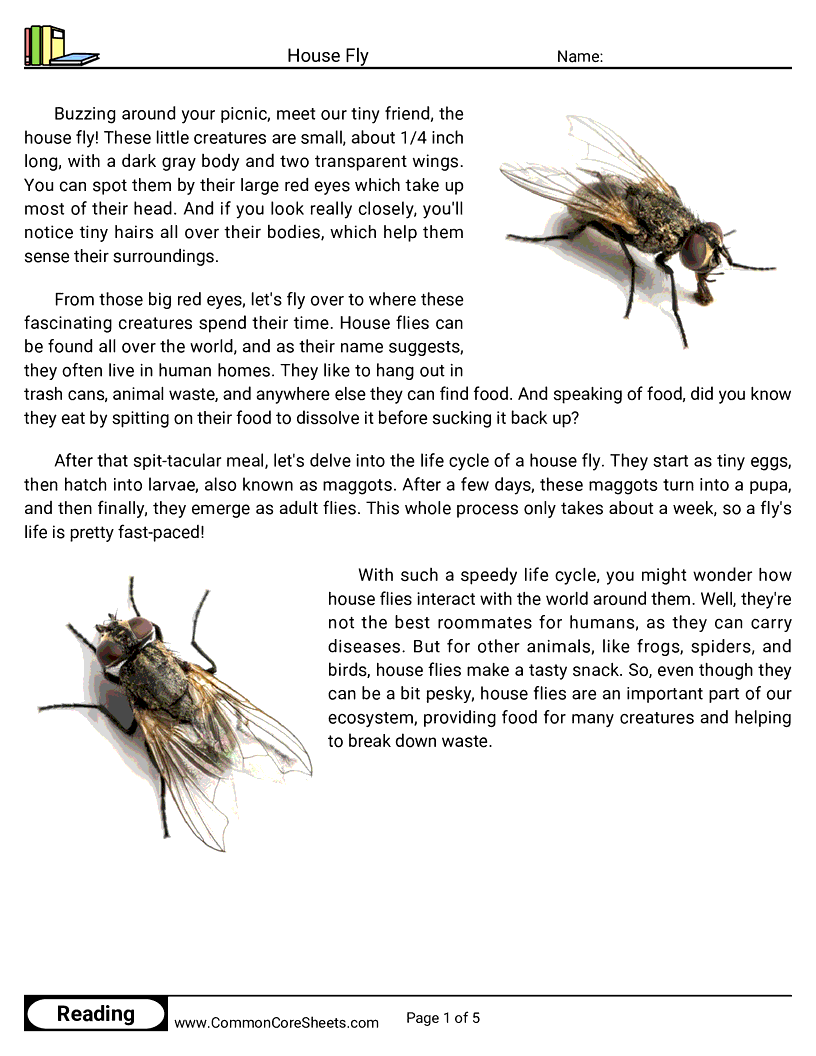
Buzzing around your picnic, meet our tiny friend, the house fly! These little creatures are small, about 1/4 inch long, with a dark gray body and two transparent wings. You can spot them by their large red eyes which take up most of their head. And if you look really closely, you'll notice tiny hairs all over their bodies, which help them sense their surroundings.
From those big red eyes, let's fly over to where these fascinating creatures spend their time. House flies can be found all over the world, and as their name suggests, they often live in human homes. They like to hang out in trash cans, animal waste, and anywhere else they can find food. And speaking of food, did you know they eat by spitting on their food to dissolve it before sucking it back up?
After that spit-tacular meal, let's delve into the life cycle of a house fly. They start as tiny eggs, then hatch into larvae, also known as maggots. After a few days, these maggots turn into a pupa, and then finally, they emerge as adult flies. This whole process only takes about a week, so a fly's life is pretty fast-paced!
With such a speedy life cycle, you might wonder how house flies interact with the world around them. Well, they're not the best roommates for humans, as they can carry diseases. But for other animals, like frogs, spiders, and birds, house flies make a tasty snack. So, even though they can be a bit pesky, house flies are an important part of our ecosystem, providing food for many creatures and helping to break down waste.
Let's learn about house flies, a common insect that you've probably seen many times! House flies are small, usually grey insects with big, red eyes that can be found all over the world. They have tiny hairs on their body that help them to taste and smell, and their wings can flap about 200 times per second, making them quite fast fliers. These fascinating creatures are a part of the Muscidae family, which includes over 4,000 different species of flies.
Now, let's talk about what house flies eat and where they live. House flies are not picky eaters, as they will consume almost anything, from food scraps to feces, and even decaying plants and animals. In order to eat, they use their sponge-like mouthparts to soak up liquids or liquefy solids with their saliva. These insects can be found in various environments, including homes, garbage dumps, and even on animal carcasses.
The life cycle of a house fly is quite interesting! It all starts when a female house fly lays her eggs, usually on a food source like garbage or rotting plants. After a day or two, the eggs hatch into larvae, also known as maggots, which feed on the food source and grow for about a week. Finally, the maggots will transform into pupae, and a few days later, emerge as fully grown adult house flies ready to start the cycle all over again.
House flies have a unique relationship with humans and other insects. Although they may seem harmless, house flies can actually carry and spread diseases to humans, such as salmonella and E. coli, by landing on our food or surfaces we touch. In the world of insects, house flies have their fair share of predators, like spiders and praying mantises, which help to control their population. Despite being considered as pests, house flies also play a role in breaking down decaying organic matter and recycling nutrients.
Lastly, let's explore some interesting facts and differences between house flies and other species. Believe it or not, house flies have a pretty short lifespan, only living for about a month. While they are closely related to other fly species, such as the fruit fly, house flies are typically larger and have a different diet. One unique fact is that house flies always land on surfaces with their front legs first, which have taste buds, allowing them to taste whatever they land on.
House flies are fascinating creatures that you might see buzzing around your home. They are small insects, usually about 6 millimeters long, with a pair of large red eyes and a pair of wings that help them fly. Their body is usually gray or black in color and covered in tiny hairs. These little insects are quite common and can be found all over the world. Let's explore more about what they eat, where they live, and some other interesting facts about house flies.
House flies are not picky eaters, and they enjoy a wide variety of foods. They are attracted to sweet, sugary substances like fruit juices and syrups, but they also eat decomposing materials like dead animals, feces, and garbage. These insects have a unique way of eating, as they first spit out saliva onto their food to dissolve it and then suck it back up through their straw-like mouthparts. This allows them to eat solid foods that would otherwise be too big for them to handle. Because of their diet, house flies can sometimes carry and spread harmful bacteria and diseases.
The life cycle of a house fly is fascinating and goes through four main stages: egg, larva, pupa, and adult. A female house fly can lay up to 150 eggs at a time, which hatch into tiny, white larvae called maggots within 24 hours. These maggots will then eat and grow for about a week before entering the pupal stage, where they transform into adult flies. The entire life cycle can be completed in as little as two weeks, depending on the temperature and availability of food. Adult house flies typically live for about a month, but some can survive for several months under the right conditions.
House flies have an interesting relationship with humans and other insects. They are often considered pests because they can transmit diseases and contaminate our food, but they also play an important role in breaking down and recycling organic waste. House flies have a few natural predators, such as spiders, birds, and other insects like the praying mantis. To defend themselves from these threats, house flies rely on their incredible speed and agility to escape danger. They can also use their tiny hairs to detect changes in air pressure, allowing them to quickly change direction and avoid being caught.
There are many different species of flies, but house flies have some unique features that set them apart. For example, they are one of the few insects that can walk upside down, thanks to the adhesive pads on their feet that allow them to grip onto surfaces. House flies also have an amazing ability to see almost 360 degrees around them, which helps them spot potential predators and food sources. Despite their small size, house flies are also capable of flying long distances, sometimes traveling up to 20 miles in search of a suitable place to lay their eggs. These incredible insects may be small, but they are full of surprises and play a significant role in our ecosystem.
About this worksheet
Students read an informational passage about house flies and answer comprehension questions about their traits, habits, and life cycle.
This worksheet is designed to foster children’s reading comprehension on the subject of house flies. It contains 20 interactive questions ranging from a fly's physical attributes to its lifecycle, providing an engaging way for kids to learn. It's customizable, can be converted into flash cards for convenient studying, and is suitable for distance learning, making it a versatile educational tool.
Student objectives
- Read a nonfiction passage about house flies and understand the main ideas
- Find facts and details about how house flies live and behave
- Learn new vocabulary words related to insects
- Answer questions using information from the text
Everyday practice
- Understand facts when reading about bugs in a nature book
- Explain to a friend why flies buzz around food
- Read a sign or label about pests and know what it means
- Talk about what you learned after reading an animal article