Hercules Beetles Worksheet Download
Free reading worksheets on Hercules Beetles. Each worksheet has 20 problems with an answer key and are ideal for teachers and homeschooling. You can download the PDF, create a set of flash cards or set it up for online learning.


Sheet Information >
Available at 2nd grade, 3rd grade, 4th grade, 5th grade and 6th grade reading levels.
Read the passage
Let's learn about the amazing Hercules beetles! These incredible insects are known for their big size and very strong bodies. Hercules beetles can be found in the rainforests of Central and South America, where they love to eat things like fruit, leaves, and other insects.
Now, let's explore the life cycle of Hercules beetles. These beetles start as tiny eggs, then grow into small, white larvae which live underground and eat decaying wood. After a few months, they turn into pupae, and finally, they become the strong, adult Hercules beetles we know and love.
Lastly, we'll look at their relationship with humans and other insects. Hercules beetles are not harmful to humans and can even be kept as interesting pets. Their powerful bodies help them defend against other insects, and one unique feature that sets them apart is their large, horn-like structure on their heads.
Hercules beetles are amazing creatures! These large beetles can be found in the tropical rainforests of Central and South America. They are usually green, tan, or black in color, and their large horns make them stand out from other insects. In their adult form, they love to munch on sweet fruits like bananas and apples.
Let's learn about the life cycle of a Hercules beetle! The female beetle will lay her eggs in decaying wood or compost. After a couple of weeks, the eggs will hatch into small white larvae that love to eat rotting wood. Eventually, the larvae will grow and turn into a pupa, and then finally transform into the adult Hercules beetle we know and love.
These beetles have a unique relationship with humans and other insects. Because of their impressive size and appearance, Hercules beetles are popular pets for bug enthusiasts. In the wild, they help recycle dead wood by feeding on it as larvae, making them an important part of the ecosystem. Their large horns are used for defense against predators and for battling other male beetles.
Hercules beetles are fascinating insects that have a lot to teach us about the natural world.
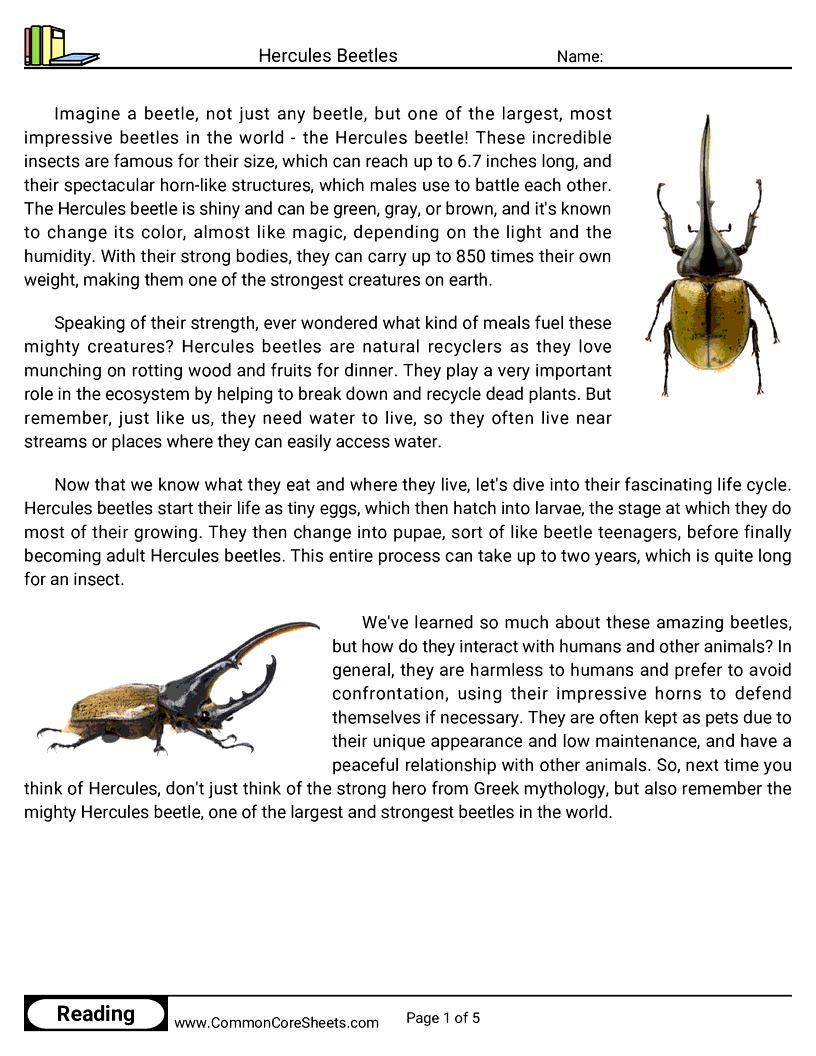
Imagine a beetle, not just any beetle, but one of the largest, most impressive beetles in the world - the Hercules beetle! These incredible insects are famous for their size, which can reach up to 6.7 inches long, and their spectacular horn-like structures, which males use to battle each other. The Hercules beetle is shiny and can be green, gray, or brown, and it's known to change its color, almost like magic, depending on the light and the humidity. With their strong bodies, they can carry up to 850 times their own weight, making them one of the strongest creatures on earth.
Speaking of their strength, ever wondered what kind of meals fuel these mighty creatures? Hercules beetles are natural recyclers as they love munching on rotting wood and fruits for dinner. They play a very important role in the ecosystem by helping to break down and recycle dead plants. But remember, just like us, they need water to live, so they often live near streams or places where they can easily access water.
Now that we know what they eat and where they live, let's dive into their fascinating life cycle. Hercules beetles start their life as tiny eggs, which then hatch into larvae, the stage at which they do most of their growing. They then change into pupae, sort of like beetle teenagers, before finally becoming adult Hercules beetles. This entire process can take up to two years, which is quite long for an insect.
We've learned so much about these amazing beetles, but how do they interact with humans and other animals? In general, they are harmless to humans and prefer to avoid confrontation, using their impressive horns to defend themselves if necessary. They are often kept as pets due to their unique appearance and low maintenance, and have a peaceful relationship with other animals. So, next time you think of Hercules, don't just think of the strong hero from Greek mythology, but also remember the mighty Hercules beetle, one of the largest and strongest beetles in the world.
Meet the Hercules beetle, one of the most fascinating insects on our planet! These amazing creatures are known for their incredible strength and size. In fact, they are considered one of the largest beetles in the world. Let's explore more about their lives, their environment, and some cool facts about them.
Hercules beetles can be found in the tropical rainforests of Central and South America. They usually live in trees or on the forest floor, hiding under leaves and logs. These beetles are nocturnal, which means they are most active during the night. Their diet mainly consists of rotting wood, fruits, and plant material.
The life cycle of a Hercules beetle is quite interesting. Like other beetles, they go through four stages: egg, larva, pupa, and adult. The entire process can take around 12-24 months, depending on the environment and food availability. During the larval stage, Hercules beetles can grow up to 4.5 inches long!
Hercules beetles have some fascinating relationships with humans and other insects. While they don't pose any threat to humans, they are sometimes kept as pets due to their unique appearance. In the wild, they play an important role in breaking down dead plants and returning nutrients to the soil. Their large size and strong exoskeleton help protect them from predators, like birds and small mammals.
There are several differences between Hercules beetles and other beetle species. One of the most noticeable differences is the large horn on the males' heads, which they use for fighting and attracting mates. Additionally, Hercules beetles can change color depending on the humidity in their environment. This ability to change color is not common among other beetle species. Now you know more about the incredible Hercules beetle, a unique and fascinating insect that plays an important role in our world.
Meet the Hercules beetle, one of the largest and strongest insects in the world! These fascinating creatures can grow up to 7 inches long, and their powerful horns can lift up to 850 times their own weight. They belong to the family Scarabaeidae, which includes other well-known beetles like the dung beetle and the rhinoceros beetle. Hercules beetles are named after the mythical Greek hero Hercules because of their incredible strength. In this article, we will explore everything you need to know about these amazing insects.
Let's start by talking about the Hercules beetle's diet. As larvae, they feed on decaying wood, which provides them with the nutrients they need to grow and develop. Adult Hercules beetles eat fruits, such as apples and bananas, as well as the sap from trees. Their strong jaws help them to easily break down their food. Interestingly, they don't need to eat much because they store energy from their larval stage.
Now, let's explore the habitat and life cycle of the Hercules beetle. They are mainly found in the rainforests of Central and South America. Their life cycle consists of four stages: egg, larva, pupa, and adult. The larval stage can last up to two years, during which time they grow and molt. Once they reach the pupal stage, they form a protective cocoon and transform into an adult beetle.
The Hercules beetle has some interesting relationships with humans and other insects. While they are not dangerous to humans, they are sometimes kept as exotic pets or used in insect fighting competitions. In their natural environment, they help to break down dead wood, which aids in recycling nutrients and maintaining the health of the rainforest ecosystem. Their main predators are birds, mammals, and other large insects. Having strong horns and a tough exoskeleton helps to protect them from these predators.
Lastly, let's look at some differences between the Hercules beetle and other beetle species. While they share similarities with other beetles, such as their life cycle and diet, their size and strength set them apart. One distinctive feature is the large horn on the males, which they use for fighting and impressing females. Another interesting fact is that the color of their exoskeleton can change depending on the humidity in their environment. This ability to change color is a unique adaptation not seen in many other beetle species.
In conclusion, Hercules beetles are fascinating creatures with their incredible strength, unique adaptations, and important role in the rainforest ecosystem. They truly live up to their name and continue to amaze us with their impressive abilities.
About this worksheet
Students read an informational passage about Hercules beetles and answer questions to show they understood the key details.
This worksheet is designed to boost reading comprehension through an engaging exploration of Hercules Beetles. Consisting of 20 multiple-choice questions, it covers beetle biology, behavior, and ecological role. Offering flexibility in use, the content can be customized, converted into flashcards, or seamlessly integrated into distance learning modules, making it suitable for diverse educational contexts.
Student objectives
- Read a nonfiction passage about Hercules beetles carefully
- Find and recall facts stated in the text
- Answer questions using details from the reading
- Understand new vocabulary about insects and their traits
Everyday practice
- Read about an animal at the zoo and remember facts to tell a friend
- Look up interesting bugs online and explain what you learned
- Read a nature magazine article and answer questions about it
- Share facts about a creature after reading a science book