Determining Fraction Value with Blocks Worksheet Download
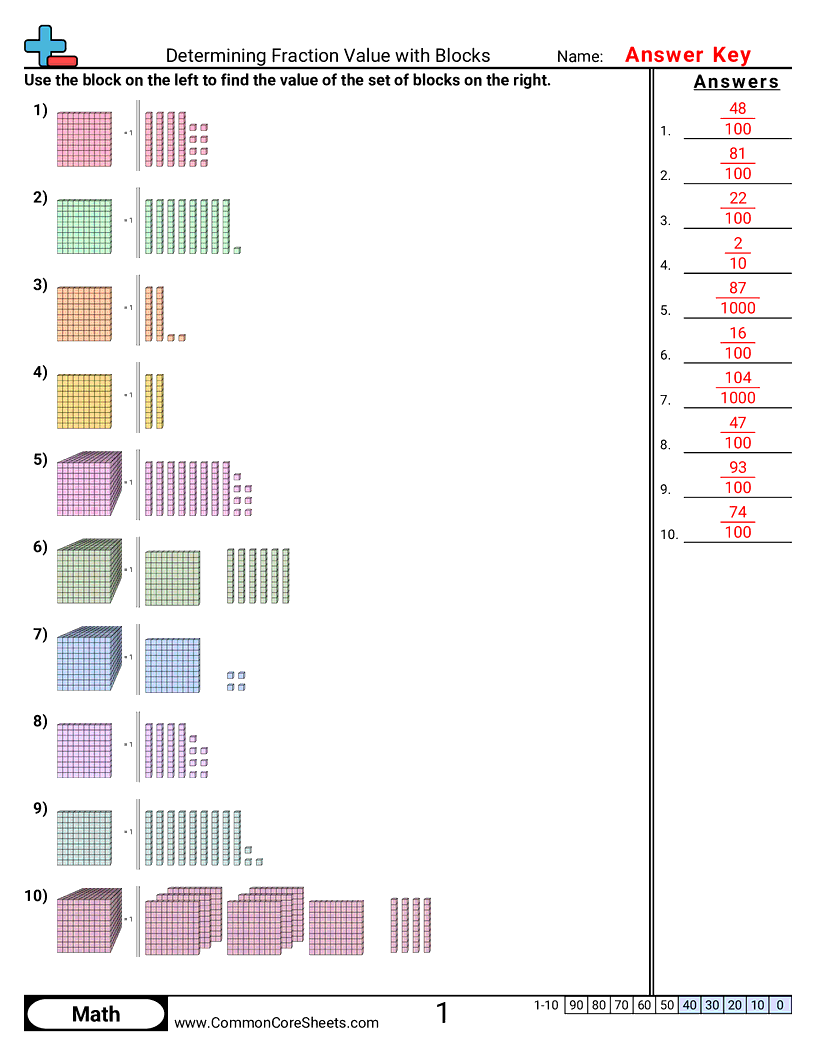
The block that counts as one whole CHANGES from problem to problem - sometimes the large cube, sometimes the flat - so a flat is worth one tenth on one problem and one whole on the next. That is the point: nothing on the page has a fixed value until the whole is named. The denominator comes from the smallest block shown, so three rods and seven units against a flat is 37/100, while four rods on their own is 4/10. Fractions are left unreduced, because counting the parts out of the whole is what the model shows. Sheet 234 is the same picture with the answer written as a decimal.


Sheet Information >
Determining Fraction Value with Blocks
One base ten block is named as the whole, and students write the value of the set of blocks beside it as a fraction.
About this worksheet
One base ten block is named as the whole, and students write the value of the set of blocks beside it as a fraction.
Student objectives
- Work out what each base ten block is worth once one of them is named the whole
- Write the value of a set of blocks as a fraction
- Use a denominator of tenths, hundredths or thousandths depending on the smallest block shown
- See how the same block changes value when a different block is the whole
Everyday practice
- Work out what one rod is worth when the flat is called one whole
- Describe part of a set when the size of the whole changes
- Name a measurement as a fraction of a meter
- Read a scale where the size of one unit is given to you