Cranberries: Berries That Bounce Worksheet Download
Free reading comprehension worksheet about how cranberries grow and are harvested. Pick the reading level (kindergarten to 8th grade), print the passage with its questions, or assign it online.


Sheet Information >
Available at kindergarten, 1st grade, 2nd grade, 3rd grade, 4th grade, 5th grade, 6th grade, 7th grade and 8th grade reading levels.
Read the passage
Look at all those red berries floating on the water! These are cranberries. They grow on low vines in sandy beds called bogs.
In fall most farmers fill the bog with water to pick the berries. Did you know each berry has tiny air pockets inside? The air makes the berries float like red balloons!
Floating is not all a cranberry can do. Good ones bounce like tiny red balls! Long ago growers sorted berries by letting them bounce down boards.
Can you guess which berry loves to bounce like a ball? It is the cranberry, a tart, or sour, berry, and good ones bounce! Cranberries grow on low vines in wet, sandy beds called bogs.
In fall, most farmers flood those bogs with water. Each berry has little air pockets inside, so it floats! Soon the bog looks like a big red blanket!
Workers gather up that red blanket of berries and pump them out. Wisconsin grows more cranberries than any other state. So a bouncing, floating berry can become wobbly sauce in a can!
Wow, a berry that bounces like a tiny rubber ball! It's the cranberry, and it grows on low, trailing vines in sandy beds called bogs. Wisconsin grows the most cranberries of any state, and in fall its bogs turn bright red.
All that red is easy to gather because cranberries float! Each berry has little air pockets inside, like tiny bubbles, so growers flood the bog and the berries bob to the top. Picture a whole field turned into a red pond!
A red pond can't stay put, so workers corral the berries, which means they gather them into one group. Long floating booms push the berries close, and a pump carries them out of the water. Berries sold fresh in stores are picked dry instead, with no flooding at all.
Fresh or flooded, a good cranberry has one more trick: it bounces! Long ago, growers sorted berries by letting them bounce down boards, and firm ones bounced best. Even the tart, or sour, jelly sauce that keeps the can's ridges began as a bouncy, floating berry.
Imagine you are beside a bog on a crisp autumn morning, where red berries cover the water like a blanket! Those are cranberries, small, round fruits with a tart, mouth-puckering taste. They grow on low, trailing vines in sandy beds called bogs, and Wisconsin grows more of them than any other state. You can also find bogs in Massachusetts, New Jersey, Oregon, Washington, and Canada.
In those places, most growers use a splashy trick at harvest time: they flood the bog with water. A machine shakes the berries off the vines, and because each berry has tiny air pockets inside, it bobs to the top. Growers corral, or gather up, the floating berries and pump them out, which is called a wet harvest, while berries sold fresh are picked dry.
Berries sold fresh need to be firm, so how can growers tell a good one? Easy: a good one bounces! Long ago, growers sorted them by letting berries bounce down a set of wooden boards. The firm ones bounced on down, while the soft ones stopped short.
After all that floating and bouncing, cranberries head to kitchens, where many families serve them as sauce. Because the berries are so tart, cooks usually stir in sugar. Some sauce comes in a can as a jelly, and when it slides out, it keeps the ridges of the can! Those ridges once belonged to red berries that floated in a bog and bounced.
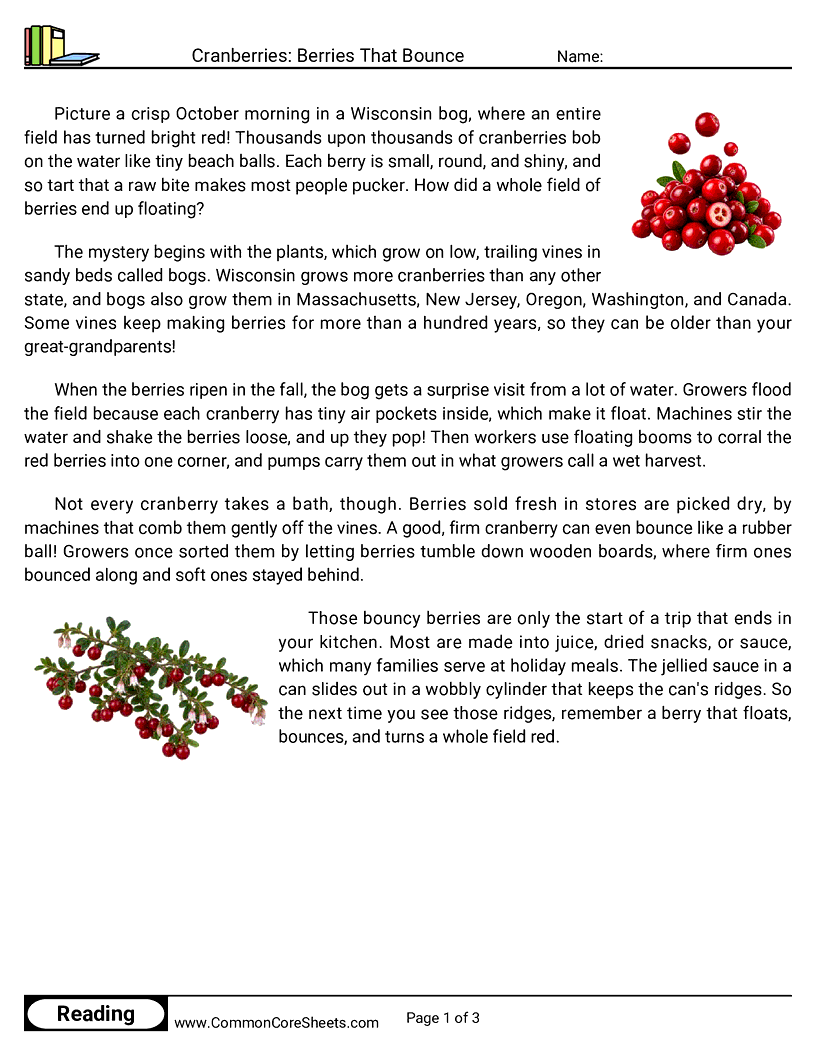
Picture a crisp October morning in a Wisconsin bog, where an entire field has turned bright red! Thousands upon thousands of cranberries bob on the water like tiny beach balls. Each berry is small, round, and shiny, and so tart that a raw bite makes most people pucker. How did a whole field of berries end up floating?
The mystery begins with the plants, which grow on low, trailing vines in sandy beds called bogs. Wisconsin grows more cranberries than any other state, and bogs also grow them in Massachusetts, New Jersey, Oregon, Washington, and Canada. Some vines keep making berries for more than a hundred years, so they can be older than your great-grandparents!
When the berries ripen in the fall, the bog gets a surprise visit from a lot of water. Growers flood the field because each cranberry has tiny air pockets inside, which make it float. Machines stir the water and shake the berries loose, and up they pop! Then workers use floating booms to corral the red berries into one corner, and pumps carry them out in what growers call a wet harvest.
Not every cranberry takes a bath, though. Berries sold fresh in stores are picked dry, by machines that comb them gently off the vines. A good, firm cranberry can even bounce like a rubber ball! Growers once sorted them by letting berries tumble down wooden boards, where firm ones bounced along and soft ones stayed behind.
Those bouncy berries are only the start of a trip that ends in your kitchen. Most are made into juice, dried snacks, or sauce, which many families serve at holiday meals. The jellied sauce in a can slides out in a wobbly cylinder that keeps the can's ridges. So the next time you see those ridges, remember a berry that floats, bounces, and turns a whole field red.
What floats like a bobber, bounces like a rubber ball, and turns a farm field into a red lake? It's the cranberry, a shiny berry so tart that it makes your mouth pucker. In autumn, workers in waders stand in bogs among thousands of red berries bobbing on the water. To crack the case, you need three clues: where the berries grow, how they are picked, and what hides inside.
The first clue is the place: sandy beds called bogs in Wisconsin (the state that grows the most), Massachusetts, New Jersey, Oregon, Washington and parts of Canada. Cranberries grow on low, trailing vines that creep along the ground like a leafy carpet. Some bogs still hold vines more than a hundred years old, older than almost everyone alive! When fall turns the berries deep red, growers do something that seems backward: they flood the field.
That backward trick is a wet harvest: growers fill the bog with water until the vines are covered. A machine churns the water and shakes the berries loose, and up they pop, because each one has tiny air pockets inside. Soon the surface is a thick red blanket, and workers use floating booms to corral the berries, a bit like cowhands herding cattle. Pumps then move the berries into waiting trucks, though berries sold fresh are picked dry instead.
Once the berries are loaded on trucks, their air pockets still have one more trick: they make good berries bounce. A firm, healthy cranberry hops like a tiny rubber ball, while a soft one lands with a thud. Long ago, growers sorted berries by tumbling them down wooden boards, where firm ones bounced over a barrier and soft ones stayed behind. Today machines do much of the sorting, but one clue, the air inside, still explains both floating and bouncing.
The berries that pass the bounce test head off to become juice, dried fruit and, for many families, sauce. Raw cranberries are so tart that cooks add sugar, and the berries pop open as they simmer. Some people stir up sauce at home, while others love the jellied kind from a can, which slides out in a wobbly cylinder that keeps the can's ridges. So when you see those ridges, remember that the berries behind them once bobbed in a red bog, held up by tiny pockets of air.
Think of a cranberry bog, and you probably picture berries growing underwater, like water lilies in a pond. Surprise: they don't! Cranberries grow on low, trailing vines that creep across sandy beds like a tangled green carpet, and each glossy berry is so tart that one raw bite makes your lips pucker. Those beds are called bogs, and you can find them in Wisconsin, which grows more cranberries than any other state, as well as in Massachusetts, New Jersey, Oregon, Washington, and Canada. So why do photographs show bogs glowing like ruby-red lakes?
The answer is a trick called the wet harvest, and it begins when growers flood a bog that has stayed dry all growing season. Special machines churn through the water and knock the berries off the vines. Up they pop, because each berry has tiny pockets of air inside, like a built-in life jacket. Growers then sweep long floating barriers, called booms, across the surface to corral the red crowd into one corner, where pumps lift the berries out and into trucks. Berries sold fresh in stores skip the swim and are picked dry.
Those same air pockets explain another odd talent: a fresh, healthy cranberry bounces like a tiny rubber ball. Can you imagine judging fruit by its hop? Growers once did exactly that, letting berries bounce down a slanted set of boards with low barriers across them. Firm, good berries hopped over the barriers and kept going, while soft or spoiled ones thudded and stayed behind. Machines do much of the sorting today, but the lesson of the bounce test still holds: a firm berry is a berry worth keeping.
Once the best berries are chosen, they head toward a taste few fruits can match: sharp, sour, and bold. Cranberries are naturally low in sugar and high in tart acids, so cooks usually sweeten them before they reach a plate. Many families serve cranberry sauce at holiday meals, sometimes with whole berries that burst open as they simmer. Others prefer the jellied kind, which slides from the can in a wobbly cylinder that still wears the can's ridges like stripes. I think that ridged little log is proof that even a plain tin can carries a bit of the bog inside.
A can on a pantry shelf may look ordinary, but the place it came from matters more than you might guess. Bogs are a kind of wetland, and wetlands soak up rainwater and shelter frogs, turtles, and birds. Cranberry vines are perennials, which means growers do not replant them every year, and some beds have kept producing for more than a century. To me, that makes cranberry farming less like a yearly race and more like a long friendship with a plant. So the next time you see a glowing red lake of berries, remember that every one of them is floating thanks to its own tiny pockets of air.
Picture a farm field that looks like a giant red blanket spread across a pond, with berries bobbing together like beads in a bathtub. That glowing scene is a cranberry harvest, and it surprises almost everyone who sees it for the first time. Here is the twist: cranberries do not grow in a pond at all. They grow on low, trailing vines in sandy beds called bogs, and the flooding comes only at special times. According to the U.S. Department of Agriculture, Wisconsin grows more cranberries than any other state, but Massachusetts, New Jersey, Oregon, Washington and Canada have bogs too.
Water is a grower's best tool, so a bog is built more like a bathtub than an ordinary field. Low walls called dikes surround each bed so it can be flooded and drained whenever needed. The vines prefer sandy, acidic soil and sprawl along the ground, sending up short shoots that carry the flowers and later the berries. These plants are long-lived, too: a well-tended bed can produce for many decades, and some beds are over a century old. In winter, growers may even flood a bed so a layer of ice shields the vines from harsh cold.
By autumn, cool nights have deepened the berries to a rich red, which is the signal to flood the bog again, this time for harvest. Here the berries' secret matters: each holds small pockets of air, so once it is knocked loose, it rises and floats like a tiny life jacket. Machines with rotating beaters churn through the water and shake the berries free. Then workers use floating booms to corral the crop into one corner, much as a sheepdog herds a flock, and pumps lift it out. It is teamwork between a machine and a bit of physics, with the water doing much of the heavy lifting.
Not every berry gets a bath, though. Cranberries sold fresh in stores are picked dry, because berries gathered from water do not keep as long. For that job, machines with teeth comb the berries off the vines, and the fruit never touches a flooded bed. Fresh berries make up only a small share of the harvest; most become juice, dried fruit and sauce. Either way, growers must tell a firm, healthy berry from a soft, tired one.
Luckily, cranberries come with a built-in quality test: a good berry bounces. Growers once sorted berries by letting them bounce down a set of boards with low barriers, so firm, fresh berries hopped over and soft ones stayed behind. The test works because a bruised or softening berry loses its spring, and the firm flesh and trapped air that help a berry float also help it bounce. But passing the bounce test only earns a berry a trip to the kitchen, where its biggest surprise waits.
Bite into a raw one and your face will explain why cranberries need help from the kitchen: they are puckeringly tart. Cooks usually simmer them with sugar and water until the berries burst and thicken into sauce, thanks to a natural thickener called pectin. Many families like cranberry sauce on the table in autumn, and some prefer the jellied kind that slides from a can with the can's ridges still printed on its sides. Those ridges are a kind of fingerprint, showing the sauce set into the exact shape of its container. So a berry with built-in air pockets can float across a flooded field, hop over a board, and finally wobble onto a plate wearing the ridges of a can.
In the early 1900s, a Massachusetts lawyer named Marcus Urann bought a cranberry bog and then had an idea that would long outlast him: cook the berries into sauce and seal it in cans. Fresh cranberries were mostly a short autumn crop, and Urann wanted them on tables in every season. His canned sauce is only the last chapter of the story, though, because the berry itself is the real puzzle. A cranberry is a small, glossy, bright red fruit that grows on a low vine, and it is so tart that almost nobody enjoys it raw. Yet it floats, it bounces, and on harvest day a whole field of them can turn into a scarlet lake.
That scarlet lake only happens because of where cranberries grow: sandy beds called bogs, built so they can be flooded and drained again. The berries hang from low, trailing vines that creep along the ground like a living carpet, and because the vines are perennials, they return every year. Some beds in Massachusetts hold vines that have kept producing for well over a century, so those plants were growing before your great-grandparents were born. Wisconsin grows more cranberries than any other state, more than half of the U.S. crop according to the U.S. Department of Agriculture, while Massachusetts, New Jersey, Oregon, and Washington add their share and Canada grows a large crop too. In winter, growers may even flood a bed on purpose so a layer of ice can shield the vines from harsh cold.
Water, it turns out, helps growers on harvest day just as it does in winter. In a wet harvest, a bed is flooded with a foot or more of water, and machines churn through it, shaking the berries loose from their vines. Because each berry contains tiny air pockets, the freed fruit bobs to the surface as if a little life jacket had been sewn into every one. Workers then use floating booms to corral the red berries into a smaller and smaller patch, and pumps lift them out of the water. From above, the berries look like a crimson blanket spread across the bed, and a single bog can hold millions of them.
Beautiful as that blanket is, it is not the only way to bring in a crop, and the choice changes what ends up in a store. Berries sold fresh are picked dry, when machines comb them off the vines and into a bag, because fresh fruit has to stay unbruised. Berries bound for juice, dried fruit, or sauce can handle a wet harvest, which is how most of the crop is gathered. In other words, neither method is simply better; each one fits the job the berry will do. Only a small share is sold fresh, and even those berries must be firm enough to earn a spot in the bag.
Firmness, it turns out, can be tested by bouncing, and for years growers sorted berries by letting them hop down a set of boards. Low barriers were set across the boards, so a firm berry could hop over each one while a soft berry thudded to a stop and dropped out of the race. The physics is simple: a sound berry with air trapped inside springs back like a rubber ball, while a damaged one soaks up the impact. Can you imagine a job where the quality test is whether your product bounces? For growers, it was a fast way to sort huge numbers of berries without cutting a single one open.
Once the berries are sorted, they still face the toughest judge of all: your tongue. A cranberry is high in natural acids and low in sugar, so cooks nearly always sweeten it, whether they are simmering sauce or stirring up juice. Even its name has been explained more than one way: it began as 'craneberry,' and some say the drooping pink blossom looked like a crane's head, while others say cranes ate the berries. The most famous result may be the jellied sauce that slides from a can in one wobbly cylinder, still wearing every ridge of the metal. A fruit that floats through a flood and bounces down boards ends up on the table with the ridges of a can printed on its sides, which may be the funniest finish to any harvest.
About this worksheet
Students read a nonfiction passage about how cranberries grow and are harvested, written at 9 reading levels (kindergarten to 8th grade), and answer multiple-choice questions about it.
A reading comprehension worksheet about how cranberries grow and are harvested with a different article for each reading level, kindergarten to 8th grade, each with its own multiple-choice questions aligned to the Common Core Reading: Informational Text standards. Printable with an answer key, and available as an online assignment at any level.
Student objectives
- Read a nonfiction passage and explain why cranberries float during a wet harvest.
- Find details in the text that tell how fresh cranberries are picked.
- Explain the meaning of the word corral using clues from the sentence.
- Identify the main idea of a paragraph and the details that support it.
Everyday practice
- Drop a fresh cranberry into a bowl of water at home or in a grocery store sink and watch it float, then see if a firm one bounces on a table.
- Look at a can of jellied cranberry sauce, if your family has one, and find the ridges that the sauce keeps.
- Check the labels on juice or dried fruit and see if cranberries are listed.