Common Wasps Worksheet Download
Free reading worksheets on Common Wasps. Each worksheet has 20 problems with an answer key and are ideal for teachers and homeschooling. You can download the PDF, create a set of flash cards or set it up for online learning.


Sheet Information >
Available at 2nd grade, 3rd grade, 4th grade, 5th grade and 6th grade reading levels.
Read the passage
Common wasps are fascinating little creatures that you might have seen buzzing around your garden. They are yellow and black in color, about 1-2 centimeters long, and have a unique, narrow waist. These wasps live in nests made of paper-like material, which they build in trees, bushes, or even your attic!
Now let's talk about what wasps eat and their life cycle. Wasps love to munch on other insects, like caterpillars and flies, making them helpful to humans by controlling pest populations. Their life cycle starts as an egg, then they grow into a larva, become a pupa, and finally emerge as an adult wasp.
Lastly, let's learn about their relationship to other insects, their defenses, and some interesting facts. Wasps have a stinger to defend themselves, and they can sting multiple times, unlike their cousin, the honeybee. One interesting fact is that only female wasps have stingers, which are actually a modified egg-laying organ called an ovipositor.
Hey there, have you ever wondered about the world of wasps? Common wasps are interesting insects that you might have seen buzzing around in the summer. They have yellow and black stripes and are usually about 1-2 cm long. Wasps are known for their stingers, but they also play an important role in nature.
Let's learn about what wasps eat and where they live. Wasps love to eat insects like flies and spiders, which helps to control the population of these bugs. They also enjoy sweet things like fruit and nectar, which they get from flowers. Wasps live in nests that they build from wood and saliva, which they usually create in trees or the eaves of buildings.
Now, let's explore the life cycle of wasps and their relationship with humans and other insects. Wasps have four stages in their life cycle: egg, larva, pupa, and adult. While they can sometimes be a nuisance to humans with their stings, wasps are also helpful by pollinating plants and controlling pests. In fact, some wasps even have a special relationship with certain plants and will only pollinate that specific plant.
So, the next time you see a wasp buzzing around, remember that they are not just scary insects with stingers, but also important helpers in our environment.
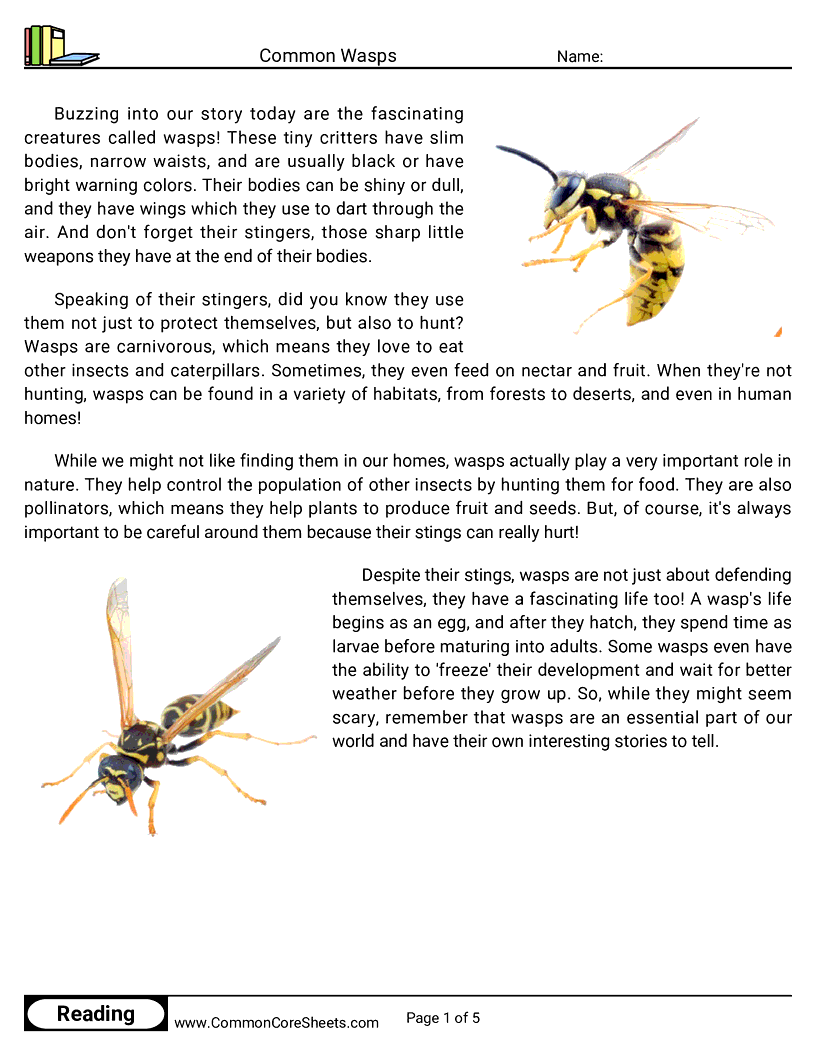
Buzzing into our story today are the fascinating creatures called wasps! These tiny critters have slim bodies, narrow waists, and are usually black or have bright warning colors. Their bodies can be shiny or dull, and they have wings which they use to dart through the air. And don't forget their stingers, those sharp little weapons they have at the end of their bodies.
Speaking of their stingers, did you know they use them not just to protect themselves, but also to hunt? Wasps are carnivorous, which means they love to eat other insects and caterpillars. Sometimes, they even feed on nectar and fruit. When they're not hunting, wasps can be found in a variety of habitats, from forests to deserts, and even in human homes!
While we might not like finding them in our homes, wasps actually play a very important role in nature. They help control the population of other insects by hunting them for food. They are also pollinators, which means they help plants to produce fruit and seeds. But, of course, it's always important to be careful around them because their stings can really hurt!
Despite their stings, wasps are not just about defending themselves, they have a fascinating life too! A wasp's life begins as an egg, and after they hatch, they spend time as larvae before maturing into adults. Some wasps even have the ability to 'freeze' their development and wait for better weather before they grow up. So, while they might seem scary, remember that wasps are an essential part of our world and have their own interesting stories to tell.
Meet the common wasp, a fascinating little creature that you've probably seen buzzing around your garden. These insects have distinctive yellow and black stripes, and they belong to the Vespidae family. There are thousands of species of wasps, but the common wasp is one you're most likely to encounter. Let's dive into their world and learn more about their behavior, life cycle, and relationships with other creatures.
First, let's talk about what wasps like to eat. They have a diverse diet and are known to be carnivorous and nectar-loving insects. Wasps consume a variety of insects, including flies and caterpillars, which helps control the population of these insects. In addition, they also enjoy sugary substances like nectar from flowers and juice from fruits.
Now, let's explore where these buzzing creatures live. Common wasps build nests made of chewed wood and saliva, which gives them a papery appearance. These nests can be found in various locations, such as trees, bushes, and even underground. In many cases, they prefer to build their nests in sheltered areas like eaves or attics.
Understanding the life cycle of wasps is essential in knowing how they grow and change. Their life cycle has four main stages: egg, larva, pupa, and adult. The queen, who is the only fertile female, starts the colony by laying eggs, which then hatch into larvae, pupate, and eventually become adult worker wasps or new queens. At the end of the season, only the newly mated queens survive to start a new colony the following year.
Lastly, let's discuss the relationship wasps have with humans and other insects. While wasps are often seen as pests, they do play a vital role in controlling insect populations and pollinating plants. Their defense mechanism, which includes stinging, is used to protect themselves and their nests. Despite their similarities, wasps differ from bees in various ways, such as having a slimmer body and being more aggressive.
Remember, while wasps might seem a little scary, they are an important part of our ecosystem. As you learn more about them, you'll discover how fascinating these tiny creatures truly are.
Let's dive into the world of common wasps, fascinating insects that are found all around us. These wasps, also known as Vespula vulgaris, are yellow and black in color and can be identified by their distinctive markings. Although they might seem a bit scary, understanding them can help us coexist peacefully. In this article, we'll explore their diet, habitat, life cycle, and their relationship with humans and other insects. So, let's start by finding out what these wasps like to eat.
Common wasps are carnivorous insects, which means they eat other insects and small invertebrates. However, they also have a sweet tooth and love to feast on nectar from flowers, as well as sugary substances like fruit and human food. This dual diet helps them provide food for their larvae, which are fed with protein-rich insects. In turn, the larvae produce a sweet substance for the adult wasps to eat. Now, let's find out where these wasps call home.
Wasps are social insects and live in colonies with a queen, workers, and drones. They build their nests in various locations, such as trees, bushes, and even in or around our homes. These nests are made from chewed wood and saliva, creating a papery material that forms the hexagonal cells of the nest. The life cycle of a wasp begins as an egg, which then hatches into a larva, pupates into a pupa, and finally emerges as an adult wasp. With their living arrangements sorted, let's explore their relationships with humans and other insects.
Wasps play a crucial role in controlling insect populations, as they are natural predators to many pests. This benefits both humans and the environment, as they help maintain a balanced ecosystem. However, their presence can be a nuisance to humans, especially when they build their nests in our living spaces and are attracted to our food. Their stings can be painful and, in some cases, cause an allergic reaction. Despite this, it's essential to remember that wasps are a vital part of our world and should be treated with respect.
Lastly, let's compare common wasps to other wasp species and learn some interesting facts. There are thousands of wasp species, ranging from tiny parasitic wasps to large hornets. Common wasps can be distinguished from bees by their slender bodies, narrow waists, and lack of hair. Did you know that only female wasps can sting, as their stingers are modified egg-laying organs called ovipositors? In conclusion, understanding the world of common wasps can help us appreciate their importance and learn to coexist with these fascinating creatures.
About this worksheet
Students read an informational passage about common wasps and answer comprehension questions about their traits, behavior, and habitat.
This worksheet is designed to boost reading comprehension while exploring the fascinating world of wasps. Featuring 20 reading problems, it covers aspects like wasp anatomy, habitat, diet, lifecycle, and their ecological role, with an emphasis on stimulation and interactivity. It's fully customizable, ideal for converting into flashcards or employing in distance learning environments, essentially turning lessons into a fun, engaging learning experience.
Student objectives
- Read an informational text about wasps and understand the main ideas
- Find specific facts about how wasps look, live, and behave
- Answer questions using details from what you read
- Learn new vocabulary related to wasps and insects
Everyday practice
- Understand a fact you read in a nature book or magazine about insects
- Explain to a friend what makes a wasp different from a bee
- Recognize a wasp and know what to do when you see one outside
- Talk about a wasp nest you spotted in your yard or neighborhood