Choosing an Equivalent Expression (Decimals and Fractions) Worksheet Download
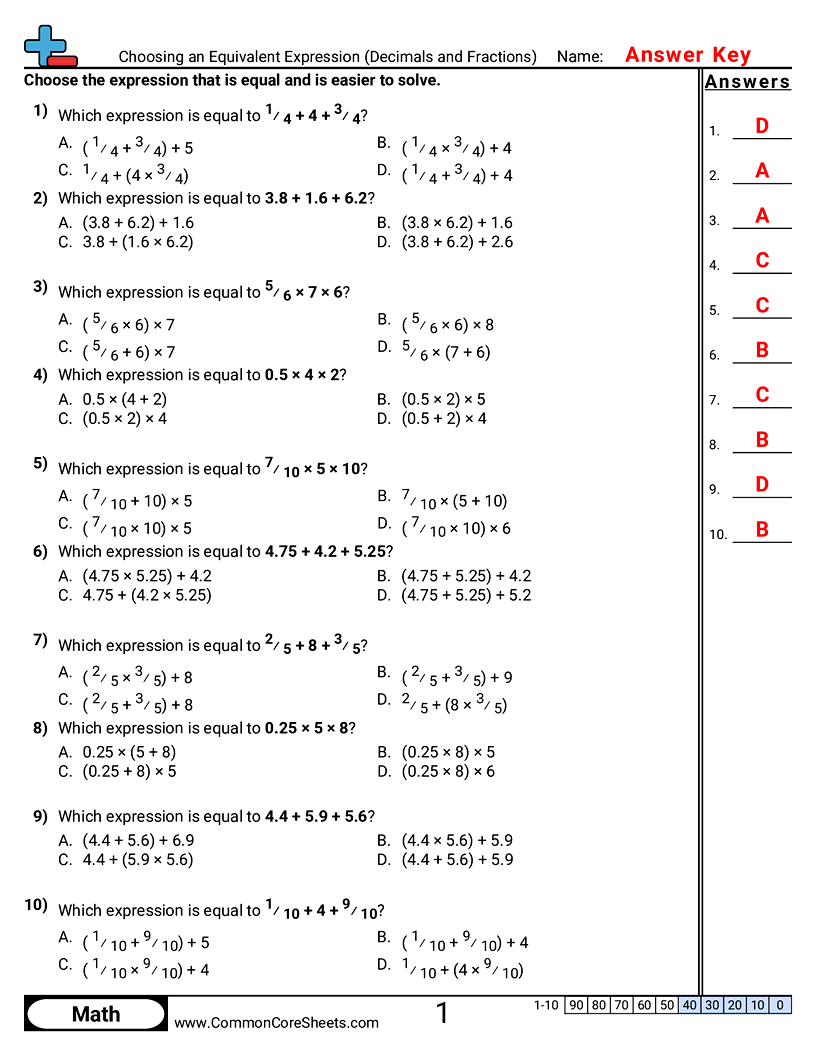
Free 6th Grade math worksheets on Choosing an Equivalent Expression (Decimals and Fractions). Each worksheet has 10 problems with an answer key and are ideal for teachers and homeschooling. You can download the PDF, create a set of flash cards or set it up for online learning.


Sheet Information >
About this worksheet
Each worksheet has 10 problems choosing the rearrangement of a sum or product that is easier to solve.
The property worksheets on this site name a property or fill in a missing digit, and the one that uses one is multiplication in whole numbers. The pairs worth spotting once the numbers are rational are 0.25 and 4, or one third and 3, or 4.75 and 5.25 - and reordering an addition so the two decimals making ten sit together has no worksheet here at any grade. The pair is always split apart in the printed expression, so a rearrangement has to actually happen, and every wrong answer is checked against the original in exact arithmetic so no problem has two right answers. Sheets can be customized, turned into flash cards, or assigned for online learning.
Student objectives
- Reorder a sum so the two values making a whole sit together.
- Regroup a product so the round pair is multiplied first.
- Tell a legal rearrangement from one that changes an operation.
Everyday practice
- Look for two numbers that add to a whole before adding a list.
- Spot the pair that multiplies to one or ten.
- Say why moving numbers around does not change a sum.