Chinese Alligator Worksheet Download
Free reading worksheets on Chinese Alligator. Each worksheet has 20 problems with an answer key and are ideal for teachers and homeschooling. You can download the PDF, create a set of flash cards or set it up for online learning.
Select a Different Activity
>


Sheet Information >
Available at 2nd grade, 3rd grade, 4th grade, 5th grade and 6th grade reading levels.
Read the passage
Hey kids! Let\'s learn about the Chinese alligator, a small and unique reptile. These cool creatures can be found living in the wetlands and freshwater areas of eastern China. They have a dark, bumpy skin, and are smaller than other alligator species, usually growing up to 5 feet long.
The Chinese alligator has a very interesting life cycle and diet. They start as eggs, which the female alligator lays in a nest she builds out of plants. As they grow, Chinese alligators eat fish, snails, and even small mammals!
Now, let\'s talk about their relationship with humans and other animals. In the wild, Chinese alligators are shy and try to avoid humans, but they are also known to be friendly when they live in zoos. Their strong jaws and sharp teeth help protect them from other animals, but sadly, they are now an endangered species due to habitat loss and hunting.
Hey there, have you ever heard of the Chinese alligator? It\'s a fascinating reptile that lives in China, and it\'s one of the only two alligator species in the world! These cool creatures have dark green or black skin and usually grow to be about 5 feet long. Unlike some other reptiles, Chinese alligators are quite social and like to live in groups called congregations.
Now let\'s talk about their life cycle and what they like to eat. Chinese alligators begin their lives as tiny eggs that hatch into cute little babies after about 70 days. As they grow older, they start munching on fish, snails, and sometimes even small mammals! They have a special relationship with humans, as they\'re considered a symbol of good luck in Chinese culture, but sadly, their habitats are being destroyed by people.
Chinese alligators have some amazing defenses and unique differences from other species. For example, they have a special bony plate called an osteoderm that protects their skin. Compared to the American alligator, Chinese alligators are smaller and less aggressive. One interesting fact is that they can survive cold winters by digging burrows to hibernate in, which is something not all reptiles can do.
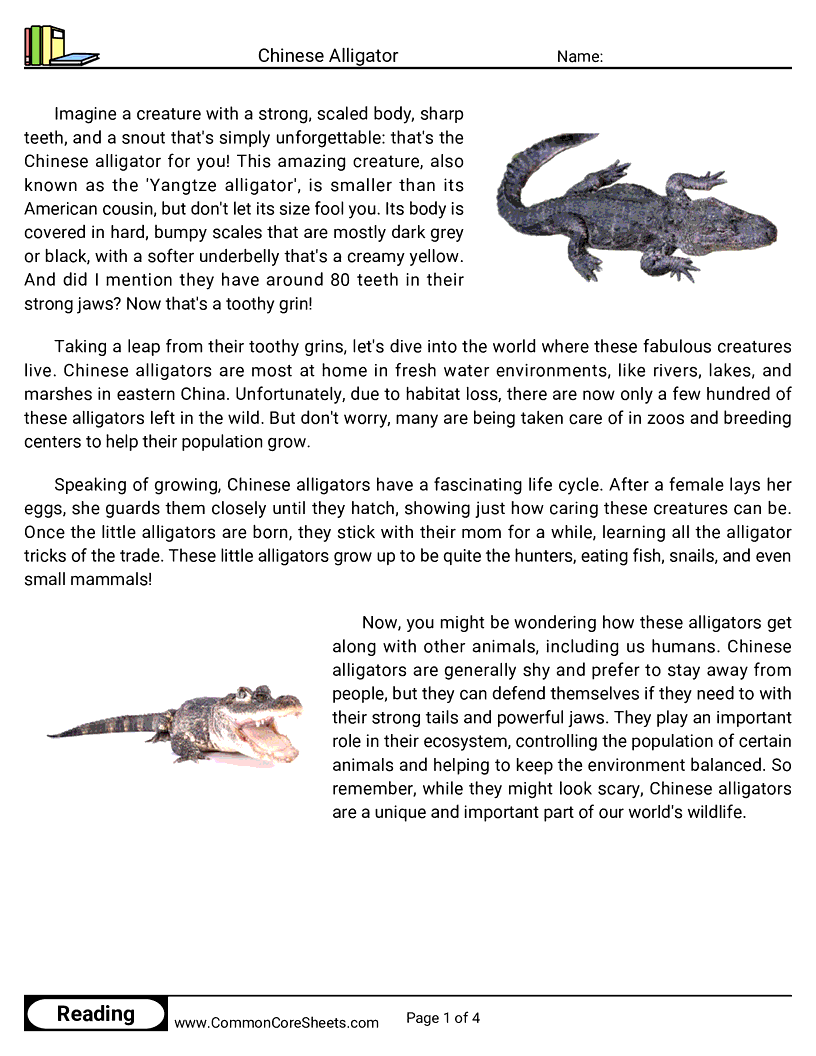
Imagine a creature with a strong, scaled body, sharp teeth, and a snout that's simply unforgettable: that's the Chinese alligator for you! This amazing creature, also known as the 'Yangtze alligator', is smaller than its American cousin, but don't let its size fool you. Its body is covered in hard, bumpy scales that are mostly dark grey or black, with a softer underbelly that's a creamy yellow. And did I mention they have around 80 teeth in their strong jaws? Now that's a toothy grin!
Taking a leap from their toothy grins, let's dive into the world where these fabulous creatures live. Chinese alligators are most at home in fresh water environments, like rivers, lakes, and marshes in eastern China. Unfortunately, due to habitat loss, there are now only a few hundred of these alligators left in the wild. But don't worry, many are being taken care of in zoos and breeding centers to help their population grow.
Speaking of growing, Chinese alligators have a fascinating life cycle. After a female lays her eggs, she guards them closely until they hatch, showing just how caring these creatures can be. Once the little alligators are born, they stick with their mom for a while, learning all the alligator tricks of the trade. These little alligators grow up to be quite the hunters, eating fish, snails, and even small mammals!
Now, you might be wondering how these alligators get along with other animals, including us humans. Chinese alligators are generally shy and prefer to stay away from people, but they can defend themselves if they need to with their strong tails and powerful jaws. They play an important role in their ecosystem, controlling the population of certain animals and helping to keep the environment balanced. So remember, while they might look scary, Chinese alligators are a unique and important part of our world's wildlife.
Let\'s learn about the fascinating Chinese alligator, a unique reptile species found in China! These alligators have a distinct look, with a shorter, more rounded snout and a fully armored body. They can grow up to 2 meters (6.5 feet) long and are usually dark gray or black in color. Their small size and unique features make them different from their larger cousin, the American alligator.
Chinese alligators thrive in freshwater habitats, such as rivers, lakes, and swamps. They are native to the Yangtze River basin in eastern China. Sadly, their population has declined due to habitat loss and human activity, making them critically endangered. Conservation efforts are now underway to protect these amazing creatures and their habitats.
These alligators are carnivorous, which means they eat meat. Their diet mainly consists of fish, snails, mussels, and other small aquatic animals. Occasionally, they might snatch a small mammal or bird that comes too close to the water\'s edge. Their sharp teeth and strong jaws help them catch and eat their prey.
The life cycle of a Chinese alligator begins when a female lays her eggs. She will carefully build a nest out of vegetation near the water and lay around 20 to 40 eggs. After about 70 days, the baby alligators hatch and are fiercely protected by their mother. These little alligators will grow and learn to hunt for themselves, eventually reaching adulthood and starting the cycle anew.
Chinese alligators have a complex relationship with both humans and other animals. People in China have historically considered these alligators as a symbol of good fortune and prosperity. However, they are sometimes seen as a threat to local fishing industries, leading to conflicts. In the wild, Chinese alligators have few natural predators, and their strong armor and powerful bite help them defend themselves.
In conclusion, Chinese alligators are fascinating reptiles with unique characteristics that set them apart from other species. Their life cycle, diet, and relationship with humans make them an interesting subject for young learners. As we continue to learn more about them, it\'s important to remember the role we play in protecting these incredible creatures and their habitats for future generations to enjoy.
Hey there, have you ever heard of the Chinese Alligator? This fascinating creature is one of only two alligator species in the world and is native to China. They can grow up to 6.5 feet long and have dark green or black scales to help them blend into their environment. Sadly, the Chinese Alligator is considered critically endangered, which means there aren\'t many of them left in the wild. However, there\'s still a lot to learn about these incredible reptiles.
First, let\'s take a look at the diet of the Chinese Alligator. These carnivorous creatures primarily eat fish, snails, and clams found in their watery habitats. Occasionally, they will also eat small mammals like rats or even water birds if given the chance. The Chinese Alligator has a powerful jaw filled with sharp teeth, perfect for crushing hard shells of their prey. Just like other reptiles, they swallow their food whole, so they need strong stomach acids to help digest their meals.
Now, let\'s explore the life cycle of the Chinese Alligator. In the summer, the female alligator will build a nest with vegetation and mud to lay her eggs. She will lay between 20 to 40 eggs and guard her nest fiercely to protect her young from predators. After about 70 days, the baby alligators will hatch, making high-pitched noises to alert their mother. The mother will then help her babies reach water, where they will grow and learn to hunt for themselves.
Chinese Alligators have a unique relationship with humans. In the past, they were often seen as a threat to people and their livestock, resulting in them being hunted. Nowadays, conservation efforts are in place to help protect the remaining population. Chinese Alligators also play an essential role in their ecosystems by controlling populations of other animals. In fact, some ancient Chinese myths even feature alligators as powerful and wise creatures.
Finally, let\'s discover some cool facts about the Chinese Alligator. One interesting fact is that they can survive the cold winters by burrowing deep into the mud and hibernating. They are also known to be less aggressive than their American counterparts, although they can still be dangerous if provoked. Chinese Alligators have an extra eyelid called a nictitating membrane, which helps them see underwater. The Chinese Alligator is truly a fascinating and unique creature that we should cherish and protect.
About this worksheet
Students read a passage about the Chinese alligator and answer comprehension questions about its habitat, appearance, and behavior.
This worksheet is designed to enhance children's reading and comprehension skills focused on the educational topic of the 'Chinese Alligator'. It comes with 20 interactive questions on the alligator's characteristics, habitat, and conservation status. It's versatile as it can be customized to suit the learner's needs, converted into flash cards for interactive learning, or be incorporated in distance learning environments to promote self-paced study.
Student objectives
- Read a nonfiction passage about the Chinese alligator
- Find facts and details in what you read
- Answer questions using information from the text
- Learn new words related to animals and habitats
Everyday practice
- Read an animal fact card at a zoo and tell a friend what you learned
- Look up information about an endangered animal for a school project
- Explain to a family member why an animal might be at risk of disappearing
- Pick out key details when reading a magazine article about wildlife