Canada's Thanksgiving Worksheet Download
Free reading comprehension worksheet about Thanksgiving in Canada. Pick the reading level (1st grade to 8th grade), print the passage with its questions, or assign it online.


Sheet Information >
Available at 1st grade, 2nd grade, 3rd grade, 4th grade, 5th grade, 6th grade, 7th grade and 8th grade reading levels.
Read the passage
Do you know when Canadians celebrate Thanksgiving each fall? It is on the second Monday in October! In the cool air, the leaves turn red, orange, and gold.
Cool air comes early up north, so the harvest does too. The harvest is the time when farmers pick their ripe crops. So Canada's Thanksgiving comes first, before the one in the United States!
Thanksgiving is always on a Monday, so families get a long weekend to enjoy fall. Many families share turkey, stuffing, mashed potatoes, and pumpkin pie. Some people watch football, and others take trips to see leaves.
Wow, Canada's Thanksgiving comes weeks before the one in the United States! In Canada, it lands on the second Monday of October, in the middle of autumn. Can you smell warm pumpkin pie drifting through the house?
Pumpkin pie is yummy, but why is Canada's holiday so early? Canada is farther north, so cold weather comes sooner and the harvest, when farmers gather ripe crops, ends earlier. In 1957, that date was made official, and it is a day off in most provinces, though not every one.
A Monday off makes a three-day weekend, with lots of time to cook. Many families eat turkey, stuffing (a tasty mix of bread and herbs), and mashed potatoes. Not every family has the same meal, and some hop in the car to see the colorful leaves.
After a leaf walk, some fans settle in to watch football. On Thanksgiving Day, the Canadian Football League plays two games in one day, called a doubleheader. Imagine eating pie, seeing red leaves, and cheering for two football games, all before November even begins!
Imagine you are sitting at a table in Canada on a crisp October afternoon, and the smell of roasting turkey drifts out of the kitchen. Outside, maple leaves glow red, orange, and yellow, like tiny flames on the trees. Many families enjoy turkey, stuffing, mashed potatoes, and pumpkin pie, all to say thanks for good things like food, family, and friends.
Those glowing leaves are a clue to why Canada's holiday comes in October. Thanksgiving there is a harvest holiday, and the harvest, when farmers gather ripe crops, comes earlier in the north because winter arrives sooner. So Canadians celebrate on the second Monday of October, more than a month before Thanksgiving in the United States. Canada made that date official in 1957.
Because the holiday always lands on a Monday, many people get a long weekend, which means three days off in a row. Families use the extra time to see the autumn colors, take woodland walks, or share a big meal. Others cheer for the Canadian Football League, which often plays a doubleheader, two games in one day, on Thanksgiving Monday.
Not everyone gets that Monday off, though. Thanksgiving is a public holiday, a day when many schools and offices close, in most provinces but not in every one. Families celebrate in many ways, and some choose foods other than turkey. Whatever is on the plate, Canadians say their thanks while the leaves still glow, weeks before Thanksgiving arrives in the United States.
Picture a country road in Ontario on a crisp October morning. Maple trees glow red, orange, and gold, and a car full of cousins rolls slowly past, everyone pointing at the leaves. They are headed to a Canadian Thanksgiving dinner, and a pie wrapped in a towel rides carefully in the trunk.
Those glowing leaves are a clue to when the holiday happens. Canadians celebrate Thanksgiving on the second Monday of October, a date that was fixed in 1957. That is more than a month earlier than in the United States, where it falls on the fourth Thursday of November. The reason is that much of Canada lies farther north, where cold weather arrives sooner and the harvest is ready earlier.
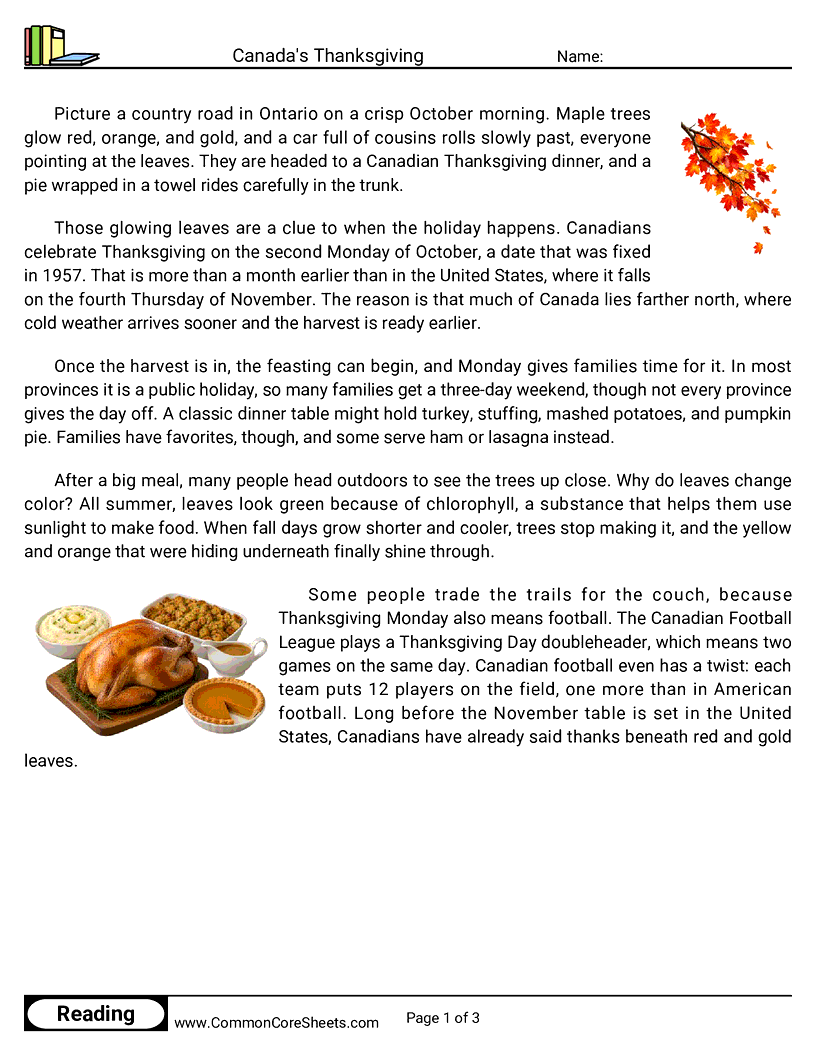
Once the harvest is in, the feasting can begin, and Monday gives families time for it. In most provinces it is a public holiday, so many families get a three-day weekend, though not every province gives the day off. A classic dinner table might hold turkey, stuffing, mashed potatoes, and pumpkin pie. Families have favorites, though, and some serve ham or lasagna instead.
After a big meal, many people head outdoors to see the trees up close. Why do leaves change color? All summer, leaves look green because of chlorophyll, a substance that helps them use sunlight to make food. When fall days grow shorter and cooler, trees stop making it, and the yellow and orange that were hiding underneath finally shine through.
Some people trade the trails for the couch, because Thanksgiving Monday also means football. The Canadian Football League plays a Thanksgiving Day doubleheader, which means two games on the same day. Canadian football even has a twist: each team puts 12 players on the field, one more than in American football. Long before the November table is set in the United States, Canadians have already said thanks beneath red and gold leaves.
Here is a calendar mystery: while kids in the United States are still picking out Halloween costumes, many families in Canada are already passing the mashed potatoes! Did someone mix up the calendar? Not at all. Canadians celebrate Thanksgiving on the second Monday of October, and the clue that solves the puzzle is hiding out in the fields.
Those fields lie far to the north, where summers are shorter and frost arrives sooner than in much of the United States. Crops there are ready to pick earlier, and farmers cannot wait around, because a hard freeze can end the growing season. That is the answer to the mystery: Canada's holiday lands in October because the harvest does. Until 1957 the date had moved around from year to year, but that year Canada fixed it for good as the second Monday in October.
Since that Monday is a day off for many people, Thanksgiving becomes a long weekend, and the kitchen gets busy. Many families sit down to turkey, stuffing, mashed potatoes, and pumpkin pie, though others cook different favorites or keep the day quiet. Pumpkin pie starts with a round squash that grows on a sprawling vine. Even the turkey has a wow fact: wild turkeys live only in North America, and they can fly short distances and sleep high up in trees!
After such a big meal, many people want to get outside and walk it off, and in October the woods put on a show. Leaves change color because shorter days make trees stop making green, which lets yellow and orange show through while some trees also make bright new reds. Many families take weekend road trips just to see forests glowing like campfires. Back indoors, football fans settle in, since the Canadian Football League often plays a doubleheader, which means two games in one day, on Thanksgiving Monday.
Football fans may cheer from the couch, but others spend the long weekend hiking, baking, or simply resting. In most provinces Thanksgiving is a public holiday, so many schools and offices close. In some eastern provinces, though, it is not a required day off for all workers, so the holiday looks a little different from place to place. Whatever a family does, the whole celebration traces back to one simple clue: a harvest that comes early in the north.
Some people think Canada's Thanksgiving is just the American holiday showing up a month too early. Not so! It has its own date, its own long weekend, and its own crisp October feeling. Picture a table crowded with golden turkey, fluffy stuffing, mashed potatoes, and pumpkin pie topped with a cloud of whipped cream. Outside the window, maple trees blaze red and orange like giant bonfires made of leaves. Many families gather for a meal like this, though others celebrate in quieter or different ways.
Whatever the menu, the celebration lands on the same day across the country: the second Monday of October. Canada's government settled on that date in 1957, and it has been the rule ever since. Why October? Up north, summers are shorter and winter arrives sooner, so crops ripen and fields are cleared earlier in the year. By the time a farmer is finishing the harvest, the air is already turning chilly. An early holiday, then, is really a well-timed one.
Perfectly timed, October is also when the trees put on their biggest show. Leaves look green because of chlorophyll, a pigment that helps them make food from sunlight. As the days get shorter and the air cools, the green fades, and the yellows and oranges that were hiding underneath finally get their turn. Many families use the long weekend to drive or hike through forests glowing with color. A walk down a crunchy, leaf-covered trail can feel like stepping inside a box of crayons.
Once everyone is back from the trail, many families settle onto the couch, because Thanksgiving Monday is also football day. The Canadian Football League usually plays two games that day, a doubleheader that lets fans watch one right after the other. Canadian football is a little different from the American kind: the field is longer and wider, and a team gets three downs instead of four. With fewer chances to move the ball, teams must gain ground quickly, so the action can really zoom. For many families, cheering at the TV while the turkey rests is as much a tradition as the pie.
Of course, not everyone is cheering at a screen, and not every family's Monday looks the same. Thanksgiving is a public holiday in most Canadian provinces, but not in every one, so some people still go to work. Even so, the idea behind the day is easy to share: stop, look around, and say thanks for the people and the food in your life. Many families also share food with neighbors or give to a food bank, so more tables can be full. That is the real surprise of Canada's Thanksgiving: it comes early not by mistake, but because up north, the harvest got there first.
Canadians can be scraping up the last bits of pumpkin pie at least five weeks before Thanksgiving dinner begins in the United States. Canada's Thanksgiving lands on the second Monday of October, which always falls between October 8 and October 14. Picture the scene: a golden turkey, fluffy mashed potatoes, and a pie still warm from the oven, while outside the maple trees blaze red and orange. The holiday fills a long weekend, so many families travel, cook, hike, or cheer for a football team. But why October, and why a Monday?
The answer to the first question begins in the fields, where Canadian farmers race the calendar every autumn. Farther north, the growing season is shorter, so the first frosts arrive earlier and crops such as pumpkins, potatoes, and corn have to be gathered sooner. By mid-October, many fields are already harvested, and the crisp air makes a hot meal feel like a reward. A harvest celebration in late November would seem oddly late where snow may already cover the farmland. In other words, the holiday follows the farm calendar, and the farm calendar follows the weather.
Of course, a date tied to the weather can wander, and before 1957 Canada's was not fixed on the calendar. That year, Parliament settled the matter by naming the second Monday in October, in a proclamation that gave thanks for the harvest. Choosing a Monday was a clever move, because it stretches the holiday into a three-day weekend for many people. Can a single decision really change how a holiday feels? It can: a loose tradition became a reliable ritual that families could plan around months ahead.
Once the weekend is on the calendar, planning turns to the menu, and for many families that means turkey. Wild turkeys live only in North America, and though they look clumsy, they can fly short distances and sleep high in trees at night. Beside the bird come stuffing, mashed potatoes, and pumpkin pie; a pumpkin is really a kind of squash that ripens on sprawling vines just in time for fall. Yet no two tables look alike: some families set out ham, lasagna, curry, or dumplings beside the turkey, and some skip the big meal entirely. The menu changes from house to house, but the spirit of the day, gratitude and time together, stays remarkably steady.
After a big meal, many families take a drive or a hike, because October has put on a show. As the days shorten, leaves stop making green chlorophyll, which lets the yellow and orange colors that were hiding underneath shine through. Sugar maples are famous for their fiery reds and oranges, and a red maple leaf sits at the center of Canada's flag. Back indoors, the Canadian Football League traditionally plays a Thanksgiving Day doubleheader, which means two games in one day. Canadian football has its own twists, such as three downs instead of four and twelve players per side instead of eleven.
Not everyone gets to settle onto the couch for those games, though, because the day off is not guaranteed everywhere. In most provinces Thanksgiving is a public holiday, but a few in Atlantic Canada do not count it as one, so some workplaces stay open. Many families there still celebrate, because a holiday lives in habits as much as in laws. That is the quiet lesson here: frost shaped the date, Parliament fixed it, and families filled it with food, color, and games. The result is a holiday that can never arrive before October 8 or after October 14, a seven-day window shaped by the rhythm of the harvest.
In 1957, Canada's Parliament issued what reads like a country-sized thank-you note. It called for a day of thanksgiving for the bountiful harvest and pinned it to the second Monday of October, where it has stayed ever since. Picture that Monday: a kitchen window fogged with steam, a turkey resting under foil, bowls of mashed potatoes and stuffing, and a pumpkin pie cooling on the counter. Outside, maple trees blaze orange and red, and a football game murmurs from the living room. Meanwhile, Americans are still weeks away from their own turkey dinner, which makes you wonder why Canada's feast arrives so early.
The classic answer is geography, because Canada's farms lie farther north, where summers run shorter and frost arrives sooner. By early October, many fields have been harvested, so a mid-October celebration of the harvest feels natural. How big is the gap? The second Monday of October always lands between October 8 and 14, while the fourth Thursday of November, the day Americans gather, falls between November 22 and 28. That puts the two holidays roughly six weeks apart. Still, a careful reader should ask whether climate explains everything, since weather cannot pick a particular Monday.
Weather may not pick a Monday, but lawmakers can, and that is where the argument gets interesting. For decades before 1957, the date shifted from year to year and sometimes landed in November, which suggests the harvest was a reason for October rather than a rule that forced it. The proclamation itself used religious language, thanking Almighty God for the harvest, and many families today honor that spirit in their own ways, from prayer to simply gathering. Others see the day as a long-weekend get-together with no religious meaning at all. Put together, the holiday has three layers: a natural cycle, a legal decision, and the meaning each family adds.
Each family adds its own ingredients, and for many that means a table of turkey, stuffing, mashed potatoes, and pumpkin pie. Plenty of others cook something different, from ham to dishes that come from their own family's heritage, and some skip the big meal altogether. Then comes the scenery, which has its own science. As autumn deepens, the green pigment chlorophyll fades, unmasking yellow and orange pigments that were hiding in the leaf all summer. The reds are a different story: many trees, including maples, make new red pigment in autumn, which is why a single hillside can look like it caught fire. Families often turn the long weekend into a drive or hike to see the colors, and Ontario's Algonquin Provincial Park is well known for its fall display.
If the leaves do not lure you outdoors, a football might, because the Canadian Football League has a tradition of scheduling a Thanksgiving Day doubleheader, two games in one day. Canadian football looks familiar to American fans, but its rules are distinct. Each side fields twelve players instead of eleven, and a team gets three downs to gain ten yards rather than four. With one fewer chance, teams are pushed to throw the ball early, which can make for lively afternoons. The field is bigger too, stretching 110 yards between the goal lines, with end zones 20 yards deep.
All that fun raises a last question: who actually gets Monday off? Thanksgiving is a public holiday in most provinces, but not in every one, and in several Atlantic provinces, including Nova Scotia and Prince Edward Island, it is not a general statutory holiday. Rules about pay and closing also vary by workplace, so some Canadians spend the day working while others sit down to dinner. That patchwork shows how a holiday can be shared without being identical, which fits a day built from law, weather, and family choice. And because the second Monday can fall anywhere from October 8 to 14, the date Parliament pinned down in 1957 still slides across a seven-day window every year.
About this worksheet
Students read a nonfiction passage about Thanksgiving in Canada, written at 8 reading levels (1st grade to 8th grade), and answer multiple-choice questions about it.
A reading comprehension worksheet about Thanksgiving in Canada with a different article for each reading level, 1st grade to 8th grade, each with its own multiple-choice questions aligned to the Common Core Reading: Informational Text standards. Printable with an answer key, and available as an online assignment at any level.
Student objectives
- Read a nonfiction passage about Canada's Thanksgiving and find details that answer questions.
- Explain why Canada's Thanksgiving comes earlier in the year than Thanksgiving in the United States.
- Find the meaning of words like chlorophyll and doubleheader using clues in the text.
- Describe how the author compares two ideas and explains a cause in one paragraph.
Everyday practice
- On a fall walk, look for leaves that have turned yellow, orange, or red, and talk about the green that has faded from them.
- Ask a family member what foods they like to eat at a harvest or fall celebration, and compare your answers.
- Look at a calendar and find the second Monday of October and the fourth Thursday of November, then count the days between them.