Brush Rabbit Worksheet Download
Free reading worksheets on Brush Rabbit. Each worksheet has 20 problems with an answer key and are ideal for teachers and homeschooling. You can download the PDF, create a set of flash cards or set it up for online learning.


Sheet Information >
Available at 2nd grade, 3rd grade, 4th grade, 5th grade and 6th grade reading levels.
Read the passage
Let's learn about the cute and fluffy brush rabbit! These small rabbits have brownish-gray fur and a white belly, which helps them blend in with their surroundings. You might find them hopping around in the shrubby areas of the western United States, where they love to call home.
Now, let's explore what brush rabbits like to eat and how they grow up. These little bunnies are herbivores, which means they love munching on plants like grasses, leaves, and even fruits. Starting as tiny babies called kits, brush rabbits grow up with their family in a safe burrow, eventually venturing out to find their own home when they're old enough.
Brush rabbits have some interesting relationships with other animals and humans. While they can be a bit shy around people, they play an important role in their ecosystem by providing food for predators like hawks, coyotes, and snakes. To stay safe, brush rabbits rely on their speed, agility, and ability to camouflage in their environment.
In conclusion, brush rabbits are fascinating little creatures with unique characteristics and important roles in their ecosystem. Always remember to admire them from a distance and let them continue to thrive in their natural habitat.
Let's learn about the cute and fascinating brush rabbit! These little creatures are also known as cottontail rabbits and can be found mainly in the western United States. They have a grayish-brown fur, big round eyes, and long ears that help them stay alert. Their small size makes them very good at hiding in bushes and tall grasses when they feel scared.
Now, let's talk about what brush rabbits eat and their life cycle. They are herbivores, which means they only eat plants like grasses, leaves, and even flowers. Brush rabbits start their life as tiny babies called kits, and they grow up to become adults in just a few months. They usually live for about 1-2 years in the wild.
Lastly, let's explore the relationship of brush rabbits with humans and other animals. While they don't typically interact with humans, they can sometimes be found in people's gardens munching on vegetables. Brush rabbits are a prey species, meaning they are often hunted by other animals like coyotes, foxes, and birds of prey. However, they are very good at hiding and can quickly hop away from danger, which helps them survive in their natural habitat.
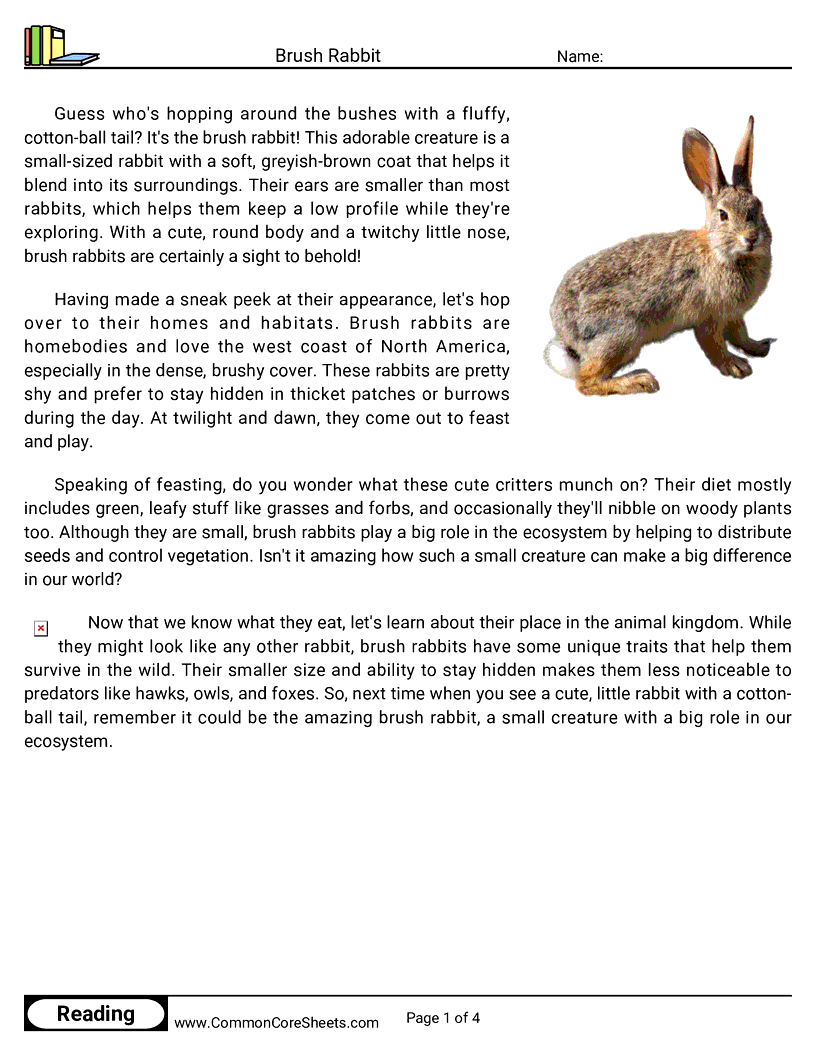
Guess who's hopping around the bushes with a fluffy, cotton-ball tail? It's the brush rabbit! This adorable creature is a small-sized rabbit with a soft, greyish-brown coat that helps it blend into its surroundings. Their ears are smaller than most rabbits, which helps them keep a low profile while they're exploring. With a cute, round body and a twitchy little nose, brush rabbits are certainly a sight to behold!
Having made a sneak peek at their appearance, let's hop over to their homes and habitats. Brush rabbits are homebodies and love the west coast of North America, especially in the dense, brushy cover. These rabbits are pretty shy and prefer to stay hidden in thicket patches or burrows during the day. At twilight and dawn, they come out to feast and play.
Speaking of feasting, do you wonder what these cute critters munch on? Their diet mostly includes green, leafy stuff like grasses and forbs, and occasionally they'll nibble on woody plants too. Although they are small, brush rabbits play a big role in the ecosystem by helping to distribute seeds and control vegetation. Isn't it amazing how such a small creature can make a big difference in our world?
Now that we know what they eat, let's learn about their place in the animal kingdom. While they might look like any other rabbit, brush rabbits have some unique traits that help them survive in the wild. Their smaller size and ability to stay hidden makes them less noticeable to predators like hawks, owls, and foxes. So, next time when you see a cute, little rabbit with a cotton-ball tail, remember it could be the amazing brush rabbit, a small creature with a big role in our ecosystem.
Meet the brush rabbit, a small and interesting creature that lives in North America. These rabbits are also known as 'bunny rabbits' and have a greyish-brown fur with a white belly. They're usually about 12 to 16 inches long and weigh between 1.5 and 2.5 pounds. Brush rabbits have big ears, large hind legs, and a short, fluffy tail.
Brush rabbits live in dense habitats filled with plants, bushes, and grasses. Their homes, called 'forms,' are small, hidden hollows in the ground or under bushes. These rabbits can be found mostly in the western United States and Baja California, Mexico. Brush rabbits love to live near water sources like streams or wetlands.
When it comes to food, brush rabbits are herbivores, meaning they eat plants. Their diet consists of grasses, leaves, twigs, and even the bark of some trees! Brush rabbits are known as 'crepuscular' animals because they are most active during dawn and dusk. During these times, they leave their hiding places to eat and explore.
Brush rabbits play an important role in their ecosystems, both as prey and as plant-eaters. Many predators, like hawks, owls, and snakes, rely on them for food. Their main defense against predators is their excellent camouflage, which helps them blend into their surroundings. Brush rabbits also have strong legs that allow them to hop away quickly and dodge danger.
Although they may look similar to other rabbit species, brush rabbits have some unique features. They have smaller ears and a different fur color compared to other rabbits like cottontails. Brush rabbits generally prefer to live in thick, brushy areas while other rabbits may live in more open spaces. Now that you know more about the amazing brush rabbit, you can appreciate their unique qualities and important role in their ecosystems.
Hey there, let's talk about the fascinating brush rabbit! These cute little creatures are also known as cottontail rabbits, and they're native to North America. Brush rabbits have a grayish-brown fur with a white belly and a fluffy white tail that looks like a cotton ball. They're smaller than other rabbit species, with an average length of 11-14 inches. You can often find them hopping around in dense brush and undergrowth to stay hidden from predators.
Brush rabbits are herbivores, which means they only eat plants. Their diet consists mostly of grasses, but they also munch on leaves, stems, and even tree bark. During summer months, they enjoy feasting on berries and other fruits. They're also known to eat their own feces to help with digestion and to get the most nutrients out of their food. This may sound gross, but it's a common behavior among rabbits called coprophagy.
Let's explore the life cycle of these adorable animals. Brush rabbits typically live for about 2 to 4 years in the wild. They're known to breed throughout the year, with a peak in breeding activity during the spring and summer months. Females can have up to 5 litters per year, with each litter containing 2-6 baby rabbits called kits. Kits are born blind and helpless, but after about a month, they're ready to venture out on their own.
Humans and brush rabbits have an interesting relationship. Some people view them as pests, as they can damage gardens and crops. However, brush rabbits are also an important part of the ecosystem, as they help control vegetation growth and serve as a food source for predators. Some people even raise brush rabbits as pets or for their fur. Conservation efforts are in place to ensure that their populations remain stable and healthy.
Lastly, let's discuss their relationships with other animals and their defenses. Brush rabbits are prey for many predators, including hawks, snakes, and coyotes. To evade predators, they rely on their quickness, agility, and their ability to blend into their surroundings. Unlike some other rabbit species, brush rabbits do not dig burrows, but instead create small nests called forms in dense vegetation. One interesting fact is that brush rabbits are good swimmers and will sometimes take to the water to escape danger.
Now that you know about the amazing brush rabbit, it's easy to see why these small, furry creatures are not only cute but also an important part of our ecosystem.
About this worksheet
Students read a short informational passage about the brush rabbit and answer comprehension questions about its habitat, diet, and behavior.
This worksheet is designed to engage kids in fun, interactive learning about the niche Brush Rabbit in North America. The 20-question reading activity focuses on the appearance, habitat, diet, and behaviors of brush rabbits, and their role in the ecosystem. The content can be utilized for distance learning, customized to cater to individual learning paces, or even converted to flash cards for interactive revision sessions.
Student objectives
- Read a nonfiction passage about an animal and understand the main idea
- Find specific facts about the brush rabbit in the text
- Answer questions using details from what you read
- Learn new words about animals and where they live
Everyday practice
- Read a sign at a zoo or nature park about an animal and remember key facts
- Look up information about a pet or wild animal you're curious about
- Answer questions a friend asks about something you just read
- Share interesting facts about animals with your family