Broad-snouted Caiman Worksheet Download
Free reading worksheets on Broad-snouted Caiman. Each worksheet has 20 problems with an answer key and are ideal for teachers and homeschooling. You can download the PDF, create a set of flash cards or set it up for online learning.
Select a Different Activity
>


Sheet Information >
Available at 2nd grade, 3rd grade, 4th grade, 5th grade and 6th grade reading levels.
Read the passage
Let\'s learn about the amazing broad-snouted caiman! These fascinating reptiles have a wide, round snout, and their body is covered in thick, bumpy skin. They live in the rivers, swamps, and wetlands of South America, and they love snacking on fish, birds, and even small mammals.
Now, let\'s talk about their life cycle and how they interact with other animals. Broad-snouted caimans lay their eggs in a nest made of leaves, and after a few months, cute little babies hatch! These caimans are important members of their ecosystem because they help control the population of the animals they eat and sometimes provide a safe home for other creatures to live on their backs.
Lastly, we\'ll discuss their relationship with humans and how they are different from other species. While they are usually shy around humans, it\'s important to remember that they are wild animals and should be respected from a distance. One interesting fact about broad-snouted caimans is that they are more social than other caiman species, often living in groups called basks.
As we\'ve learned, broad-snouted caimans are fascinating creatures with unique features and an important role in their ecosystem. So next time you think about these amazing reptiles, remember to appreciate their beauty and the incredible world they live in!
Meet the broad-snouted caiman, a fascinating reptile that loves to swim! These remarkable creatures can grow up to 10 feet long and have a wide, rounded snout, perfect for catching their prey. Their diet consists of fish, crustaceans, and even small mammals that they find near their watery homes. You can find them living in the swamps, marshes, and rivers of South America, from Brazil to Argentina.
Now let\'s talk about the life cycle of these amazing reptiles. Female caimans build nests made of plants and mud, where they lay their eggs and guard them carefully until they hatch. The baby caimans, called hatchlings, are born with a special tooth called an egg tooth, which helps them break out of their shells. As they grow older, they learn to hunt and survive on their own, eventually becoming adults and starting the life cycle all over again.
Broad-snouted caimans have some interesting relationships with humans and other animals. They help keep the population of certain animals in check, acting as a natural form of pest control. While they generally avoid humans, they can be dangerous if they feel threatened, so it\'s important to admire them from a safe distance. One fascinating fact about these creatures is that their skin changes color based on the temperature, helping them stay hidden from predators and prey alike.
Remember, the broad-snouted caiman is a fascinating and important part of our natural world. Let\'s continue to learn about and appreciate these amazing creatures!
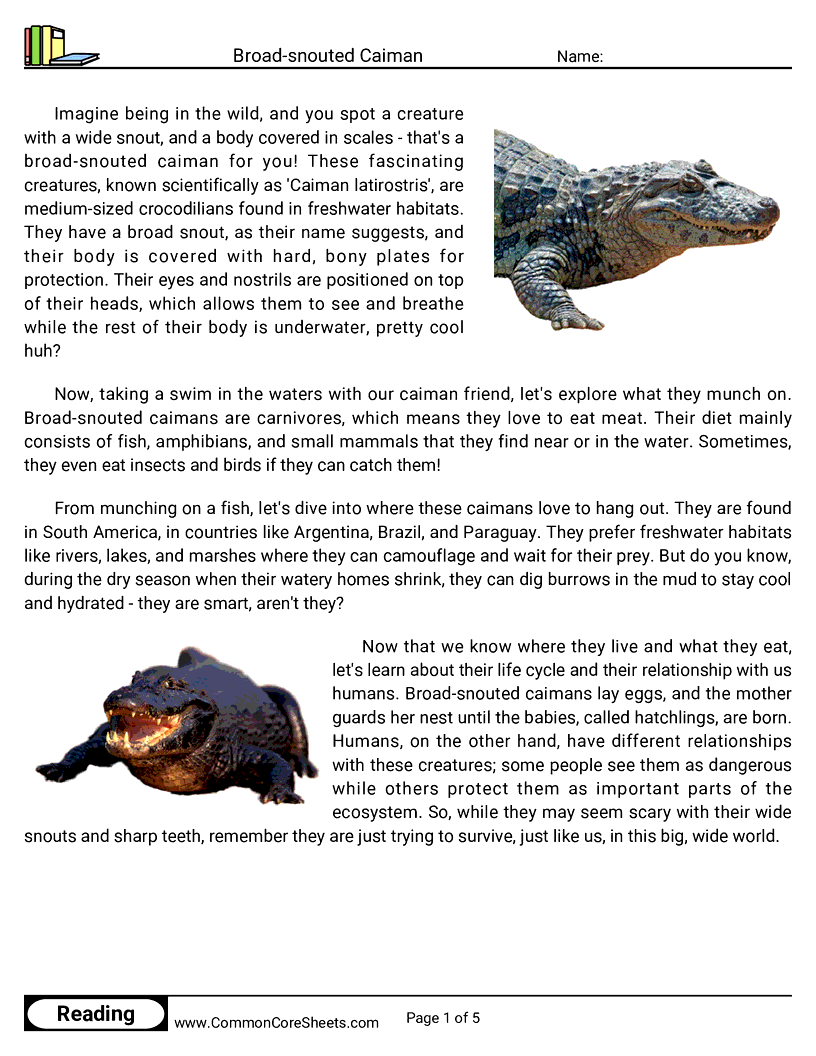
Imagine being in the wild, and you spot a creature with a wide snout, and a body covered in scales - that's a broad-snouted caiman for you! These fascinating creatures, known scientifically as 'Caiman latirostris', are medium-sized crocodilians found in freshwater habitats. They have a broad snout, as their name suggests, and their body is covered with hard, bony plates for protection. Their eyes and nostrils are positioned on top of their heads, which allows them to see and breathe while the rest of their body is underwater, pretty cool huh?
Now, taking a swim in the waters with our caiman friend, let's explore what they munch on. Broad-snouted caimans are carnivores, which means they love to eat meat. Their diet mainly consists of fish, amphibians, and small mammals that they find near or in the water. Sometimes, they even eat insects and birds if they can catch them!
From munching on a fish, let's dive into where these caimans love to hang out. They are found in South America, in countries like Argentina, Brazil, and Paraguay. They prefer freshwater habitats like rivers, lakes, and marshes where they can camouflage and wait for their prey. But do you know, during the dry season when their watery homes shrink, they can dig burrows in the mud to stay cool and hydrated - they are smart, aren't they?
Now that we know where they live and what they eat, let's learn about their life cycle and their relationship with us humans. Broad-snouted caimans lay eggs, and the mother guards her nest until the babies, called hatchlings, are born. Humans, on the other hand, have different relationships with these creatures; some people see them as dangerous while others protect them as important parts of the ecosystem. So, while they may seem scary with their wide snouts and sharp teeth, remember they are just trying to survive, just like us, in this big, wide world.
The broad-snouted caiman is an exciting and fascinating reptile. Belonging to the crocodile family, these creatures can grow up to 10 feet long and have a wide, rounded snout. Their skin is covered with tough, bony plates called scutes, which help protect them from predators. Let\'s dive deeper into the world of broad-snouted caimans and learn more about them.
One of the most interesting aspects of broad-snouted caimans is their diet. They are carnivorous, which means they eat meat, and their favorite meals include fish, birds, and small mammals. When they\'re young, they also eat insects and crustaceans. Their strong jaws and sharp teeth make it easy for them to catch and eat their prey.
These fascinating creatures can be found in South America, primarily in countries like Brazil, Argentina, and Paraguay. They live in freshwater habitats such as rivers, lakes, and swamps. Broad-snouted caimans are excellent swimmers and can hold their breath underwater for up to 30 minutes. In the dry season, they create burrows to stay moist and avoid the heat.
Broad-snouted caimans have a unique life cycle and interesting relationships with other animals. Females lay their eggs in nests made of vegetation and guard them until they hatch. Once hatched, the mother will carry her young in her mouth to the water, where they\'ll learn to swim and hunt. While they have few predators, some large cats and humans can pose a threat to them.
Lastly, let\'s look at some amazing facts and differences between broad-snouted caimans and other species. Compared to other caimans, they have a wider snout, which helps them catch their prey more easily. They are also more tolerant of saltwater, allowing them to live in a wider range of habitats. Though they can be dangerous, broad-snouted caimans are generally not aggressive toward humans unless they feel threatened.
In conclusion, the broad-snouted caiman is a fascinating and unique reptile with an interesting life cycle and habitat. As we continue to learn more about them, we can better appreciate and protect these amazing creatures.
Get ready to learn about the fascinating broad-snouted caiman! This reptile is a type of crocodilian, which means it\'s related to crocodiles and alligators. They have a wide, rounded snout, which is where they get their name. These creatures can grow up to 8 feet long and have a tough, scaly skin that helps protect them from predators. Their color can vary, but they are usually a light green or olive color, which helps them blend in with their surroundings.
The broad-snouted caiman has a pretty diverse diet. They mainly eat fish, but they also enjoy snacking on birds, small mammals, and even insects. They are known as opportunistic feeders, which means they will eat whatever they can catch. Their powerful jaws and sharp teeth make it easy for them to catch and eat their prey. They usually hunt at night, so their excellent night vision helps them find food in the dark.
Broad-snouted caimans are found in a variety of habitats. They live in South America, mainly in countries like Brazil, Argentina, and Paraguay. These caimans can be found in rivers, lakes, swamps, and even sometimes in temporary pools of water that form during the rainy season. They need to live near water because they are cold-blooded, which means that they rely on their environment to regulate their body temperature. During the day, they like to bask in the sun to warm up, and they cool off by spending time in the water.
Let\'s talk about the life cycle of the broad-snouted caiman. The female caiman builds a nest out of vegetation, where she lays her eggs. She will fiercely protect her nest from predators, like raccoons, foxes, and even other caimans. After about 75 days, the baby caimans hatch and their mother helps them get to the water. These little caimans will grow up and eventually have their own babies, starting the cycle all over again.
Broad-snouted caimans have an interesting relationship with humans and other animals. They are not usually dangerous to humans, but they can be if they feel threatened. In some areas, humans hunt caimans for their meat and skin, which can be turned into leather. Caimans also have an important role in their ecosystems, as they help control the populations of their prey. By learning more about these fascinating creatures, we can better understand and appreciate the amazing world of reptiles.
About this worksheet
Students read an informational passage about the broad-snouted caiman and answer comprehension questions about its habitat, diet, and behavior.
This worksheet is designed to enhance children's reading skills through information about the Broad-snouted Caiman, a fascinating reptile. It presents 20 engaging problems about the Caiman's scientific name, natural behavior, diet, habitat, physical features, offspring and global locations. It offers versatility for teachers as it can be customized, converted into flash cards, or used in distance learning environments. Emphasis on natural science helps imbue learners with a sense of respect for biodiversity.
Student objectives
- Read a nonfiction passage about a reptile and understand the main ideas
- Find specific facts in the text to answer questions
- Learn new words related to animals and their habitats
- Explain what a broad-snouted caiman eats and where it lives
Everyday practice
- Read a sign at a zoo or aquarium and understand facts about an animal
- Look up information about an animal for a school report
- Talk about animals you see in a nature documentary
- Explain to a friend what makes one reptile different from another