Box Turtle Worksheet Download
Free reading worksheets on Box Turtle. Each worksheet has 20 problems with an answer key and are ideal for teachers and homeschooling. You can download the PDF, create a set of flash cards or set it up for online learning.
Select a Different Activity
>


Sheet Information >
Available at 2nd grade, 3rd grade, 4th grade, 5th grade and 6th grade reading levels.
Read the passage
Box turtles are fascinating little creatures that can be found in different parts of the world. They have a dome-shaped shell which is usually brown or black with yellow, orange, or red markings. These turtles live mostly on land, but they can also be found near water, like ponds and streams.
When it comes to their diet, box turtles are omnivores, which means they eat both plants and animals. They enjoy munching on insects, worms, snails, fruits, and vegetables. Box turtles have a very interesting life cycle, starting as tiny eggs, then hatchlings, and finally growing into adults that can live 25 to 50 years, or even longer!
Box turtles are gentle creatures and usually don\'t harm other animals or humans. Their main defense is to hide inside their strong shells when they feel threatened. One cool fact about box turtles is that they can recognize their human caregivers and even respond to their voice!
Now that you know more about box turtles, you can see why they are such amazing animals. Who knew a small creature like a box turtle could be so interesting and unique?
Box turtles are fascinating creatures that you might find in your own backyard! These small, land-dwelling reptiles are known for their hard, dome-shaped shells that protect them from predators. You can find box turtles in a variety of habitats like forests, grasslands, and even near swamps and ponds. There are several different species of box turtles, but they all have unique patterns and colors on their shells.
A box turtle\'s diet is very diverse, which means they eat many different things. They enjoy munching on plants, fruits, insects, worms, and even small animals like frogs and snails. Box turtles have a unique life cycle, starting out as tiny eggs that hatch into small turtles with soft shells. As they grow and mature, their shells become harder and stronger to protect them from predators and other dangers.
Box turtles have a special relationship with humans and other animals. Many people enjoy having box turtles as pets because they are low-maintenance and have interesting personalities. In the wild, they help control insect populations and serve as a food source for some larger animals. Box turtles have a few defenses to keep them safe, like hiding in their tough shells and releasing a foul-smelling musk to scare off predators. Now that you know more about box turtles, you can appreciate their unique qualities and the important role they play in our ecosystem.
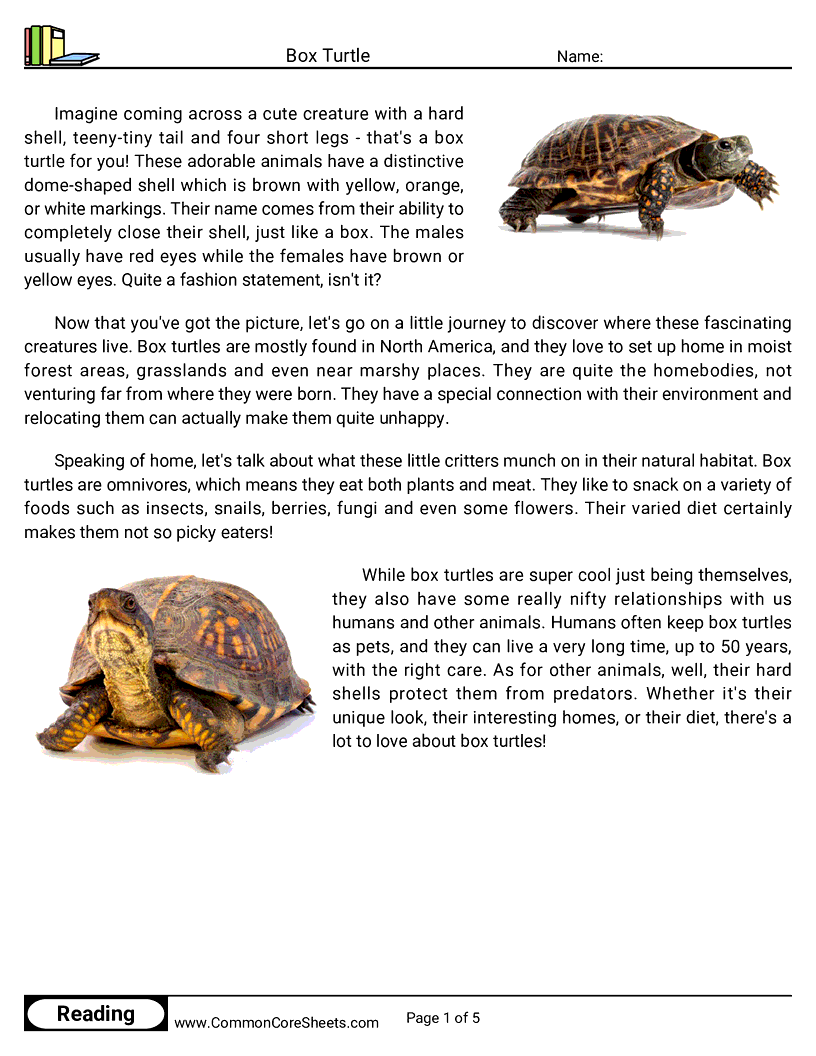
Imagine coming across a cute creature with a hard shell, teeny-tiny tail and four short legs - that's a box turtle for you! These adorable animals have a distinctive dome-shaped shell which is brown with yellow, orange, or white markings. Their name comes from their ability to completely close their shell, just like a box. The males usually have red eyes while the females have brown or yellow eyes. Quite a fashion statement, isn't it?
Now that you've got the picture, let's go on a little journey to discover where these fascinating creatures live. Box turtles are mostly found in North America, and they love to set up home in moist forest areas, grasslands and even near marshy places. They are quite the homebodies, not venturing far from where they were born. They have a special connection with their environment and relocating them can actually make them quite unhappy.
Speaking of home, let's talk about what these little critters munch on in their natural habitat. Box turtles are omnivores, which means they eat both plants and meat. They like to snack on a variety of foods such as insects, snails, berries, fungi and even some flowers. Their varied diet certainly makes them not so picky eaters!
While box turtles are super cool just being themselves, they also have some really nifty relationships with us humans and other animals. Humans often keep box turtles as pets, and they can live a very long time, up to 50 years, with the right care. As for other animals, well, their hard shells protect them from predators. Whether it's their unique look, their interesting homes, or their diet, there's a lot to love about box turtles!
Let\'s learn about the fascinating world of box turtles! Box turtles are small land-dwelling reptiles with a high-domed shell and a hinged belly that can close up like a box. There are several species of box turtles, but they all have this unique ability to protect themselves from predators. One interesting fact is that their shell is actually part of their skeleton, and it grows with them throughout their lives.
Box turtles can be found in various habitats, from forests to grasslands. Depending on their species, they might live in North America, Central America, or Southeast Asia. These adaptable creatures can thrive in both wet and dry environments, but they usually prefer areas with lots of vegetation and hiding spots. Box turtles are known to be quite territorial and often stay within a small area their entire lives.
A box turtle\'s diet is quite diverse and changes as they age. Young box turtles are mostly carnivorous, feasting on insects, worms, and even small animals like mice. As they grow older, they become more omnivorous and start eating a variety of plants, fruits, and fungi. This varied diet helps them get all the nutrients they need to stay healthy and strong.
Box turtles have a unique life cycle that involves a lot of growing and changing. Female box turtles lay their eggs in a shallow hole and leave them to incubate in the sun\'s warmth. After about two to three months, the baby turtles hatch from their eggs and are left to fend for themselves. Box turtles can live for a very long time, sometimes more than 50 years in the wild!
Humans and animals alike interact with box turtles in various ways. Some people keep box turtles as pets, but it\'s important to remember that they need a lot of care and attention to be happy and healthy. In the wild, box turtles have many predators, like raccoons and birds, but their unique shell defense helps keep them safe. Other animals, like insects and small mammals, might share a box turtle\'s habitat and even become part of their diet.
Now that you\'ve learned all about box turtles, their habitats, diets, life cycles, and relationships with humans and other animals, you can truly appreciate these amazing reptiles and their place in our world.
Let\'s talk about box turtles, fascinating reptiles that make great pets for kids. They come in different colors and patterns, with their shells usually being dark brown or black, and their skin ranging from yellow to orange. Box turtles are known for their hinged shells, which allow them to completely close their shells for protection. They are generally small, with their size ranging from 4 to 8 inches long. These turtles can live a long time, with some even surpassing 100 years old!
Box turtles can be found in various habitats, depending on the specific species. Some species live in forests, while others prefer grasslands or swamps. In the United States, you can find box turtles in the eastern, central, and southwestern parts of the country. They are primarily land-dwelling creatures, but they do enjoy soaking in water sometimes. During colder months, box turtles hibernate by digging into the ground for protection.
Let\'s take a look at the interesting diet of a box turtle. These reptiles are omnivores, meaning they eat both plants and animals. Their diet includes insects, worms, snails, fruits, and vegetables. In captivity, it\'s important to provide a balanced diet with plenty of variety for your box turtle. Remember to give them fresh water every day, as they need it for both drinking and soaking.
Box turtles have unique ways of interacting with other animals and humans. In the wild, they can be preyed upon by animals like raccoons, foxes, and birds of prey. Their main defense mechanism is closing their shell, which helps them avoid being eaten by predators. When it comes to humans, box turtles can be gentle and friendly if handled with care. However, it\'s important to remember that they are wild animals and should be treated with respect.
Finally, let\'s explore some fun facts and differences between box turtles and other turtle species. Unlike other turtles, box turtles cannot fully retract their legs and head into their shells. One interesting fact is that a box turtle\'s gender can be determined by examining the shape of its shell and the color of its eyes. Compared to aquatic turtles, box turtles are more terrestrial, spending most of their time on land. Now that you know more about these amazing creatures, you can impress your friends with your box turtle knowledge!
About this worksheet
Students read a short informational passage about box turtles and answer comprehension questions about the details.
This worksheet is designed to enhance children's reading and comprehension skills while learning about box turtles. Covering various aspects about box turtles, from their lifespan, habitat, characteristics, to their interaction with the environment, the study material can be customized to suit individual learning styles. Ideal for distance learning, the worksheet can be easily converted into interactive flash cards for a more engaging learning experience.
Student objectives
- Read a nonfiction passage about box turtles and understand the main idea
- Find and recall specific facts stated in the text
- Learn new vocabulary related to box turtles and their habitat
- Answer questions using details from what they read
Everyday practice
- Understand facts when reading about an animal at the zoo or a nature center
- Read the information card on a pet turtle's habitat needs
- Answer questions after reading an animal article in a kids' magazine
- Share facts you learned about turtles with family or friends