Arctic Hare Worksheet Download
Free reading worksheets on Arctic Hare. Each worksheet has 20 problems with an answer key and are ideal for teachers and homeschooling. You can download the PDF, create a set of flash cards or set it up for online learning.


Sheet Information >
Available at 2nd grade, 3rd grade, 4th grade, 5th grade and 6th grade reading levels.
Read the passage
Let's learn about the amazing Arctic hare! These fluffy creatures live in the cold Arctic regions of North America and Greenland, where they blend in with the snowy environment thanks to their white fur. Arctic hares mostly eat plants like moss, leaves, and twigs, but sometimes they munch on berries and seaweed too.
Now, let's explore the life cycle and unique features of the Arctic hare. During their lifetime, which is about 3 to 5 years, Arctic hares go through some fascinating changes: from adorable little babies (called leverets) to grown-up hares. These hares are different from other species because they have shorter ears and legs, which help them stay warm and avoid frostbite.
Finally, let's talk about the Arctic hare's relationships with humans and other animals. Arctic hares are generally shy and try to stay away from humans, but sometimes people hunt them for their fur and meat. In the wild, Arctic hares have to watch out for predators like Arctic foxes and wolves, but they can jump really high and run fast to escape danger. Isn't it fascinating to learn about the Arctic hare and its unique adaptations to survive in the harsh Arctic environment?
Let's learn about the amazing Arctic hare! These fluffy creatures live in the cold Arctic regions of North America and Greenland. They have thick white fur to keep them warm and help them blend in with their snowy surroundings. Their diet mainly consists of plants, like leaves, roots, and bark.
The Arctic hare has a fascinating life cycle and relationships with other animals. They are born in the spring, and by the time they are one year old, they are fully grown and ready to have their own babies. Arctic hares are usually friendly with each other, but they need to be careful of predators like Arctic foxes and wolves. To protect themselves, they rely on their great speed and ability to blend in with the snow.
There are some cool differences between Arctic hares and other hare species. Compared to other hares, they have shorter ears and legs to help them stay warm in the freezing Arctic. Arctic hares are not domesticated and have limited interaction with humans. However, some Inuit communities hunt them for food and fur, but they are not considered an endangered species.
Now that you know all about the Arctic hare, you can share these fun and interesting facts with your friends!
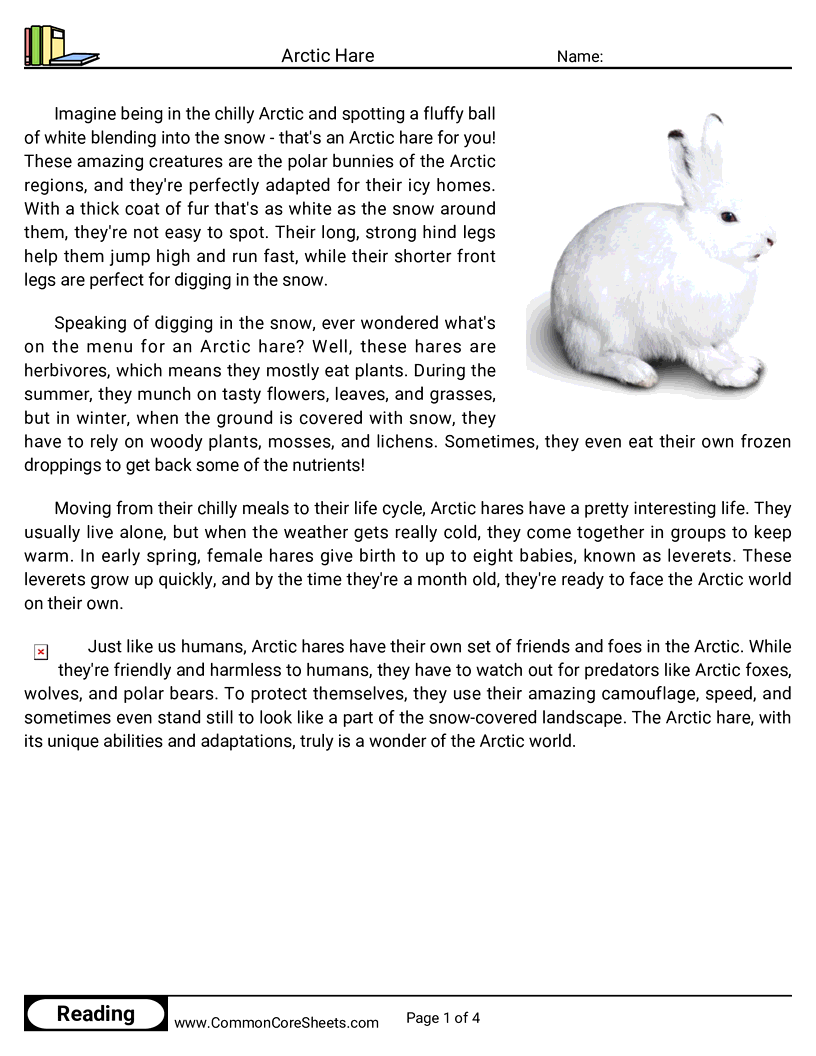
Imagine being in the chilly Arctic and spotting a fluffy ball of white blending into the snow - that's an Arctic hare for you! These amazing creatures are the polar bunnies of the Arctic regions, and they're perfectly adapted for their icy homes. With a thick coat of fur that's as white as the snow around them, they're not easy to spot. Their long, strong hind legs help them jump high and run fast, while their shorter front legs are perfect for digging in the snow.
Speaking of digging in the snow, ever wondered what's on the menu for an Arctic hare? Well, these hares are herbivores, which means they mostly eat plants. During the summer, they munch on tasty flowers, leaves, and grasses, but in winter, when the ground is covered with snow, they have to rely on woody plants, mosses, and lichens. Sometimes, they even eat their own frozen droppings to get back some of the nutrients!
Moving from their chilly meals to their life cycle, Arctic hares have a pretty interesting life. They usually live alone, but when the weather gets really cold, they come together in groups to keep warm. In early spring, female hares give birth to up to eight babies, known as leverets. These leverets grow up quickly, and by the time they're a month old, they're ready to face the Arctic world on their own.
Just like us humans, Arctic hares have their own set of friends and foes in the Arctic. While they're friendly and harmless to humans, they have to watch out for predators like Arctic foxes, wolves, and polar bears. To protect themselves, they use their amazing camouflage, speed, and sometimes even stand still to look like a part of the snow-covered landscape. The Arctic hare, with its unique abilities and adaptations, truly is a wonder of the Arctic world.
Have you ever heard of the Arctic Hare? These fluffy and fascinating creatures can be found living in the cold Arctic regions of North America and Greenland. They have adapted well to their icy environment, with their thick fur coats keeping them warm and their white color helping them blend in with the snow. Let's learn more about the Arctic Hare's diet, habitat, and unique features!
First, let's talk about what Arctic Hares eat. Their diet mainly consists of woody plants, leaves, and various types of grasses that grow in their habitat. During winter months when food is scarce, they dig through the snow to reach the plants buried underneath. Occasionally, they might also eat other animals' leftovers, but they are primarily herbivores.
Now, let's discuss the Arctic Hare's life cycle. These hares breed between April and May, and the female gives birth to around 2-8 baby hares called leverets. The leverets grow up quickly and become independent in just a few weeks. Arctic Hares usually live for about 5 years in the wild.
Arctic Hares have interesting relationships with other animals and humans. Some of their natural predators are Arctic foxes, wolves, and birds of prey. To defend themselves, they rely on their speed and camouflage. Humans, while not a direct threat, can impact their lives through climate change and habitat loss.
Lastly, let's explore some differences between Arctic Hares and other hare species. One major difference is their size, as Arctic Hares are larger than most other hare species. Another difference is their ability to survive in extreme cold temperatures. Lastly, unlike other hares, Arctic Hares are known to huddle together in groups for warmth and protection from predators.
As we have learned, Arctic Hares are unique and fascinating animals that live in the cold Arctic regions. They have a special diet, life cycle, and relationships with other animals and humans. By understanding these creatures better, we can appreciate their importance in the Arctic ecosystem and work to protect their habitat for future generations.
Did you know there's a super cool animal called the Arctic hare that lives in the freezing cold Arctic? These fluffy creatures have thick white fur to keep them warm, and they can grow up to 70 centimeters long. They have large, powerful hind legs, which help them hop and run at speeds up to 60 kilometers per hour! You can find them in countries like Canada, Greenland, and even some parts of Alaska. Their white fur not only keeps them warm but also helps them blend in with the snowy environment, making them hard to spot.
Arctic hares are herbivores, which means they eat plants. Their diet mainly consists of woody plants, mosses, and lichens. In the summer, they also munch on flowers, leaves, and berries when they're available. Because there's not much food in the Arctic, they have to search far and wide for their meals. They even dig through the snow to find plants hidden underneath!
You might be curious about the life cycle of these fascinating animals. Arctic hares have a relatively short life span of about 3 to 5 years. They mate and give birth during the spring, with females usually having 2 to 8 babies, called leverets. These cute little leverets grow up quickly and are ready to hop around on their own after just a few weeks. By the time they're 1 year old, they're considered adults and can have their own babies.
Arctic hares have some interesting relationships with both humans and other animals. In some areas, Indigenous people hunt them for food and fur, but their populations are generally stable and not at risk. Arctic hares also have some natural predators, like Arctic foxes, wolves, and birds of prey. To protect themselves, they rely on their speed, camouflage, and the ability to hide in small groups called 'hare bands'. These hare bands can include up to a few hundred hares, making it harder for predators to single one out.
You might wonder how Arctic hares are different from other hare species. One key difference is their size; Arctic hares are much larger than their relatives, like the snowshoe hare. Another difference is their thick fur, which is essential for surviving in the harsh Arctic climate. Finally, Arctic hares have shorter ears to help conserve heat, while other hares have longer ears to help them stay cool in warmer environments. So, as you can see, Arctic hares are perfectly adapted to their unique, frosty homes!
About this worksheet
Students read a passage about the arctic hare and answer comprehension questions about its habitat, appearance, and behavior.
This worksheet is designed to enhance children's reading comprehension skills with a focus on the Arctic Hare. It presents 20 engaging multiple-choice questions that cover aspects such as their behaviors, lifecycle, and feeding habits. Ideal for distance learning, this customizable tool can easily be converted into flashcards for further study, offering a versatile addition to any lesson plan.
Student objectives
- Read a nonfiction passage about the arctic hare
- Answer questions using details from the text
- Learn facts about how arctic animals survive the cold
- Build vocabulary related to animals and habitats
Everyday practice
- Read a fact sheet at a zoo about an animal you're seeing
- Look up information about an animal for a school report
- Understand a nature article in a kids' magazine
- Talk about how different animals stay warm in winter