American Pika Worksheet Download
Free reading worksheets on American Pika. Each worksheet has 20 problems with an answer key and are ideal for teachers and homeschooling. You can download the PDF, create a set of flash cards or set it up for online learning.


Sheet Information >
Available at 2nd grade, 3rd grade, 4th grade, 5th grade and 6th grade reading levels.
Read the passage
Meet the American pika, a small and adorable mammal related to rabbits and hares. These little creatures have round bodies, big round ears, and can be found in the western mountains of North America. Living in rocky slopes and alpine meadows, pikas make their homes in the spaces between rocks called talus.
The American pika has a vegetarian diet, which means they only eat plants. They love munching on grasses, wildflowers, and even small shrubs. Pikas are also known for their unique way of storing food, called 'haystacks', which they gather during the summer months and save for the cold winter.
Like any other animal, the American pika has its own way of protecting itself and interacting with its environment. They are known to be very vocal, using high-pitched calls to communicate with each other and to warn off predators such as eagles, coyotes, and weasels. Although they are not directly related to humans, pikas play an important role in the ecosystem by serving as food for other animals and spreading plant seeds through their droppings.
In this article, we learned about the American pika, their habitat, and diet. We also discovered their unique way of communication and their importance in the ecosystem. So, next time you're exploring the mountains, keep an eye out for these cute little critters and appreciate the role they play in our world.
Meet the American pika, a small and adorable mammal that lives in the mountains of western North America. They have round bodies, big round ears, and are covered in soft, brown fur. These little creatures are about the same size as a guinea pig, and they live in rocky areas called talus. American pikas are active during the day, so if you're lucky, you might spot one while hiking in the mountains.
Pikas have a varied diet, munching on all kinds of plants, including grass, leaves, and flowers. They love to gather food during the warm months of the year and store it in their den to eat during the cold winter months. Pikas are important to other animals in their ecosystem because they serve as a food source for predators such as eagles, coyotes, and bobcats. However, don't worry too much about these little guys, as they are quite fast and have a unique call that they use to warn each other of danger.
Humans and American pikas don't interact very often because pikas live in remote mountain areas. However, climate change is affecting their habitat, and scientists are studying pikas to understand how they adapt to changing environments. One interesting fact about pikas is that they are related to rabbits and hares, even though they look quite different. So, the next time you're exploring the mountains, keep an eye out for these fascinating little creatures and appreciate the unique role they play in their ecosystem.
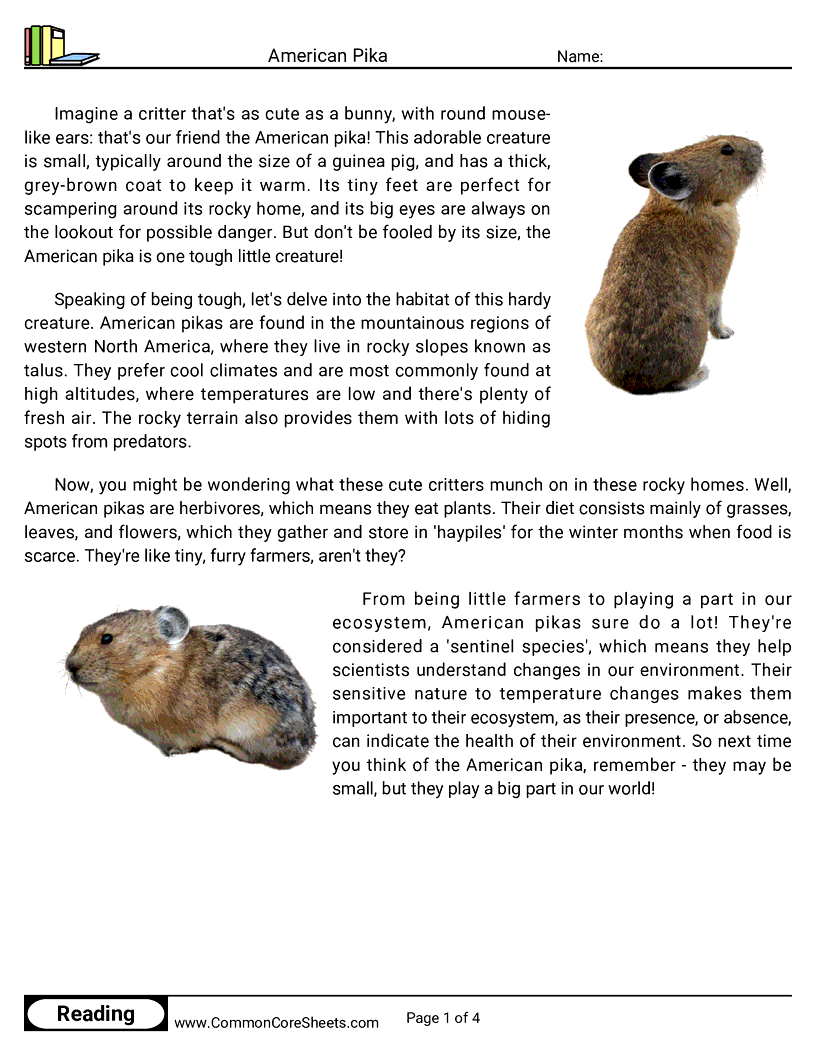
Imagine a critter that's as cute as a bunny, with round mouse-like ears: that's our friend the American pika! This adorable creature is small, typically around the size of a guinea pig, and has a thick, grey-brown coat to keep it warm. Its tiny feet are perfect for scampering around its rocky home, and its big eyes are always on the lookout for possible danger. But don't be fooled by its size, the American pika is one tough little creature!
Speaking of being tough, let's delve into the habitat of this hardy creature. American pikas are found in the mountainous regions of western North America, where they live in rocky slopes known as talus. They prefer cool climates and are most commonly found at high altitudes, where temperatures are low and there's plenty of fresh air. The rocky terrain also provides them with lots of hiding spots from predators.
Now, you might be wondering what these cute critters munch on in these rocky homes. Well, American pikas are herbivores, which means they eat plants. Their diet consists mainly of grasses, leaves, and flowers, which they gather and store in 'haypiles' for the winter months when food is scarce. They're like tiny, furry farmers, aren't they?
From being little farmers to playing a part in our ecosystem, American pikas sure do a lot! They're considered a 'sentinel species', which means they help scientists understand changes in our environment. Their sensitive nature to temperature changes makes them important to their ecosystem, as their presence, or absence, can indicate the health of their environment. So next time you think of the American pika, remember - they may be small, but they play a big part in our world!
Meet the American pika, a small and adorable mammal that lives in the mountains. These little creatures are related to rabbits and have round bodies, big round ears, and short legs. You can find American pikas in the western United States and parts of Canada, usually in the rocky alpine regions. These cute animals are well adapted to cold environments, which is why they prefer living at higher elevations.
Now let's talk about what American pikas like to eat. These herbivores munch on various plants, including grasses, flowers, and even twigs. They are known to collect and store their food in piles called haypiles, so they have enough to eat during the winter months. American pikas are quite busy during the summer, as they gather and prepare their food for the colder season.
The life cycle of an American pika is quite fascinating. They breed during spring, and after about 30 days, the female gives birth to a litter of two to six babies called kits. Kits are born blind and hairless but quickly grow fur and open their eyes within a few weeks. By the time they are about 4 weeks old, they are ready to leave their mother and start their own lives.
American pikas have a unique relationship with humans and other animals. While they don't have any direct interaction with humans, they are an important part of the food chain, serving as prey for predators like eagles, coyotes, and weasels. Pikas communicate with each other by making a high-pitched 'eep' sound, which helps warn others of approaching danger. Their main defense is their agility and their ability to quickly hide in the rocks when they sense danger.
Let's discover some interesting facts and differences between American pikas and other species. Unlike some other pika species, American pikas don't hibernate during winter. Instead, they rely on their thick fur and stored food to survive the cold months. Despite their small size and adorable appearance, American pikas are tough and resilient creatures that can survive in harsh environments. Next time you're in the mountains, keep an eye out for these amazing little animals and appreciate their unique characteristics.
Let's dive into the fascinating world of the American pika, a small mammal that's full of surprises. These adorable creatures are related to rabbits and hares, belonging to the Ochotonidae family. With their round bodies, big ears, and a furry tail, pikas look like a mix of a rabbit and a mouse. They are usually found in the western parts of North America, from New Mexico to Canada. You can spot them hopping around the rocky slopes of mountains, which they call home.
The American pika has an interesting diet, which mainly consists of plants. They love to eat wildflowers, grasses, and even some small shrubs. During the summer, pikas gather plants and store them in a secret stash called a 'haypile'. This haypile provides enough food for the pika to survive the long, cold winter months. Did you know that pikas can eat almost a third of their body weight in a single day?
Now let's explore the life cycle of the American pika, which is quite unique. Pikas usually live for about three to seven years in the wild. They mate in the springtime, and after about 30 days, female pikas give birth to a litter of two to six babies, called 'kits'. These kits grow up quickly, becoming independent within just a month. By the time they're three months old, they're ready to start a family of their own.
Humans and pikas have a relatively peaceful relationship, with pikas generally avoiding humans. However, human activities, such as climate change, have been affecting the pikas' habitats. As temperatures rise, pikas may have to move to higher elevations to find cooler temperatures. Some conservation efforts are being made to protect the pikas and their homes. By learning about pikas and their needs, we can help ensure their survival for future generations.
Lastly, let's explore the American pika's relationships with other animals and its unique defenses. Predators, like eagles, coyotes, and weasels, find pikas to be a tasty treat. To protect themselves, pikas rely on their agility, speed, and their ability to hide in the rocky terrain of their habitat. When threatened, pikas also use a high-pitched alarm call to warn other pikas of potential danger. Despite their small size, the American pika is a resilient and resourceful creature that has adapted well to its environment.
As we've discovered, the American pika is an amazing little mammal with a fascinating life cycle and unique relationships with its environment. By appreciating and understanding these creatures, we can help protect them and the habitats they call home.
About this worksheet
Students read an informational passage about the American pika and answer comprehension questions about the animal's habitat, diet, and behavior.
This worksheet is designed to educate children about the American Pika. It contains 20 engaging reading problems that cover the creature's preferred climate, habitat, size, diet, and winter adaptations. The questions also prompt image associations like the pika's resemblance to other small animals. Facilitating multiple learning modes, the worksheet can be customized, converted into flashcards, or effectively utilized in distance learning setups to make education about wildlife interactive and fun.
Student objectives
- Read a nonfiction passage about the American pika and understand the main ideas
- Find specific facts about where pikas live and what they eat
- Learn new vocabulary related to animals and mountain habitats
- Answer questions using details from the reading
Everyday practice
- Understand facts when reading about animals at a zoo or nature center
- Pull key details out of a science article or nature magazine
- Talk about what an animal eats and where it lives after reading about it
- Look up information about wildlife you spot on a hike