American Black Bear Worksheet Download
Free reading worksheets on American Black Bear. Each worksheet has 20 problems with an answer key and are ideal for teachers and homeschooling. You can download the PDF, create a set of flash cards or set it up for online learning.


Sheet Information >
Available at 2nd grade, 3rd grade, 4th grade, 5th grade and 6th grade reading levels.
Read the passage
Hey kids, let's talk about the American black bear, a fascinating animal that lives in North America! These bears have a thick black coat, small eyes, and a large snout, making them look quite adorable. They can be found living in forests, swamps, and mountainous regions, making their homes in caves or hollow trees.
Now, let's discuss what these wonderful creatures eat and their life cycle. American black bears are omnivores, which means they eat both plants and animals, like berries, nuts, fish, and insects. Their life cycle begins as tiny cubs and they grow up to be strong adult bears, living about 20 years in the wild.
Finally, let's explore their relationships with humans, other animals, and their unique characteristics. While they usually avoid humans, it's important to remember that they are wild animals and can be dangerous if they feel threatened. They are not as big as their relatives, the grizzly bear, but they are excellent climbers and can run quite fast, making them impressive animals in their own right.
In conclusion, the American black bear is a fascinating creature with a diverse diet, interesting life cycle, and unique relationships with both humans and other animals. Remember to always respect their space and admire them from a safe distance.
Did you know that American black bears are the smallest and most common bears found in North America? They have a wide range of fur colors, from black to brown, and even white! These amazing animals live in forests, swamps, and mountain areas all across the continent. They like to eat berries, insects, fish, and even small mammals, but they also love to munch on human food if they can find it.
The life cycle of an American black bear is fascinating and starts when they are born in a cozy den during the winter. As they grow up, they learn how to find food and protect themselves from other animals. Black bears are known to be shy and usually avoid people, but sometimes they come close to our homes in search of an easy meal. They have a special relationship with other animals, like bees, because they eat honey and help spread pollen, which helps plants grow.
There are some key differences between American black bears and other bear species. For example, they are smaller than grizzly bears and have a less aggressive nature. When they feel threatened, black bears climb trees or use their strong legs to run away quickly. An interesting fact is that they have an excellent sense of smell, which helps them find food from miles away.
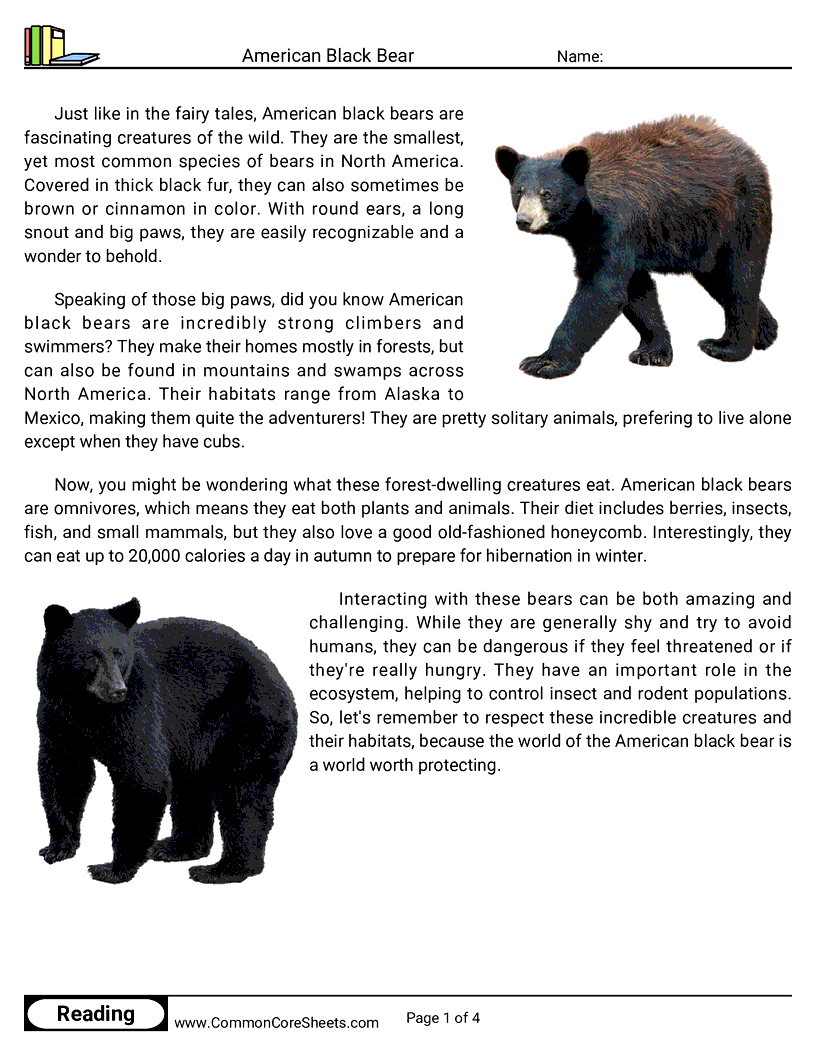
Just like in the fairy tales, American black bears are fascinating creatures of the wild. They are the smallest, yet most common species of bears in North America. Covered in thick black fur, they can also sometimes be brown or cinnamon in color. With round ears, a long snout and big paws, they are easily recognizable and a wonder to behold.
Speaking of those big paws, did you know American black bears are incredibly strong climbers and swimmers? They make their homes mostly in forests, but can also be found in mountains and swamps across North America. Their habitats range from Alaska to Mexico, making them quite the adventurers! They are pretty solitary animals, prefering to live alone except when they have cubs.
Now, you might be wondering what these forest-dwelling creatures eat. American black bears are omnivores, which means they eat both plants and animals. Their diet includes berries, insects, fish, and small mammals, but they also love a good old-fashioned honeycomb. Interestingly, they can eat up to 20,000 calories a day in autumn to prepare for hibernation in winter.
Interacting with these bears can be both amazing and challenging. While they are generally shy and try to avoid humans, they can be dangerous if they feel threatened or if they're really hungry. They have an important role in the ecosystem, helping to control insect and rodent populations. So, let's remember to respect these incredible creatures and their habitats, because the world of the American black bear is a world worth protecting.
Let's learn about the American black bear, a fascinating and intelligent animal. These bears can be found all across North America, from Canada to Mexico. They are called black bears because of their dark fur, but they can also be brown, cinnamon, or even white! American black bears are medium-sized bears, usually measuring 4 to 6 feet in length and weighing between 200 and 600 pounds.
American black bears are omnivores, which means they eat both plants and animals. Their diet mainly consists of berries, nuts, insects, fish, and small mammals. During the fall, they eat large amounts of food to prepare for hibernation in the winter months. When food is scarce, they may scavenge for human leftovers in garbage cans and campsites.
The life cycle of an American black bear is quite interesting. Females give birth to one to three cubs in their winter dens, usually in January or February. The cubs stay with their mother for about 1.5 to 2 years, learning how to survive and find food. Black bears can live for more than 20 years in the wild, but their life span is usually shorter due to human interactions and habitat loss.
American black bears share their habitat with other animals, including humans. They usually avoid people, but encounters can happen when bears are attracted to human food sources. To avoid conflicts, it is important to store food properly and give bears plenty of space when seen in the wild. Bears also interact with other animals like deer, moose, and smaller mammals, either sharing food resources or preying on them.
There are a few key differences between American black bears and other bear species. Compared to their larger cousins, the grizzly bear, black bears are more adaptable to different habitats and have a wider range. Unlike polar bears, black bears are not adapted for life in the Arctic and rely on forests for shelter and food. Fun fact: American black bears are excellent climbers and swimmers, which helps them escape from predators and search for food.
In conclusion, American black bears are fascinating creatures that play an important role in their ecosystems. By learning more about them and respecting their habitats, we can help ensure their survival for future generations.
Let's learn about the American black bear, a fascinating and intelligent animal found in North America. These bears can be found in various habitats such as forests, swamps, and even deserts. American black bears can vary in color from black to brown, gray, or even cinnamon. They are the smallest of the three bear species found in North America, but they can still weigh up to 600 pounds. These bears are good tree climbers and excellent swimmers, making them quite versatile in their environments.
Now let's explore the diverse diet of the American black bear. These bears are omnivores, meaning they eat both plants and animals. Their diet consists of berries, nuts, insects, fish, and even small mammals. In some cases, black bears may also consume human food and trash if they can access it. It's important for humans to properly store food and waste to prevent bears from becoming too reliant on these sources.
The life cycle of the American black bear is quite interesting. Mating season occurs between June and August, and females give birth to cubs in their dens during the winter months. Cubs typically stay with their mother for about a year and a half, learning how to survive and find food. Black bears have a life expectancy of around 20 years in the wild. These bears are solitary animals, except for mothers with cubs or during mating season.
Humans and black bears have a complex relationship. Many people appreciate the beauty and intelligence of these animals, while others fear them due to their size and strength. It's important for humans to respect the bears' space and not approach them too closely. Black bears are usually not aggressive towards humans, but can be if they feel threatened or are protecting their cubs. By being aware of our actions and surroundings, we can coexist with these magnificent creatures.
Lastly, let's compare the American black bear to other bear species. As mentioned earlier, they are the smallest of the three bear species found in North America, with the others being the grizzly bear and the polar bear. Black bears are more adaptable to different environments compared to grizzly bears, which prefer more remote and mountainous areas. Polar bears, on the other hand, are specialized for life in the Arctic and rely on the sea ice for hunting seals. Each bear species is unique and plays an important role in its ecosystem.
In conclusion, the American black bear is a fascinating creature with a diverse diet, interesting life cycle, and complex relationship with humans and other animals. By understanding and respecting these bears, we can continue to coexist with them and appreciate their role in nature.
About this worksheet
Students read a short informational passage about the American black bear and answer comprehension questions about its habitat, diet, and behavior.
This worksheet is designed to enhance children's reading comprehension through an informative focus on American Black Bears. It features 20 engaging multiple-choice questions covering various aspects of their characteristics, habitat, diet, and behavior. The versatile format allows customization, conversion into flash cards, or adoption for distance learning, making it an essential tool for flexible, fun, and effective learning.
Student objectives
- Read a nonfiction passage about black bears and understand the main ideas
- Find and recall facts about where black bears live and what they eat
- Answer questions using details directly from the reading
- Learn new vocabulary related to bears and their environment
Everyday practice
- Understand facts you read at a zoo exhibit or on a nature sign
- Follow along with a nature documentary about wild animals
- Look up information about an animal for a school report
- Explain to a friend what you learned about black bears